
Semester VI MDSE-4b Understanding Savarkar
Unit I · 21 min read · Updated 24 Nov 2026
As per the University of Delhi (DU) BA (Hons) Political Science syllabus
Contents
- 1.1 Savarkar’s Life and The Indian War of Independence, 1857
- A Revolutionary Historian
- The Argument of the Book
- Savarkar in London
- 1.2 Six Glorious Epochs of Indian History
- History as Resistance
- Perverted Virtues
- Savarkar and Nationalist Historiography in Maharashtra
- 1.3 The Historiography of 1857 and the Gender Critique
- Raugh: The Battle of the Books
- Pati: Situating 1857
- Kumar: History and Gender in Savarkar
- 1857 in Popular Memory
- Assessing Savarkar as a Historian
- 1.4 Important Questions
- Discuss Savarkar’s interpretation of the revolt of 1857 in The Indian War of Independence.
- Discuss Savarkar’s interpretation of Indian history in Six Glorious Epochs of Indian History.
- Discuss the historiography of the revolt of 1857.
- Discuss the relationship between history, gender and nationalism in Savarkar’s writings.
- Short Notes
क्या यह एक सैनिक विद्रोह है, या यह एक राष्ट्रीय विद्रोह है?
Is it a military mutiny, or is it a national revolt?
— Benjamin Disraeli, House of Commons, 27 July 1857
VVINAYAK DAMODAR SAVARKAR (1883–1966) was a revolutionary, prisoner, writer and ideologue whose ideas remain at the centre of Indian political debate. He was also a historian of a particular kind: he wrote history to awaken national pride and the will to fight. His book on the revolt of 1857, written in London as a young revolutionary, called it India’s war of independence, and his last major work, Six Glorious Epochs of Indian History, retold Indian history as a story of resistance to invaders. Professional historians have praised, debated and criticised these works. This chapter studies Unit I of the syllabus: Savarkar and Indian historiography, including the wider debate on 1857 and the critique of the gendered nature of his histories.

1.1 Savarkar’s Life and The Indian War of Independence, 1857
A Revolutionary Historian
As a student in Nashik, Savarkar founded the Mitra Mela (1899), which became the secret revolutionary society Abhinav Bharat (1904). In 1906 he went to London to study law and joined the circle of Indian revolutionaries at India House. There, using records at the India Office Library, he wrote a history of the revolt of 1857 in Marathi. An English translation, The Indian War of Independence, 1857, was published anonymously in 1909 in the Netherlands, after the colonial government banned it even before publication. Copies were smuggled into India, and the book became an inspiration for later revolutionaries.
The Argument of the Book
British writers had described 1857 as the Sepoy Mutiny, a revolt of soldiers caused by grievances such as the greased cartridges. Savarkar rejected this. He argued that 1857 was a planned national war of independence, fought for two ideals, swadharma (one’s own religion) and swaraj (self-rule). He presented it as a war in which Hindus and Muslims fought together against foreign rule, under leaders such as Nana Saheb, Rani Lakshmibai, Tatya Tope, Kunwar Singh, Bahadur Shah Zafar and Maulvi Ahmadullah Shah. He described secret preparations and signals, such as the circulation of chapatis, as evidence of planning. His purpose was not only to record the past but to inspire a new war of independence.
- Nationalism. The book gave 1857 a central place in the nationalist imagination as the first war of independence.
- Hindu-Muslim unity. Unusually for his later writings, it celebrated unity between Hindus and Muslims in the struggle.
- Influence. Revolutionaries, including the circle of Bhagat Singh, reprinted and circulated it, and Subhas Chandra Bose’s Indian National Army drew on its spirit.
- Method. It combined archival research with a passionate, romantic style meant to arouse emotion.

Savarkar in London
- Mazzini. In 1907 Savarkar published a Marathi translation of the autobiography of the Italian nationalist Giuseppe Mazzini, with an introduction praising revolutionary nationalism.
- Commemorating 1857. The India House group celebrated the anniversary of 1857 in May 1908 and circulated a pamphlet in honour of its martyrs.
- Free India Society. Savarkar organised meetings and lectures among Indian students in London to spread nationalist ideas.
- Poetry. In 1909, at Brighton, he wrote a famous Marathi poem expressing longing for the motherland.
- Arrest. He was arrested in London in 1910 in connection with the assassination of the Nashik collector A. M. T. Jackson, and was shipped to India for trial.
1.2 Six Glorious Epochs of Indian History
History as Resistance
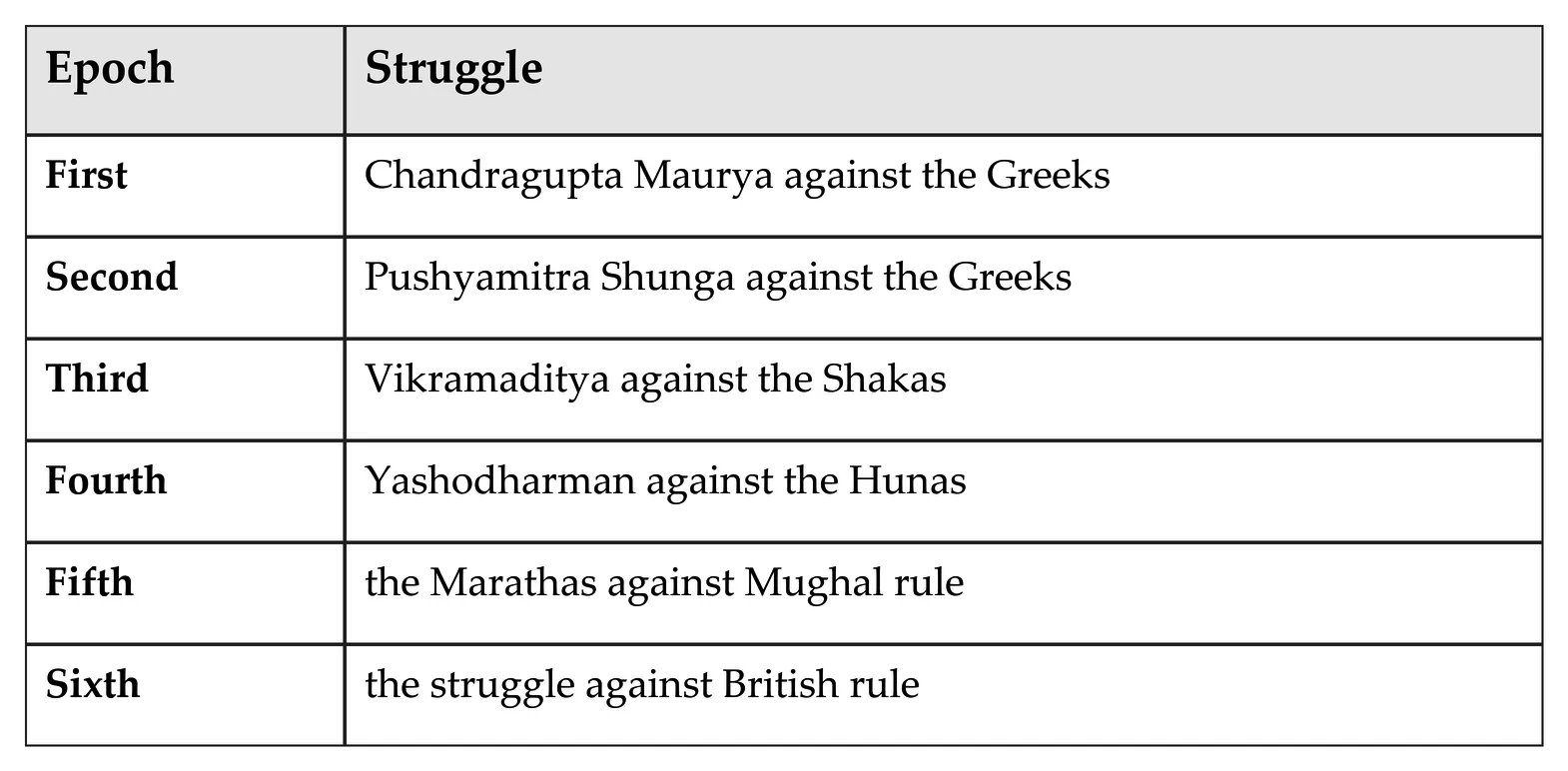
Savarkar’s last major historical work, written in Marathi and published in English as Six Glorious Epochs of Indian History (1971), retold the history of India as a series of glorious struggles in which Indians defeated foreign invaders. He wished to correct what he saw as a defeatist history that dwelt on conquests of India rather than on Indian victories. The six epochs were:
- First epoch. Chandragupta Maurya’s victory over the Greeks after Alexander’s invasion.
- Second epoch. Pushyamitra Shunga’s resistance to the Greeks (Yavanas).
- Third epoch. The victory of Vikramaditya over the Shakas.
- Fourth epoch. Yashodharman’s defeat of the Hunas.
- Fifth epoch. The long resistance to Muslim rule, culminating in the rise of the Marathas.
- Sixth epoch. The struggle against British rule, culminating in independence.
Perverted Virtues
A central and controversial argument of the book is the idea of perverted virtues (sadguna vikriti). Savarkar argued that some Hindu virtues, when applied to enemies, became weaknesses. He criticised what he saw as an excessive emphasis on non-violence, which he associated in some passages with the influence of Buddhism on Indian political life; misplaced religious tolerance towards aggressors; and the chivalry of Hindu rulers who spared the women of defeated enemies even when, in his view, enemies did not show the same restraint. He urged Hindus to be strong and to respond to aggression with strength. Critics argue that this reading of history is selective, presents medieval history as a simple conflict between Hindus and Muslims, and, in its argument about enemy women, legitimises violence.
Savarkar and Nationalist Historiography in Maharashtra
Savarkar wrote within a strong tradition of nationalist history-writing in Maharashtra. M. G. Ranade, in Rise of the Maratha Power (1900), presented the Marathas as a national movement, and V. K. Rajwade collected thousands of Maratha documents to write history from Indian sources. Bal Gangadhar Tilak revived the memory of Shivaji through public festivals from the 1890s. Savarkar shared their aim of restoring pride in the Indian past, but wrote with a more openly revolutionary purpose, using history to call for armed struggle. Like many nationalist historians, he focused on heroic individuals and moral lessons rather than on social and economic structures.
1.3 The Historiography of 1857 and the Gender Critique
Raugh: The Battle of the Books
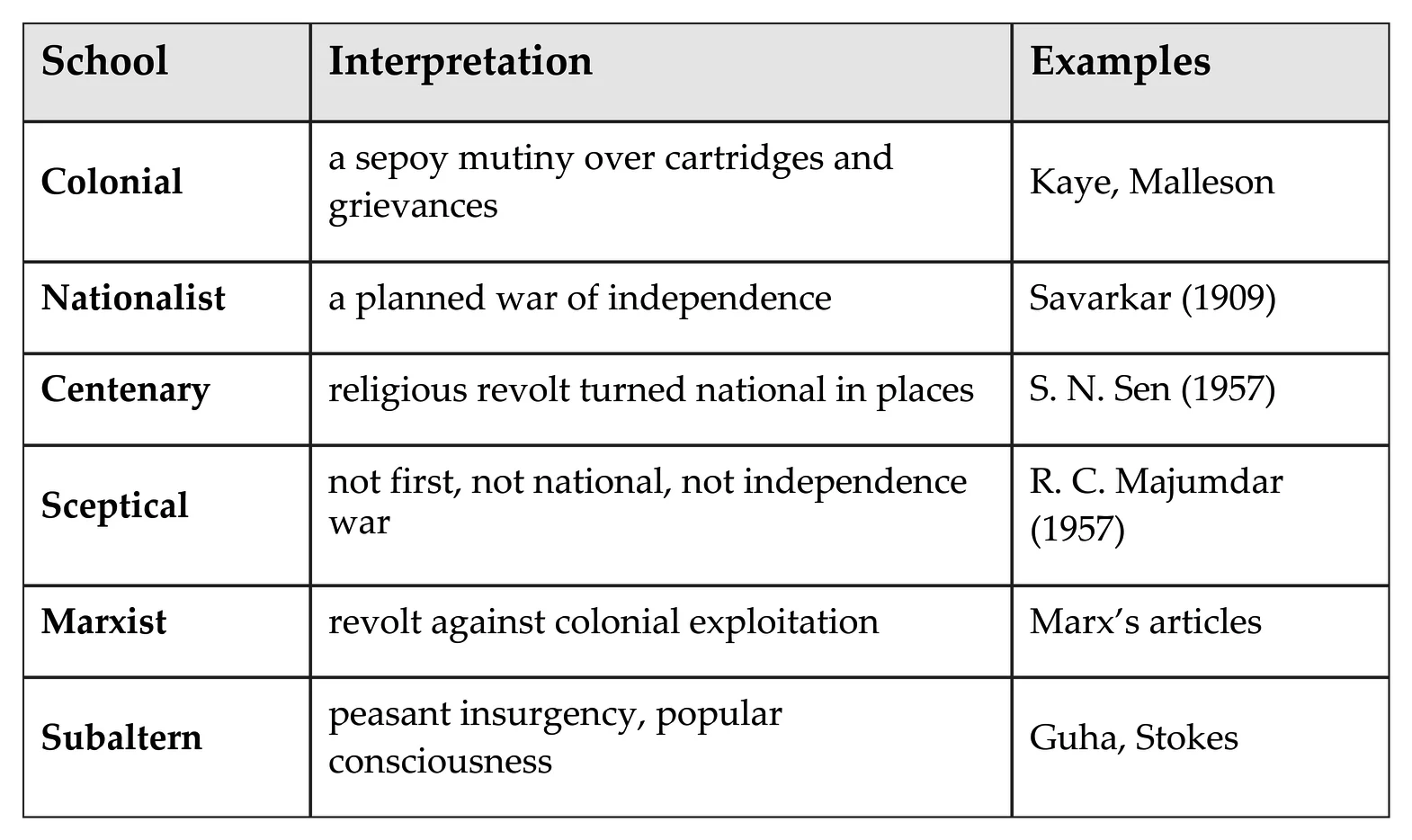
Harold Raugh, in The Battle of the Books: An Indian Mutiny Historiography (2017), surveys the long debate over 1857. British accounts written soon after the revolt, such as John Kaye’s History of the Sepoy War (1864–76) and George Malleson’s History of the Indian Mutiny (1878–80), described a military mutiny caused by religious fears, the greased cartridges and grievances over annexations, and celebrated British heroism. Indian nationalists, beginning with Savarkar, challenged this view, turning the historiography into a battle of the books between imperial and nationalist interpretations.
Pati: Situating 1857
Biswamoy Pati, in Historians and Historiography: Situating 1857 (2007), shows that the interpretation of 1857 has changed with the concerns of each generation. At the centenary in 1957, S. N. Sen’s official history Eighteen Fifty-Seven argued that what began as a fight for religion ended as a war of independence, while R. C. Majumdar argued that it was neither the first, nor national, nor a war of independence. Marxist historians, drawing on Marx’s articles of 1857–58, saw it as a revolt against colonial exploitation. Eric Stokes, in The Peasant Armed (1986), showed how rural society and local elites shaped the revolt, and Ranajit Guha and the Subaltern Studies historians emphasised the consciousness of peasants and the poor. Pati calls for a history that includes peasants, tribals, women and regional variations rather than a single heroic narrative.
Kumar: History and Gender in Savarkar
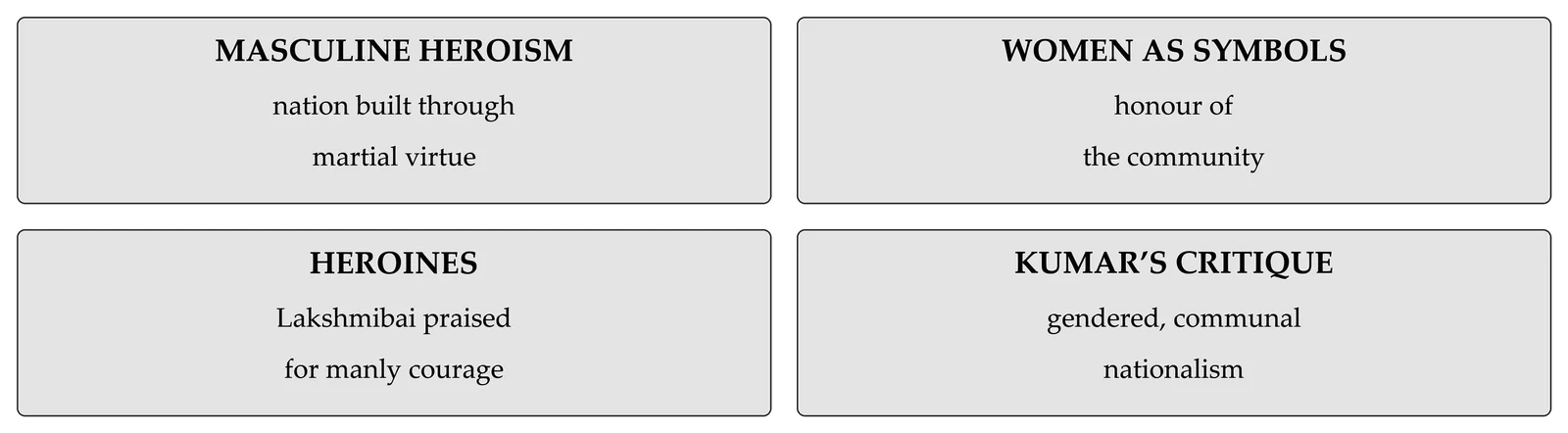
M. Kumar, in History and Gender in Savarkar’s Nationalist Writings (2006), examines how gender shapes Savarkar’s histories. The nation is built through masculine heroism, physical strength and martial virtue. Women appear mainly as symbols of the honour of the community, to be protected or avenged, or as exceptional heroines such as Rani Lakshmibai, praised for manly courage. Kumar argues that the argument about perverted virtues, especially regarding enemy women, links nationalism with communal and gendered violence. Her analysis connects Savarkar’s historiography with wider feminist critiques of nationalism, which show how nations are often imagined through the bodies and honour of women.
1857 in Popular Memory
Partly because of Savarkar’s book, 1857 is widely remembered in India as the First War of Independence. The Hindi poem on the Rani of Jhansi by Subhadra Kumari Chauhan (1930) made Lakshmibai a household heroine, and the government marked the centenary in 1957 and the 150th anniversary in 2007 with official celebrations. Historians continue to debate how far this popular memory matches the complex events of 1857, but the revolt remains a powerful symbol of resistance to colonial rule.
Assessing Savarkar as a Historian
Historians judge Savarkar’s historical writing in different ways. Admirers credit him with recovering the revolt of 1857 from the colonial label of mutiny and with giving Indians a heroic view of their past at a time when colonial histories stressed Indian weakness. Critics point out that he was a political writer rather than a professional historian: he selected evidence to fit his argument, gave little attention to social and economic causes, and, especially in his later work, read the past through a lens of permanent Hindu-Muslim conflict. Both views agree that his histories were meant to act on the present, which makes them essential sources for understanding his ideology.
- Strengths: archival research for 1857, recovery of Indian agency, powerful narrative.
- Weaknesses: selective evidence, heroic individuals over social forces, communal framing in later work.
- Legacy: a lasting influence on popular memory and on Hindu nationalist interpretations of history.
1.4 Important Questions
- Question 1 Discuss Savarkar’s interpretation of the revolt of 1857 in The Indian War of Independence.
- Question 2 Discuss Savarkar’s interpretation of Indian history in Six Glorious Epochs of Indian History.
- Question 3 Discuss the historiography of the revolt of 1857.
- Question 4 Discuss the relationship between history, gender and nationalism in Savarkar’s writings.
DU asks the same idea in different words. So learn one broad answer for each question below; the same answer works for every question joined by OR.
Important Question 1
Discuss Savarkar’s interpretation of the revolt of 1857 in The Indian War of Independence.
OR
Examine Savarkar’s claim that 1857 was a war of independence.
OR
Discuss the significance of Savarkar’s book on 1857 for Indian nationalism.
Model Answer
“The so-called First National War of Independence of 1857 is neither First, nor National, nor a War of Independence.”
— R. C. Majumdar, The Sepoy Mutiny and the Revolt of 1857 (1957)
Introduction. In The Indian War of Independence, 1857, written in London and published in 1909, Savarkar rejected the British description of 1857 as a sepoy mutiny. He presented it as a planned national war of independence fought by Hindus and Muslims together for swadharma and swaraj. The book became a classic of revolutionary nationalism, though professional historians such as R. C. Majumdar later challenged its claims.
1. Context of Writing
Savarkar wrote the book in London while living at India House among revolutionaries. He used records at the India Office Library.
2. Publication and Ban
The English translation appeared in 1909 in the Netherlands. The colonial government banned it even before publication.
3. Rejecting the Mutiny Thesis
British writers called 1857 a sepoy mutiny caused by greased cartridges. Savarkar rejected this as too narrow.
4. A Planned War
He argued that the revolt was planned, citing secret preparations and signals such as circulating chapatis.
5. Swadharma and Swaraj
He presented swadharma and swaraj as the ideals for which the revolutionaries fought.
6. Hindu-Muslim Unity
He celebrated Hindus and Muslims fighting together, a theme unusual in his later writings.
7. Heroes of 1857
He glorified leaders such as Nana Saheb, Rani Lakshmibai, Tatya Tope, Kunwar Singh and Bahadur Shah Zafar.
8. History as Inspiration
His aim was to inspire a new war of independence, not only to record the past.
9. Style
The book combined research with a romantic, emotional style designed to arouse patriotism.
10. Influence
Revolutionaries such as the circle of Bhagat Singh reprinted it, and it inspired later freedom fighters.
11. Nationalist Historiography
It began a nationalist tradition of interpreting 1857 as the first war of independence.
12. Majumdar’s Critique
R. C. Majumdar argued in 1957 that 1857 was neither first, nor national, nor a war of independence.
13. Sen’s Middle View
S. N. Sen argued that a fight for religion turned into a war of independence in some regions.
14. Limited Spread
Critics note that large parts of India, including the south and many princes, did not join the revolt.
15. Lasting Debate
Later Marxist and subaltern historians offered new views, but Savarkar’s framing shaped popular memory.
16. Criticism
Historians argue that Savarkar overstated planning and national consciousness to serve his political purpose.
17. The Fiftieth Anniversary
Savarkar and the India House circle marked the fiftieth anniversary of 1857 in London in 1907, turning its memory into a call for revolution.
18. Use of Sources
Savarkar relied largely on British accounts, reading them against the grain to find evidence of Indian purpose and planning.
19. Mazzini’s Influence
Savarkar had translated Mazzini’s autobiography in 1907, and the Italian model of a people rising for national unity shaped his reading of 1857.
20. Rejecting British Heroics
He reversed British accounts that celebrated colonial heroism, recasting rebels as patriots and British actions as repression.
21. Smuggled Editions
Despite the ban, copies were smuggled into India in disguised covers, and later editions appeared in several languages.
22. Evaluation
The book is better read as nationalist inspiration than as balanced history, but its influence was immense.
Conclusion. Thus, Savarkar transformed the image of 1857 from a mutiny into a war of independence for swadharma and swaraj. Though Majumdar argued that it was neither first, nor national, nor a war of independence, Savarkar’s book shaped the nationalist memory of 1857.
Important Question 2
Discuss Savarkar’s interpretation of Indian history in Six Glorious Epochs of Indian History.
OR
Examine Savarkar’s idea of perverted virtues in Indian history.
OR
Discuss Savarkar’s approach to writing Indian history.
Model Answer
“The facts speak only when the historian calls on them: it is he who decides to which facts to give the floor, and in what order or context.”
— E. H. Carr, What is History? (1961)
Introduction. In Six Glorious Epochs of Indian History, published in English in 1971, Savarkar retold Indian history as a series of victories over foreign invaders. He wished to replace a history of defeats with one of resistance and pride. The book also advanced the controversial idea of perverted virtues, which critics see as a selective and communal reading of the past.
1. Purpose
Savarkar wanted to correct what he saw as a defeatist history. He emphasised Indian victories over invaders.
2. Carr on Selection
As Carr noted, historians choose which facts to highlight. Savarkar selected facts to build a narrative of resistance.
3. First Epoch
Chandragupta Maurya’s victory over the Greeks after Alexander’s invasion opened the series.
4. Second Epoch
Pushyamitra Shunga’s resistance to the Greeks was the second glorious epoch.
5. Third and Fourth Epochs
Vikramaditya’s victory over the Shakas and Yashodharman’s defeat of the Hunas followed.
6. Fifth Epoch
The long resistance to Muslim rule culminating in the rise of the Marathas formed the fifth epoch.
7. Sixth Epoch
The struggle against British rule, culminating in independence, completed the series.
8. Perverted Virtues
Savarkar argued that some virtues, applied to enemies, became weaknesses, which he called perverted virtues.
9. Non-Violence
He criticised excessive non-violence, linking it in some passages with the influence of Buddhism on political life.
10. Tolerance and Chivalry
He criticised misplaced tolerance towards aggressors and the chivalry of Hindu rulers towards enemy women.
11. Strength as Virtue
He urged Hindus to value strength and to answer aggression with force.
12. Supporters’ View
Supporters see the book as restoring pride and highlighting forgotten resistance.
13. Critics’ View
Critics argue that it reads medieval history as a simple Hindu-Muslim conflict and ignores cooperation and syncretism.
14. The Gender Problem
Kumar and others argue that the argument about enemy women legitimises violence against women.
15. Changing Tone
Compared with his book on 1857, which praised Hindu-Muslim unity, this work reflects his later Hindutva outlook.
16. Method
The book is an interpretive, political history rather than a work of professional historical research.
17. History and Ideology
The book shows how history can serve ideology: by selecting victories and assigning blame for defeats, Savarkar sought to shape the political will of his readers.
18. Comparison with Nehru
Nehru’s The Discovery of India (1946) stressed synthesis and continuity among cultures, offering a very different reading of the same past.
19. Evaluation
Six Glorious Epochs is important for understanding Savarkar’s ideology, though its history is highly selective.
Conclusion. Thus, Savarkar’s six epochs retold Indian history as resistance to invaders, and his idea of perverted virtues criticised non-violence and chivalry towards enemies. As Carr reminds us, historians decide which facts speak, and critics argue that Savarkar’s choices served his ideology.
Important Question 3
Discuss the historiography of the revolt of 1857.
OR
Compare the colonial, nationalist, Marxist and subaltern interpretations of 1857.
OR
Examine the battle of the books on the revolt of 1857.
Model Answer
“We hold Ourselves bound to the Natives of Our Indian Territories by the same obligations of duty which bind Us to all Our other Subjects.”
— Queen Victoria’s Proclamation (1 November 1858)
Introduction. The revolt of 1857 has been interpreted in many ways: as a sepoy mutiny, a national war of independence, a revolt against colonial exploitation and a peasant insurgency. Harold Raugh calls the debate a battle of the books, and Biswamoy Pati shows how interpretations have reflected the concerns of each generation.
1. The Events
The revolt began at Meerut in May 1857 and spread across north and central India before it was suppressed in 1858.
2. Aftermath
The Crown took over from the East India Company, and Queen Victoria’s Proclamation promised equal treatment and non-interference in religion.
3. The Colonial View
Kaye and Malleson described a military mutiny caused by cartridges, religious fears and annexations.
4. Raugh’s Battle of the Books
Raugh shows that imperial and nationalist writers fought over the meaning of 1857 for over a century.
5. Savarkar’s Nationalist View
Savarkar called it a planned national war of independence for swadharma and swaraj.
6. The Centenary Debate
In 1957, S. N. Sen’s official history and R. C. Majumdar’s critical study offered different verdicts.
7. Sen’s View
Sen argued that what began as a fight for religion ended as a war of independence in some areas.
8. Majumdar’s View
Majumdar argued that it was neither first, nor national, nor a war of independence.
9. Marxist View
Marxists, drawing on Marx’s articles of 1857–58, saw a revolt against colonial exploitation.
10. Stokes’s Peasant Armed
Eric Stokes showed how local rural society and elites shaped the revolt in different regions.
11. Subaltern View
Ranajit Guha and the Subaltern Studies historians stressed the consciousness of peasants and the poor.
12. Pati’s Situating 1857
Pati shows that each generation reinterpreted 1857 according to its own concerns.
13. Missing Voices
Pati calls for including peasants, tribals, women and regional variations in the history of the revolt.
14. Regional Variations
The revolt took different forms in Awadh, Bundelkhand, Bihar and Delhi, defying a single explanation.
15. Memory and Politics
The memory of 1857 has been used for different political purposes, from nationalism to regional pride.
16. Criticism of All Schools
Each interpretation highlights some aspects and neglects others, so a plural history is needed.
17. New Sources
Recent historians have used Urdu newspapers, petitions and local records to recover Indian perspectives, as in William Dalrymple’s The Last Mughal (2006).
18. Women in 1857
Beyond Lakshmibai, women such as Begum Hazrat Mahal of Awadh led resistance, while ordinary women suffered violence on all sides.
19. Causes Debated
Historians still debate the relative weight of military grievances, annexations such as Awadh in 1856, land revenue policies and religious fears in causing the revolt.
20. Official Recognition
Independent India officially adopted the language of the first war of independence, marking the centenary in 1957 with stamps and publications.
21. Evaluation
The historiography of 1857 shows that history is constantly rewritten in the light of new questions.
Conclusion. Thus, 1857, after which the Crown promised to treat Indians as equal subjects, has been read as mutiny, war of independence, anti-colonial revolt and peasant insurgency. Raugh and Pati show that this battle of the books reflects changing politics and calls for a plural history.
Important Question 4
Discuss the relationship between history, gender and nationalism in Savarkar’s writings.
OR
Examine M. Kumar’s analysis of history and gender in Savarkar’s nationalist writings.
OR
Discuss the representation of women in Savarkar’s historical writings.
Model Answer
“As a woman I have no country. As a woman I want no country. As a woman my country is the whole world.”
— Virginia Woolf, Three Guineas (1938)
Introduction. Feminist scholars have shown that nationalism often imagines the nation through gender, with men as protectors and women as symbols of honour. M. Kumar applies this insight to Savarkar’s historical writings, arguing that they construct the nation through masculine heroism and treat women mainly as symbols of community honour, while the argument about perverted virtues links nationalism with gendered violence.
1. Gender and Nationalism
Feminist scholars show that nations are often imagined through gendered images of protection and honour.
2. Woolf’s Challenge
Virginia Woolf’s statement that as a woman she had no country challenged the masculine character of nationalism.
3. Kumar’s Study
Kumar examines how gender shapes Savarkar’s histories of 1857 and of India’s six epochs.
4. Masculine Heroism
Savarkar’s nation is built through male strength, martial virtue and heroic sacrifice.
5. Women as Symbols
Women appear mainly as symbols of the honour of the community, to be protected or avenged.
6. Exceptional Heroines
Heroines such as Rani Lakshmibai are praised for courage described in masculine terms.
7. Perverted Virtues and Women
Savarkar’s criticism of Hindu rulers’ chivalry towards enemy women is the most controversial part of his history.
8. Kumar’s Critique
Kumar argues that this argument links nationalism with communal and gendered violence.
9. Honour and Violence
The idea of avenging community honour through women’s bodies has been seen in many communal riots.
10. Comparison with Other Nationalists
Gandhi drew women into the national movement through non-violent action, offering a different gendered model.
11. Hindu Nationalism and Women
Scholars such as Tanika Sarkar have studied how Hindu nationalist movements organised and represented women.
12. Women’s Agency
Feminist historians stress women’s own agency in history, which Savarkar’s symbolic framing tends to hide.
13. Contemporary Relevance
Debates on violence against women in communal conflicts show the continuing importance of this critique.
14. Supporters’ Response
Supporters argue that Savarkar also favoured social reforms for women, such as education and widow remarriage.
15. Reading Historically
His writings should be read in their historical context, while their implications are critically examined.
16. Criticism
Some argue that Kumar focuses on selected passages, though the gendered framing is widely recognised.
17. Nation as Mother
Nationalists often imagined the nation as a mother, Bharat Mata, whose honour sons must defend, a gendered image found across Indian nationalism.
18. Feminist Theory
Nira Yuval-Davis, in Gender and Nation (1997), showed how women are made the biological and cultural reproducers of the nation, an idea that helps explain such framings.
19. Social Reform and Women
Savarkar supported some reforms for women, such as education and an end to child marriage, which shows a tension between his social reformism and his symbolic framing.
20. Communalism and Gender
Studies of communal riots show how violence against women is used to dishonour rival communities, which makes the gender critique of nationalist history urgent.
21. Evaluation
Kumar’s analysis shows that Savarkar’s historiography cannot be separated from its gendered vision of the nation.
Conclusion. Thus, Kumar shows that Savarkar’s histories imagine the nation through masculine heroism and treat women as symbols of honour. Feminist critiques, from Woolf’s refusal of a masculine nation to Kumar’s study, reveal the gendered foundations of his nationalism.
Short Notes
(a) Abhinav Bharat
The secret revolutionary society founded by Savarkar in 1904, growing out of the Mitra Mela of Nashik, which sought to overthrow British rule by armed struggle.
(b) Perverted virtues
Savarkar’s term (sadguna vikriti) in Six Glorious Epochs for virtues such as non-violence, tolerance and chivalry that, in his view, became weaknesses when applied to enemies.
(c) Battle of the books
Harold Raugh’s term for the long debate between imperial and nationalist writers over the meaning of the revolt of 1857.
More notes: MDSE-4b Understanding Savarkar
These notes are prepared by PADHO TO AISE for study help. They are not an official University of Delhi publication.