
Semester VI MDSC-6A Perspectives on Public Administration
Unit II · 36 min read · Updated 24 Nov 2026
As per the University of Delhi (DU) BA (Hons) Political Science syllabus
Contents
- 2.1 Scientific Management (F.W. Taylor)
- 2.2 Ideal-Type Bureaucracy (Max Weber)
- 2.3 Human Relations Theory (Elton Mayo)
- 2.4 Rational Decision-Making (Herbert Simon)
- 2.5 Ecological Approach (Fred Riggs)
- 2.6 Important Questions
- Critically examine F.W. Taylor’s theory of scientific management.
- Discuss Max Weber’s ideal-type bureaucracy. Is it still relevant?
- Explain the Hawthorne experiments and the main ideas of the human relations theory.
- Examine Herbert Simon’s theory of rational decision-making.
- Explain Fred Riggs’s ecological approach to public administration.
- Short Notes
अतीत में मनुष्य सर्वोपरि था; भविष्य में व्यवस्था को सर्वोपरि होना होगा।
In the past the man has been first; in the future the system must be first.
— Frederick Winslow Taylor, The Principles of Scientific Management (1911)
HOW SHOULD AN ORGANISATION be run? The first modern answers to this question came between 1900 and 1960, when the factory, the government department and the army were growing larger than ever before. Five thinkers gave the answers that became the mainstream of public administration. F.W. Taylor looked for the one best way of doing each job. Max Weber described bureaucracy as the most rational form of organisation. Elton Mayo discovered that workers are social beings, not machines. Herbert Simon made decision-making the heart of administration. And Fred Riggs showed that administration can be understood only in its social environment. Each of them answered the weaknesses of the one before, so we read them as one connected story, from structure to people, from people to decisions, and from decisions to the environment.
2.1 Scientific Management (F.W. Taylor)
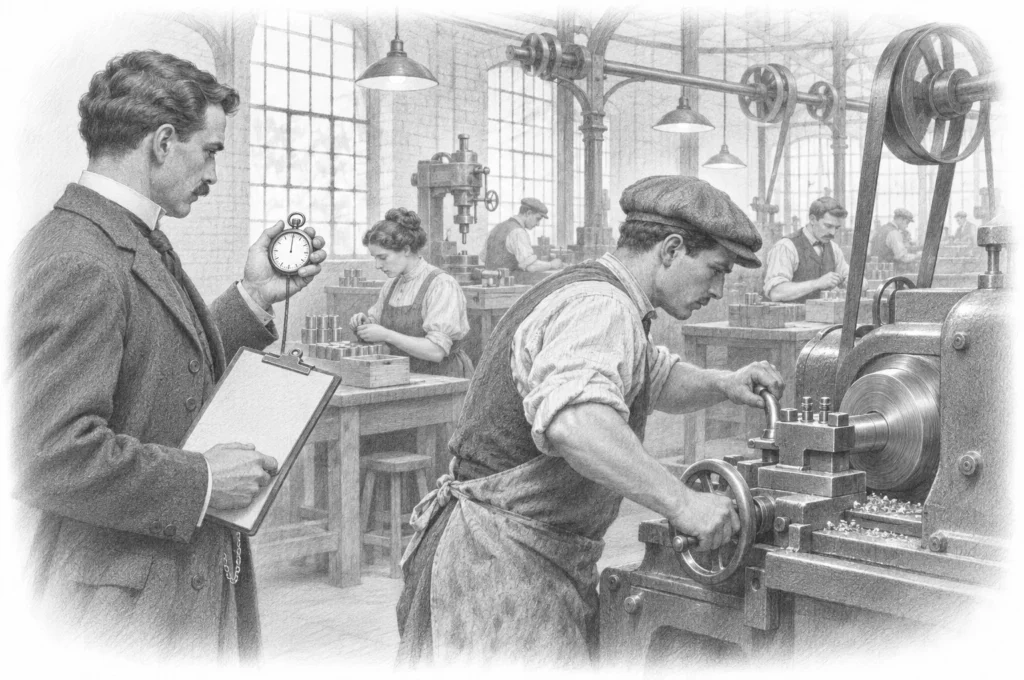
F.W. Taylor was an American engineer who rose from labourer to chief engineer at the Midvale Steel Company and later worked at Bethlehem Steel. He observed that workers deliberately worked slowly, a practice he called soldiering, because they feared that higher output would mean lower piece rates or unemployment, and because managers left them to work by rule of thumb. Taylor believed that the cause was not laziness but bad management. His answer was to study every job scientifically and find the one best way of doing it.
A. The four principles
In The Principles of Scientific Management (1911), Taylor gave four principles (Figure 2.2):
- Science, not rule of thumb: develop a science for each element of a person’s work, through careful observation and measurement.
- Scientific selection and training: select the right worker for each job and train and develop him, instead of letting workers choose their jobs and train themselves.
- Co-operation: management should co-operate heartily with workers to ensure that work is done according to the science.
- Equal division of responsibility: management should take over the work of planning, for which it is better fitted, while workers carry out the work.

B. Techniques
- Time study and motion study: each task was broken into motions, unnecessary motions were removed and the time for each was measured with a stopwatch; Frank and Lillian Gilbreth refined motion study.
- Standardisation of tools, materials and working conditions, as in his famous shovelling experiment, which fixed the best load for a shovel.
- Functional foremanship: instead of one foreman, each worker would receive instructions from eight specialised foremen, four in the planning department (route clerk, instruction-card clerk, time-and-cost clerk, shop disciplinarian) and four on the shop floor (gang boss, speed boss, repair boss, inspector).
- Differential piece-rate system: a higher rate for workers who reach the standard output and a lower rate for those who fail, so that pay is linked to performance.
- Separation of planning from doing: thinking was moved from the worker to the planning department.
C. The mental revolution
Taylor insisted that scientific management was not a set of efficiency devices but a mental revolution on both sides. Instead of quarrelling over how to divide the surplus, management and workers should co-operate to increase the surplus, so that there would be higher wages for workers and higher profits for owners at the same time.
D. Contribution to public administration
Taylor’s ideas spread quickly into government. The American Commission on Economy and Efficiency (1910–13) applied them to federal administration, and Gulick’s principles, organisation-and-methods units, work study, budgeting and performance measurement all owe something to him. Efficiency became the main value of the classical school. Even Lenin, in 1918, called the Taylor system a combination of the refined brutality of bourgeois exploitation and a number of the greatest scientific achievements, and wanted Soviet Russia to adopt it.
E. Criticism
Taylor treated the worker as an economic man, motivated only by money, and as a part of a machine. Workers and unions in America opposed his system, and a congressional inquiry was held in 1911–12. Fayol argued that functional foremanship violated unity of command. The human relations school showed that social and psychological needs matter as much as money. The Soviet scholar D. Gvishiani [ग्विशियानी], in Organisation and Management (1972), wrote from a Marxist position that Western management theories, beginning with Taylor, served to intensify the exploitation of labour, even though their scientific methods could be used under socialism; Harry Braverman (1974) later argued that Taylorism de-skilled workers by taking away their control over work. Yet Taylor’s influence survives in performance targets and the measurement culture of the New Public Management, sometimes called neo-Taylorism.
2.2 Ideal-Type Bureaucracy (Max Weber)
Max Weber [वेबर] (1864–1920), the German sociologist, gave the classic theory of bureaucracy in Economy and Society (published in 1922) and in the essay ‘Bureaucracy’, translated in Gerth and Mills, From Max Weber (1946). Weber did not invent bureaucracy, but he explained why it had become the dominant form of organisation in the modern world.
A. Authority and legitimacy
Weber began with authority, power that people accept as legitimate. He identified three types. Traditional authority rests on custom and the sanctity of old traditions, as in the rule of a hereditary king. Charismatic authority rests on the extraordinary personal qualities of a leader, such as a prophet or a revolutionary hero. Legal-rational authority rests on impersonal rules that are made by correct procedures; people obey the office, not the person. Bureaucracy is the purest form of legal-rational authority.
B. Meaning of an ‘ideal type’
An ideal type is a mental construct that exaggerates the main features of a phenomenon to make it clear. It is ‘ideal’ in the sense of being a pure model, not in the sense of being perfect or desirable. No real organisation matches it fully, but real organisations can be compared with it to see how bureaucratic they are. Nicos Mouzelis [मूज़ेलिस], in Organisation and Bureaucracy (1967), stresses this point, and also notes that Weber sometimes treated the model as if it described the most efficient organisation, which created confusion among his readers.
C. Features of the ideal-type bureaucracy
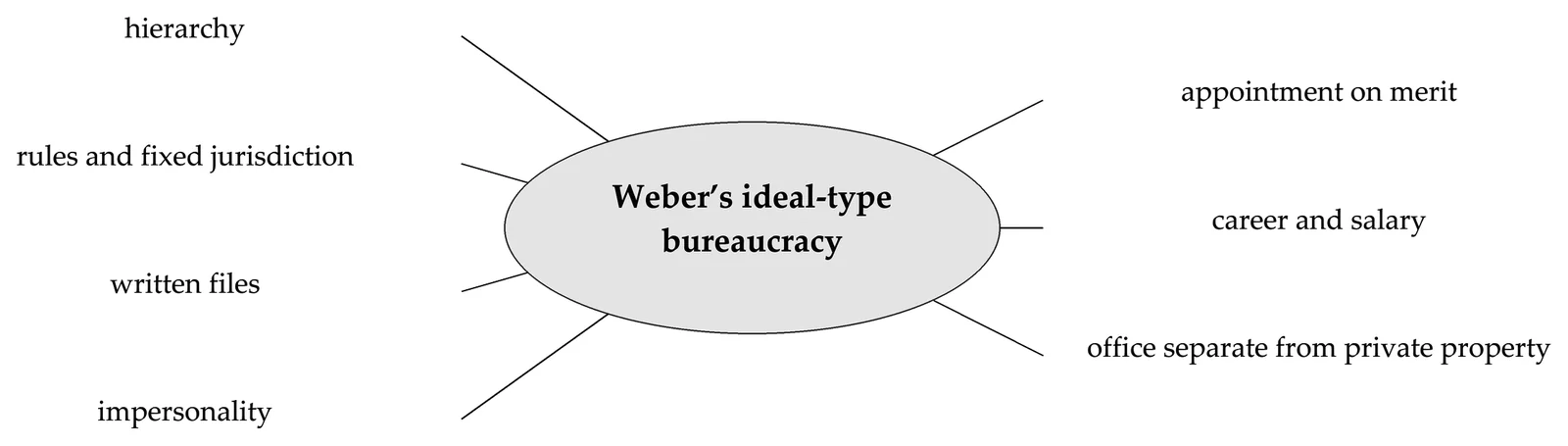
Weber’s bureaucracy has the following features (Figure 2.3):
- Fixed jurisdiction: official duties are fixed by rules and divided among offices.
- Hierarchy: offices are arranged in a clear hierarchy, each lower office under the control of a higher one.
- Written documents: administration is based on files, which are preserved.
- Expert training: officials are trained specialists.
- Full-time work: the official devotes his full working capacity to the office.
- General rules: the office is managed according to stable, exhaustive rules that can be learnt.
- Impersonality: officials apply rules without hatred or passion, without regard to persons.
- Appointment on merit: officials are appointed, not elected, on the basis of qualifications, usually tested by examination.
- Career and salary: officials receive a fixed salary and pension and have a career with promotion by seniority or merit.
- Separation of office and property: the official does not own the means of administration or his office.
D. Why bureaucracy spread
Weber argued that bureaucracy spread because of its technical superiority. Compared with other forms of organisation it offers precision, speed, clarity, knowledge of the files, continuity, discretion, unity, strict subordination and the reduction of friction and costs; it compares with them, he said, as a machine compares with non-mechanical modes of production. The growth of the money economy, mass democracy and the large modern state all required it.
E. Weber’s own fears
Weber was not a simple admirer of bureaucracy. He feared that the spread of rationalisation would trap human beings in an ‘iron cage’, a world of rules in which there would be ‘specialists without spirit’. He also feared that the expert bureaucracy would become too powerful for elected politicians to control, and so he looked to strong parliaments and charismatic political leaders to give direction to it.
F. Criticism
Robert Merton, in ‘Bureaucratic Structure and Personality’ (1940), showed the dysfunctions of bureaucracy: rules become ends in themselves (goal displacement), officials develop a ‘trained incapacity’ to deal with new situations, and red tape and rigidity follow. Philip Selznick and Alvin Gouldner showed that real bureaucracies differ greatly from the ideal type; Gouldner (1954) found mock, representative and punishment-centred bureaucracies. The human relations school pointed to the neglected informal organisation. Warren Bennis, in Beyond Bureaucracy, predicted that rigid bureaucracy would be replaced by flexible, temporary, problem-solving teams in a fast-changing world. Marxists see bureaucracy as an instrument of the ruling class; feminists such as Kathy Ferguson (1984) argue that its hierarchy reflects male domination; and Riggs showed that in developing countries the formal bureaucratic model often hides very different realities. Yet modern governments, including the Indian civil services, are still largely Weberian in structure.
2.3 Human Relations Theory (Elton Mayo)
Elton Mayo [मेयो] (1880–1949), an Australian psychologist who taught at the Harvard Business School, is the father of the human relations movement. His ideas came from the famous Hawthorne studies at the Western Electric Company’s Hawthorne Works near Chicago (1924–32), reported by Fritz Roethlisberger [रॉथलिसबर्गर] and William Dickson in Management and the Worker (1939) and by Mayo in The Human Problems of an Industrial Civilization (1933).
A. The Hawthorne experiments
The studies passed through four stages (Figure 2.4):
- Illumination experiments (1924–27): engineers varied the lighting for a test group and kept it constant for a control group. Output rose in both groups, and even when the light was reduced. Clearly something other than physical conditions was at work.
- Relay assembly test room (1927–32): six women assembling telephone relays were studied for five years while rest pauses, working hours and refreshments were changed. Output rose with almost every change, and stayed high even when the original conditions were restored. The explanation was the friendly supervision, the attention they received, their participation in decisions and the team spirit of the group.
- Mass interviewing (1928–30): more than 20,000 workers were interviewed. When interviewers allowed them to talk freely, their complaints revealed feelings, social relations and attitudes that affected their work.
- Bank wiring observation room (1931–32): fourteen men wiring telephone switchboards were observed. They had their own informal norms: do not produce too much (be a ‘rate-buster’), do not produce too little (be a ‘chiseler’), do not tell the supervisor anything that harms a colleague (be a ‘squealer’). The group restricted output despite financial incentives.

B. Findings
- The worker is a social man, not only an economic man; recognition, security and belonging matter as much as money.
- Every formal organisation contains an informal organisation of groups with their own leaders, norms and communication.
- Group norms, not management targets, often decide output.
- Participation, two-way communication and supportive, democratic leadership raise morale and productivity.
- Being observed and given attention can itself change behaviour, later called the Hawthorne effect (Landsberger, 1958).
C. Significance
The human relations theory shifted the attention of administration from structure to people. It inspired the behavioural study of organisations and later theories of motivation such as Maslow’s hierarchy of needs (1943), Herzberg’s two-factor theory (1959) and McGregor’s Theory X and Theory Y (1960). In public administration it led to concern with morale, participative management, grievance redressal, communication and leadership training.
D. Criticism
Critics, notably Alex Carey (1967), showed that the Hawthorne studies were scientifically weak: the samples were very small, conditions were not controlled, and some workers in the relay room were replaced for being uncooperative. Industrial sociologists accused the school of being pro-management, using friendliness to manipulate workers into producing more, and mocked it as ‘cow sociology’, since contented cows give more milk. It ignored trade unions, conflict and the importance of wages, neglected the formal organisation, and was based on factory experience rather than government. Still, its central discovery, that organisations are made of human beings, is now accepted by all.
2.4 Rational Decision-Making (Herbert Simon)
Herbert Simon (1916–2001), American political scientist and winner of the Nobel Prize in Economics in 1978, transformed public administration with Administrative Behavior (1947). After attacking the classical principles as ‘proverbs’, he argued that decision-making is the heart of administration, and that the vocabulary of administrative theory must be derived from the logic and psychology of human choice.
A. Facts and values
Influenced by logical positivism, Simon distinguished between factual elements of a decision, which can be tested empirically, and value elements, which express preferences and cannot be proved true or false. A science of administration should study the factual side, the choice of means, while ends are set by politics. He also replaced the politics–administration dichotomy with a fact–value dichotomy.
B. Bounded rationality and satisficing
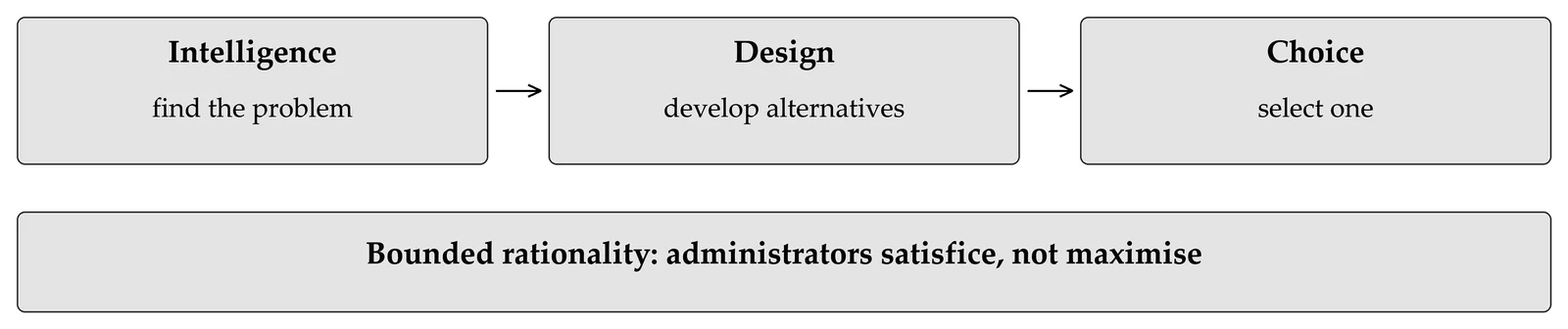
Classical economics assumed an economic man who knows all the alternatives and their consequences and chooses the best one. Simon showed that real decision-makers cannot do this: their knowledge is incomplete, they cannot foresee all consequences, and they have limited time and mental capacity. Their rationality is therefore bounded. Instead of looking for the best possible alternative (maximising), they choose the first one that is good enough (satisficing, a word Simon formed from ‘satisfy’ and ‘suffice’). Simon called this realistic decision-maker the administrative man.
C. The process of decision-making
Simon described decision-making as three stages (Figure 2.5): intelligence, searching the environment for problems that require decisions; design, inventing and analysing possible courses of action; and choice, selecting one of them. He also distinguished programmed decisions, which are routine and handled by rules, from non-programmed decisions, which are new and require judgement. He identified several kinds of rationality, objective, subjective, conscious, deliberate, organisational and personal, depending on whose goals and whose knowledge are involved.
D. How the organisation shapes decisions
Because individual rationality is limited, the organisation helps by setting goals, dividing work, providing information and training and creating routines. It influences the decisions of its members through authority (subordinates accept decisions within a ‘zone of acceptance’), communication, training, the criterion of efficiency and identification or loyalty to the organisation. With James March, in Organizations (1958), Simon also described the inducement–contribution balance: members stay in an organisation as long as what it offers them exceeds what they give.
E. Criticism
Dwight Waldo argued, in his famous debate with Simon (1952), that facts and values cannot be separated in administration, which is full of value choices about justice and democracy. Charles Lindblom, in ‘The Science of “Muddling Through”’ (1959), argued that real policy-making is incremental: administrators make small changes from existing policies rather than following rational stages. Chris Argyris (1973) criticised Simon’s rational model for neglecting human growth and feelings. Others said that his positivism made public administration narrow and technical. Yet Simon’s ideas of bounded rationality and satisficing remain central to the study of decision-making, public policy and behavioural economics.
2.5 Ecological Approach (Fred Riggs)
Ecology is the study of the relationship between living things and their environment. John Gaus (1947) first applied the idea to public administration, arguing that administration is shaped by its people, place, technology and social conditions. Fred W. Riggs (1917–2008), the leading figure of the Comparative Administration Group (1960), developed the approach fully in The Ecology of Public Administration (1961) and Administration in Developing Countries: The Theory of Prismatic Society (1964). His central claim was that administration cannot be understood apart from the society in which it operates, which is why Western models often fail in developing countries.
A. Ecological factors
Riggs studied the influence of five factors on administration: the economic foundations, the social structure, the communication networks, the symbol system or ideology, and the political system. He compared the USA, Thailand and the Philippines to show how these factors shape administration differently.
B. Fused, prismatic and diffracted societies
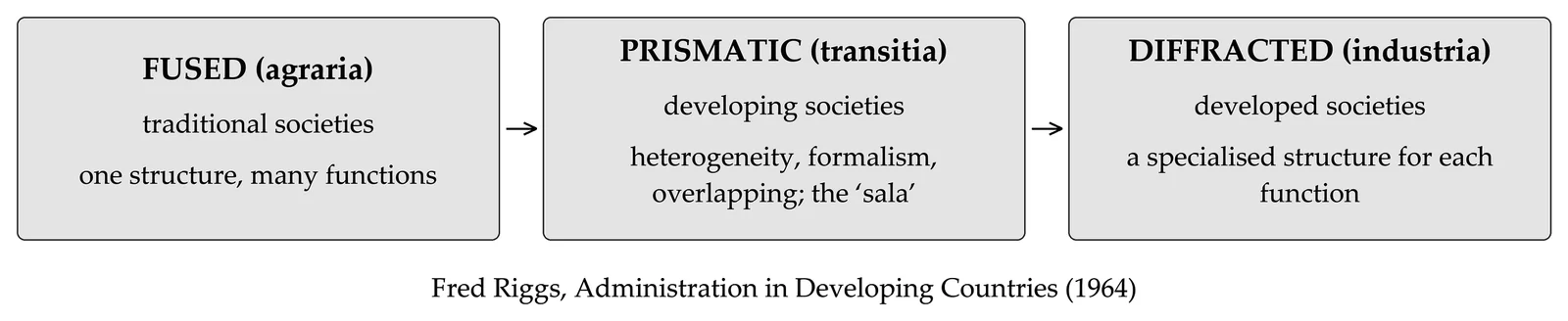
Riggs first contrasted agricultural (agraria) and industrial (industria) societies, and later used the analogy of a prism. White light, in which all colours are fused, passes through a prism and comes out diffracted into separate colours. In the same way (Figure 2.6):
- A fused society is a traditional society in which one structure performs many functions; the king’s household, for example, combines government, religion and economy.
- A diffracted society is a developed society in which each function is performed by a separate, specialised structure, such as parliaments, courts, markets and bureaucracies.
- A prismatic society is a transitional, developing society in which new specialised structures have been created formally, but old traditional structures still influence how they work.
C. Features of the prismatic society
- Heterogeneity: the coexistence of very different systems, practices and viewpoints, such as modern cities and traditional villages, Western-educated elites and illiterate masses.
- Formalism: the gap between what is formally prescribed and what is actually practised; laws, rules and plans exist on paper but are not enforced.
- Overlapping: new structures, such as courts and ministries, exist formally, but traditional structures, such as family, caste and religion, still decide how they function.
- Poly-communalism: many ethnic and religious communities live side by side with mistrust; Riggs called their organisations ‘clects’.
- Nepotism and ascription: appointments are made on the basis of family or community rather than merit, even though merit rules exist.
- Poly-normativism: modern and traditional norms coexist, and people use whichever suits them.
- Bazaar-canteen economy: prices are not fixed by the market but vary according to the buyer’s relationship with the seller.
D. The sala model
Riggs called the administrative office in a prismatic society the sala [साला], a Spanish word meaning a room or a government office. In the sala, administration overlaps with family and community: officials favour their relatives and caste, rules are applied selectively, corruption is common, and the bureaucracy is powerful because political institutions are weak. The sala stands between the household of a fused society (the chamber) and the specialised bureau of a diffracted society.
E. Evaluation
Riggs gave comparative and development administration their most influential model and made scholars sensitive to the environment of administration. His ideas of formalism and overlapping explain many problems of developing countries, including India, where good laws are often weakly implemented. But critics say that his writing is full of difficult new terms, that his models are abstract and difficult to test, and that they treat the Western diffracted society as the ideal, viewing developing societies only in terms of what they lack. Global South scholars argue that they ignore the effects of colonialism and the strengths of indigenous institutions. Riggs himself revised his model in ‘Prismatic Society Revisited’ (1973).
2.6 Important Questions
- Question 1 Critically examine F.W. Taylor’s theory of scientific management.
- Question 2 Discuss Max Weber’s ideal-type bureaucracy. Is it still relevant?
- Question 3 Explain the Hawthorne experiments and the main ideas of the human relations theory.
- Question 4 Examine Herbert Simon’s theory of rational decision-making.
- Question 5 Explain Fred Riggs’s ecological approach to public administration.
DU asks the same idea in different words. So learn one broad answer for each question below; the same answer works for every question joined by OR.
Important Question 1
Critically examine F.W. Taylor’s theory of scientific management.
OR
Discuss the principles of scientific management and their relevance to public administration.
OR
‘Scientific management is a mental revolution.’ Discuss.
Model Answer
“Scientific management involves a complete mental revolution on the part of the workingman and on the part of those on the management’s side.”
— F.W. Taylor, testimony before the House of Representatives (1912)
Introduction. Scientific management is the approach that seeks to find the ‘one best way’ of doing every job through scientific observation and measurement. Its founder, F.W. Taylor (1856–1915), an engineer at Midvale and Bethlehem Steel, developed it as an answer to the inefficiency of American industry at the end of the nineteenth century. It became the foundation of the classical theory of organisation and the cult of efficiency in public administration.
1. Context
Taylor saw that workers practised ‘soldiering’, deliberately working slowly, because managers relied on rule of thumb and cut piece rates when output rose. He believed the remedy lay in better management, not harder driving of workers. An engineer at the Midvale and Bethlehem steel works, he published The Principles of Scientific Management in 1911.
2. The Four Principles
Taylor’s principles were: develop a science for each element of work in place of rule of thumb; select, train and develop workers scientifically; secure hearty co-operation between management and workers; and divide work and responsibility equally, with management taking over planning. Managers were to plan the work and workers to execute it, sharing responsibility between them.
3. Techniques
He introduced time and motion study, standardisation of tools and conditions, the differential piece-rate system, the separation of planning from doing and functional foremanship, in which eight specialised foremen replaced the single foreman. His pig-iron experiment at Bethlehem Steel raised output from 12.5 to 47.5 tons a day. His experiments on shovelling and pig-iron handling showed large increases in output.
4. Functional Foremanship
Taylor replaced the single foreman with eight functional foremen, each responsible for one aspect such as speed, inspection, repair or discipline, applying specialisation to supervision.
5. Differential Piece-Rate
He proposed paying a higher rate to workers who reached the standard output and a lower rate to those who did not, as an incentive for efficiency.
6. The Mental Revolution
Taylor argued that the essence of scientific management was a change of attitude: management and workers should stop quarrelling over the division of the surplus and co-operate to increase it, so that both would gain.
7. Contribution to Public Administration
Scientific management made efficiency the central value of administration. It influenced the Commission on Economy and Efficiency (1910–13), Gulick’s POSDCORB, budgeting, organisation and methods, work study and personnel management. Its emphasis on standards and measurement returned in the performance targets of the New Public Management. It influenced the Taft Commission on Economy and Efficiency (1910–13) and the efficiency movement in American government.
8. Criticism
Taylor’s economic man ignored social and psychological needs, as the Hawthorne studies later showed. His system treated workers as parts of a machine, removed their control over work and led to monotony; Braverman called this de-skilling. Unions opposed it as speed-up, and a congressional inquiry investigated it. Functional foremanship violated unity of command. Gvishiani’s Marxist critique saw Taylorism as a technique for intensifying the exploitation of labour under capitalism. And methods developed for factories do not easily fit government, whose goals are not easily measured. Trade unions accused it of speeding up work and turning workers into machines, and a committee of the US Congress investigated it in 1911–12.
9. Scientific Management in India
Its legacy can be seen in work study units, the National Productivity Council (1958) and performance targets in public organisations.
10. Relevance Today
Scientific management survives in work measurement, performance indicators, standard operating procedures and the ‘neo-Taylorism’ of the New Public Management. It must, however, be combined with attention to motivation, participation and public values. Modern ‘Taylorism’ is visible in call centres and gig platforms that monitor every movement of workers.
11. Taylor and Fayol Compared
Taylor and Fayol together laid the foundation of classical theory, but they looked at the organisation from opposite ends. Taylor worked from the bottom up: he studied the shop floor, the individual worker and operative efficiency. Fayol worked from the top down: he studied the functions and principles of general management. Taylor’s functional foremanship gave a worker several bosses, while Fayol insisted on unity of command. Yet both believed in universal principles, in the separation of planning from execution and in efficiency as the supreme value, and both were later criticised for neglecting the human side of organisation.
Conclusion. Thus, Taylor made administration systematic and efficiency-minded. His theory is incomplete because it ignores the human side of work, but it began the scientific study of organisations.
Important Question 2
Discuss Max Weber’s ideal-type bureaucracy. Is it still relevant?
OR
Critically analyse the features of Weber’s model of bureaucracy.
OR
Examine the main criticisms of Weber’s theory of bureaucracy.
Model Answer
“The decisive reason for the advance of bureaucratic organization has always been its purely technical superiority over any other form of organization.”
— Max Weber, ‘Bureaucracy’ (in From Max Weber, 1946)
Introduction. Bureaucracy is an organisation of appointed officials who work according to rules within a hierarchy. Max Weber (1864–1920) gave the classic theory of bureaucracy as part of his study of authority and rationalisation in the modern world. His ideal type remains the starting point of every discussion of bureaucracy.
1. Authority as the Basis
Weber distinguished traditional, charismatic and legal-rational authority. Bureaucracy is the administrative form of legal-rational authority, where obedience is owed to impersonal rules and to the office rather than to a person. Weber set out this analysis in Economy and Society (1922).
2. Meaning of the Ideal Type
An ideal type is a pure model that exaggerates the essential features of a phenomenon. It is a tool for comparison, not a description of any real organisation, nor a statement of what is best. Mouzelis notes that Weber’s ambiguity on this point led many to read the model as a recipe for efficiency. It is a tool of comparison, not a description of any actual organisation.
3. Features
Weber’s bureaucracy has fixed jurisdictions governed by rules; a hierarchy of offices; administration based on written files; trained, full-time officials; stable general rules; impersonality; appointment by merit, not election; a fixed salary, pension and career; and the separation of the office from the private property of the official. Officials are appointed on merit, paid fixed salaries, follow careers with promotion and keep office separate from private property.
4. Technical Superiority
Weber argued that bureaucracy is superior to other forms of organisation in precision, speed, clarity, continuity, discretion, unity and reduced costs, as a machine is superior to manual production. Capitalism, the money economy and mass democracy all needed it. He compared bureaucracy to a machine, superior to other forms as machine production is to handicraft.
5. Weber’s Concerns
Weber feared the ‘iron cage’ of rationalisation and the power of the expert official, who might escape the control of elected politicians. He wanted strong parliaments and political leadership to direct bureaucracy. He feared that bureaucrats might dominate politicians, who lack expert knowledge.
6. Criticism
Merton (1940) showed the dysfunctions of bureaucracy: goal displacement, trained incapacity, rigidity and red tape. Selznick and Gouldner found that real bureaucracies deviate from the ideal type. The human relations school showed that the model ignores informal groups and human feelings. Bennis predicted that bureaucracy would give way to flexible, temporary organisations. Marxists see it as an instrument of class rule, feminists such as Ferguson as an expression of male hierarchy, and Riggs as unsuited to prismatic societies where formalism prevails. The New Public Management attacked it as slow and inward-looking. Selznick and Gouldner showed how bureaucracies develop informal goals and patterns of behaviour.
7. Relevance
Despite these criticisms, bureaucracy remains the backbone of modern government. Merit recruitment, rules, hierarchy, records and impersonality are the guarantees of fairness, equality before the law and accountability, and are precisely what is missing where corruption and nepotism prevail. India’s civil services, built on the ‘steel frame’, are largely Weberian. The challenge is to make bureaucracy more flexible, responsive and citizen-friendly without losing its rule-based fairness. Rules and records also protect citizens from arbitrary decisions.
8. Weber and India
India’s civil services follow the Weberian model of merit, hierarchy and rules, but critics note that political interference, corruption and patronage distort it in practice.
9. Post-Weberian Models
New Public Management and governance theories challenged Weber’s model by stressing flexibility, results and networks, but Pollitt and Bouckaert describe a ‘neo-Weberian state’ that keeps bureaucracy while modernising it.
10. Bureaucracy and Democracy
Weber saw a deep tension between bureaucracy and democracy. Mass democracy needs bureaucracy, because equal treatment under general rules abolishes the privileges of birth and patronage. But bureaucracy also threatens democracy, because the expert official controls information, prefers secrecy and can dominate ministers who are amateurs in comparison. Weber therefore wanted a strong parliament, with powers of inquiry, and political leaders with the vision and will to direct the administration. The Indian debate between a ‘committed’ and a ‘neutral’ bureaucracy echoes the same problem. He hoped that strong parliamentary leaders could control the bureaucracy.
Conclusion. Thus, Weber’s ideal type remains the most influential model of bureaucracy. It needs to be adapted, not abandoned, in the age of governance.
Important Question 3
Explain the Hawthorne experiments and the main ideas of the human relations theory.
OR
Discuss Elton Mayo’s contribution to administrative theory.
OR
Compare the classical and human relations approaches to organisation.
Model Answer
“The working group as a whole actually determined the output of individual workers.”
— Elton Mayo, The Social Problems of an Industrial Civilization (1945)
Introduction. The human relations theory holds that organisations are social systems and that the feelings, attitudes and group relations of workers decide their productivity. It arose from the Hawthorne studies (1924–32) at the Western Electric Company, Chicago, led by Elton Mayo, Roethlisberger and Dickson, and it challenged the mechanical view of the classical school.
1. Background
Taylor and the classical writers assumed that workers are economic beings who respond to money and rational structure. The Hawthorne studies began as an attempt to find the effect of physical conditions on output, within this classical framework. Elton Mayo and Fritz Roethlisberger of Harvard led the research at the Western Electric Company’s Hawthorne Works near Chicago.
2. The Illumination Experiments (1924–27)
Output rose in both test and control groups whatever happened to the lighting, which suggested that psychological factors were at work. The puzzling result showed that factors other than physical conditions affected output.
3. The Relay Assembly Test Room (1927–32)
Six women were studied while rest pauses and hours were changed. Output rose with each change and remained high even when the original conditions returned, because of friendly supervision, attention, participation and group spirit. The researchers concluded that the attention given to the workers and their group spirit raised output, later called the ‘Hawthorne effect’.
4. Mass Interviewing (1928–30)
Interviews with over 20,000 workers, conducted in a non-directive way, revealed that complaints reflected social attitudes and personal situations, and that being listened to improved morale. Being listened to itself improved the workers’ morale.
5. The Bank Wiring Room (1931–32)
Fourteen men developed informal norms that restricted output and punished ‘rate-busters’, ‘chiselers’ and ‘squealers’, showing the power of the informal group over financial incentives. Workers who produced too much were called ‘rate-busters’ and those who produced too little ‘chiselers’.
6. Leadership and Communication
The experiments suggested that supervisors who are friendly, listen to workers and encourage participation achieve higher morale and productivity than authoritarian supervisors.
7. Main Ideas of the Theory
The worker is a social man; organisations contain informal groups with their own norms and leaders; non-economic rewards such as recognition and belonging motivate workers; participation, communication and democratic leadership raise morale and output; and the attention paid to workers itself changes behaviour (the Hawthorne effect). Communication, participation and leadership became central concerns of management.
8. Mayo’s Wider Concerns
In The Human Problems of an Industrial Civilization (1933), Mayo argued that industrial society had destroyed traditional communities, and that the workplace must provide a sense of belonging.
9. Classical and Human Relations Approaches Compared
The classical approach sees the worker as an economic man, focuses on formal structure and seeks productivity through scientific methods and incentives. The human relations approach sees the worker as a social man, focuses on informal groups and morale and seeks productivity through satisfaction and good leadership. The first stresses structure; the second, people.
10. Criticism and Significance
Critics such as Carey found the research methods weak; others called the approach pro-management and manipulative, ‘cow sociology’ that ignored unions, conflict and wages, and neglected formal structure. Yet the theory led to the behavioural sciences, to motivation theories of Maslow, Herzberg and McGregor, and to participative management in government. Marxists criticised it as a technique for making workers accept managerial control.
11. Influence on Later Theories
The human relations school opened the way to theories of motivation. Abraham Maslow (1943) arranged human needs in a hierarchy, from physiological and safety needs to social, esteem and self-actualisation needs. Douglas McGregor (1960) contrasted Theory X, which assumes that people dislike work and must be controlled, with Theory Y, which assumes that people seek responsibility and can direct themselves. Frederick Herzberg (1959) separated hygiene factors, such as pay and conditions, from motivators, such as achievement and recognition, and Rensis Likert advocated participative management.
12. Relevance to Public Administration
In government the theory explains the importance of morale, team spirit, grievance redressal, recognition of good work and participative leadership in offices, and why training programmes now focus on attitudes and behaviour as well as rules. Training in leadership and teamwork at Indian civil service academies reflects these ideas.
Conclusion. Thus, the human relations theory humanised administration. Its findings complement, rather than replace, the classical theory: an organisation needs both a sound structure and satisfied people.
Important Question 4
Examine Herbert Simon’s theory of rational decision-making.
OR
Discuss Simon’s concept of bounded rationality.
OR
‘Decision-making is the heart of administration.’ Explain.
Model Answer
“Whereas economic man maximizes, his cousin, whom we shall call administrative man, satisfices: he looks for a course of action that is satisfactory or ‘good enough’.”
— Herbert Simon, Administrative Behavior (2nd ed., 1957)
Introduction. Herbert Simon’s Administrative Behavior (1947) shifted public administration from the study of structures and principles to the study of decisions. He argued that administration is essentially a process of decision-making, and that it must be studied scientifically, by observing how people actually choose. His ideas earned him the Nobel Prize in Economics in 1978.
1. Critique of the Principles
In ‘The Proverbs of Administration’ (1946), Simon argued that the classical principles contradict each other and cannot guide action. A real science must study the decisions that lie behind every administrative act. A narrow span of control, for example, conflicts with the principle of few levels of hierarchy.
2. Administrative Behavior (1947)
Simon’s Administrative Behavior made decision-making the heart of administration, arguing that organisations are best understood as systems of decisions.
3. The Fact–Value Distinction
Following logical positivism, Simon separated factual propositions, which can be tested, from value propositions, which cannot. Administrative science should study the factual element, the choice of means, while values come from the political process.
4. Bounded Rationality
The economic man of classical economics is perfectly rational. Real people have incomplete information, limited foresight, limited time and limited ability to process information. Their rationality is bounded. Limits of information, time, attention and computing ability prevent perfect rationality.
5. Satisficing and the Administrative Man
Because of these limits, the administrative man does not maximise; he satisfices, choosing the first alternative that meets minimum standards. He simplifies problems and uses rules of thumb. He chooses the first alternative that is good enough.
6. Stages and Types of Decisions
Decision-making has three stages, intelligence, design and choice. Decisions may be programmed, routine and repetitive, or non-programmed, new and complex. Simon also distinguished objective, subjective, conscious, deliberate, organisational and personal rationality. Programmed decisions are routine and repetitive; non-programmed decisions are new and unstructured.
7. The Role of the Organisation
The organisation extends the limited rationality of individuals by providing goals, information, training and routines, and it influences decisions through authority, communication, the criterion of efficiency and loyalty. Subordinates accept orders that fall within their zone of acceptance. With March (1958), Simon explained membership through the inducement–contribution balance. It provides goals, rules, communication and training that shape the premises of individual decisions.
8. Incrementalism as an Alternative
Charles Lindblom’s ‘The Science of Muddling Through’ (1959) argued that policy-makers actually proceed by small, incremental changes, offering an alternative to Simon’s rational model.
9. Wider Influence
Simon received the Nobel Prize in Economics in 1978 for his research on decision-making in economic organisations, showing the reach of his ideas beyond public administration.
10. Criticism
Waldo argued that facts and values cannot be separated in public administration. Lindblom (1959) showed that real decisions are incremental, ‘muddling through’ rather than rational. Argyris found the model mechanical and neglectful of human growth. Others said it ignores politics, power and ethics, and that its positivism narrowed the field.
11. Significance
Simon made public administration behavioural and empirical, linked it to psychology, economics and computer science, and gave the concepts of bounded rationality and satisficing that remain central in policy analysis and behavioural economics.
12. The Simon–Waldo Debate
In 1952 Dwight Waldo argued that public administration must be grounded in democratic theory and that efficiency itself is a value, not a neutral fact. Simon replied that Waldo’s reasoning was loose and that a science of administration requires propositions that can be tested empirically. The debate set the lasting tension in the discipline between those who want a value-free science of administration and those who see administration as part of democratic politics.
13. Applications
Simon’s ideas led to operations research and management science, to computer-assisted decision-making (he was a pioneer of artificial intelligence), and to behavioural public policy, such as the ‘nudges’ of Thaler and Sunstein (2008), which design choices for people with bounded rationality.
Conclusion. Thus, Simon showed that administration is about choosing, and that choices are made by people with limited rationality. His model is realistic, though it underestimates the role of values in public decisions.
Important Question 5
Explain Fred Riggs’s ecological approach to public administration.
OR
Discuss Riggs’s prismatic-sala model.
OR
Examine the features of a prismatic society.
Model Answer
“An ecological approach to public administration builds quite literally from the ground up; from the elements of a place to the people who live there.”
— John M. Gaus, Reflections on Public Administration (1947)
Introduction. The ecological approach studies public administration in relation to its environment: its economy, society, culture and politics. Its leading exponent, Fred Riggs, argued that administrative systems of developing countries cannot be understood with models drawn from the West, and developed the prismatic-sala model to explain them.
1. Meaning of Ecology
Ecology is the study of the interaction between an organism and its environment. John Gaus (1947) introduced it into public administration; Riggs developed it in The Ecology of Public Administration (1961) and Administration in Developing Countries (1964). John Gaus introduced the ecological approach to public administration in 1947, and Riggs developed it in The Ecology of Public Administration (1961).
2. Ecological Factors
Riggs identified five environmental factors that shape administration: economic foundations, social structures, communication networks, symbol systems and political systems. These factors explain why the same institutions work differently in different societies.
3. The Prism Analogy
Fused white light passes through a prism and emerges diffracted into colours. Similarly, a fused traditional society, in which one structure performs many functions, moves through a prismatic transitional stage to a diffracted modern society, in which each function has its own specialised structure. Agrarian societies are fused, industrial ones diffracted, and developing countries prismatic.
4. Features of the Prismatic Society
Its main features are heterogeneity, the coexistence of modern and traditional; formalism, the gap between formal rules and actual practice; and overlapping, in which formally modern structures are controlled by traditional ones. Other features are poly-communalism and ‘clects’, nepotism, poly-normativism, the lack of consensus, and a bazaar-canteen economy with indeterminate prices. Formalism is the gap between formal rules and actual behaviour; overlapping means that modern structures coexist with traditional ones.
5. Clects and the Bazaar-Canteen
Riggs described prismatic social groups as ‘clects’, combining traditional community ties with modern associations, and the prismatic economy as a ‘bazaar-canteen’, where prices depend on personal relations and bargaining.
6. Poly-normativism
In a prismatic society several sets of norms coexist, and formal authority is often weaker than informal control by powerful groups, which explains the gap between laws and their implementation.
7. The Sala Model
The administrative office of the prismatic society is the sala. In it, family and community influence appointments and decisions, rules are applied selectively, corruption is common, and the bureaucracy dominates weak political institutions. It lies between the chamber of the fused society and the bureau of the diffracted society. Officials favour relatives and their own community, practise nepotism and corruption, and mix public and private interests.
8. Relevance to India
Riggs’s concepts help explain features of Indian administration, such as formalism in rules, the influence of caste and kinship on appointments and the persistence of corruption, although India has also modernised in many ways.
9. Criticism
Riggs’s models are abstract, full of difficult new terms and hard to test. They treat the Western diffracted society as the norm and see developing societies negatively, ignoring their strengths and the effects of colonialism. Critics also note that formalism and nepotism exist in developed societies too. Some argue that the model portrays developing countries negatively and treats Western societies as the norm.
10. Riggs and Development Administration
Riggs was a founder of development administration, which Edward Weidner and Riggs described as the administration of development programmes and the development of administrative capacity. The prismatic model explains why institutions copied from the West, such as merit-based civil services, planning commissions or anti-corruption laws, often do not work as intended in new nations such as India, where good laws are badly implemented: they are formally adopted but reshaped by family, caste and community. For administrative reform, the lesson is that institutions must be adapted to their ecology, and that social change and administrative change go together. The Comparative Administration Group (1960), which Riggs led, promoted the study of administration in developing countries.
11. Evaluation
Riggs widened public administration beyond Western experience and showed that administration cannot be understood apart from its environment. His terms are difficult, but his central insight, that context shapes administration, remains valuable.
Conclusion. Thus, Riggs’s ecological approach reminds us that administration is a product of its environment, and that reforms must fit the society in which they are applied.
Short Notes
(a) Functional foremanship
Taylor’s plan to replace the single foreman with eight specialised foremen: four in the planning department (route clerk, instruction-card clerk, time-and-cost clerk, shop disciplinarian) and four on the shop floor (gang boss, speed boss, repair boss, inspector). It applied specialisation to supervision, but was criticised by Fayol for violating unity of command.
More notes: MDSC-6A Perspectives on Public Administration
These notes are prepared by PADHO TO AISE for study help. They are not an official University of Delhi publication.