
Semester VI DSC-17 Comparative Political Systems
Unit VI · 21 min read · Updated 24 Nov 2026
As per the University of Delhi (DU) BA (Hons) Political Science syllabus
Contents
- 6.1 Political Traditions and Constitutional Development
- 6.2 Society and Economy: Nature of the State
- 6.3 Party and Electoral System
- 6.4 Unitary and Federal Features: Cooperative Government
- 6.5 Important Questions
- Discuss South Africa’s transition from apartheid to democracy and the main features of its Constitution.
- Examine the relationship between society, economy and the state in post-apartheid South Africa.
- Discuss the party and electoral system of South Africa.
- Is South Africa a federal or a unitary state? Discuss the system of cooperative government.
- Short Notes
मैंने एक लोकतांत्रिक और स्वतंत्र समाज के आदर्श को संजोया है, जिसमें सभी लोग सद्भाव से और समान अवसरों के साथ रहें।
I have cherished the ideal of a democratic and free society in which all persons live together in harmony and with equal opportunities.
— Nelson Mandela, statement at the Rivonia Trial (1964)
SOUTH Africa’s modern history is the story of colonial conquest, a system of racial domination called apartheid, and a remarkable negotiated transition to democracy in 1994. Its 1996 Constitution, with a powerful Constitutional Court and a Bill of Rights that includes social and economic rights, is admired across the world. Yet South Africa remains one of the most unequal societies on earth, and the African National Congress, dominant for thirty years, lost its majority in 2024. This unit studies South Africa’s political traditions and constitutional development, its society and economy and the nature of the state, its party and electoral system, and its quasi-federal system of cooperative government, drawing on Tom Lodge and Anthony Butler.

6.1 Political Traditions and Constitutional Development
European settlement began with the Dutch at the Cape in 1652; Britain took the Cape in 1806, and the discovery of diamonds and gold led to the Anglo-Boer War (1899–1902). The Union of South Africa (1910) excluded the black majority from power, and the Natives Land Act (1913) confined Africans to a small share of the land. The African National Congress was founded in 1912. After 1948, the National Party built apartheid, classifying people by race, segregating residential areas and creating ethnic homelands. Resistance grew: the Freedom Charter (1955), the Sharpeville massacre (1960), the banning of the ANC, Mandela’s life sentence (1964) and the Soweto uprising (1976).
Faced with resistance, sanctions and economic decline, President F.W. de Klerk unbanned the ANC and released Mandela in 1990. Negotiations produced an interim Constitution (1993), the first democratic election in 1994, and a Government of National Unity under Mandela. The final Constitution (1996), drafted by an elected Constitutional Assembly and certified by the Constitutional Court, is supreme law. It includes a Bill of Rights with socio-economic rights, a Constitutional Court, and independent institutions such as the Public Protector. Tom Lodge describes this transition as one of the most successful negotiated democratisations.
6.2 Society and Economy: Nature of the State
Apartheid left a deeply divided society: land, jobs, education and wealth were distributed by race. South Africa has about 62 million people, most of them black African, along with coloured, white and Indian communities, and twelve official languages. Since 1994, governments have pursued redistribution through the Reconstruction and Development Programme (1994), a market-oriented strategy called GEAR (1996), Black Economic Empowerment, and social grants that reach millions of households.
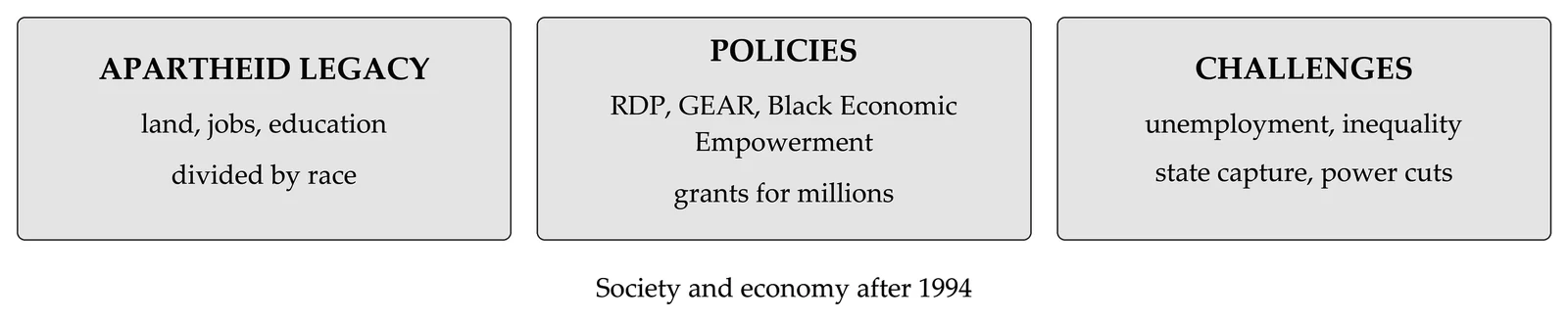
Yet South Africa remains among the most unequal countries in the world, with very high unemployment, especially among young black people. Anthony Butler examines the tension between the ANC’s aims of transformation and the realities of a globalised economy. Under President Jacob Zuma (2009–18), state capture by private interests damaged public institutions, as the Zondo Commission documented, and failures at the power utility Eskom caused years of power cuts. The state aspires to be a developmental state but has struggled with capacity and corruption.
6.3 Party and Electoral System
The 400-member National Assembly is elected by closed-list proportional representation, half from national lists and half from provincial lists, with no threshold. Since 2024 independent candidates may also stand. The Assembly elects the President, who must then leave parliament; Presidents serve at most two five-year terms. Proportional representation was chosen to include all groups and produces a parliament that closely reflects votes.
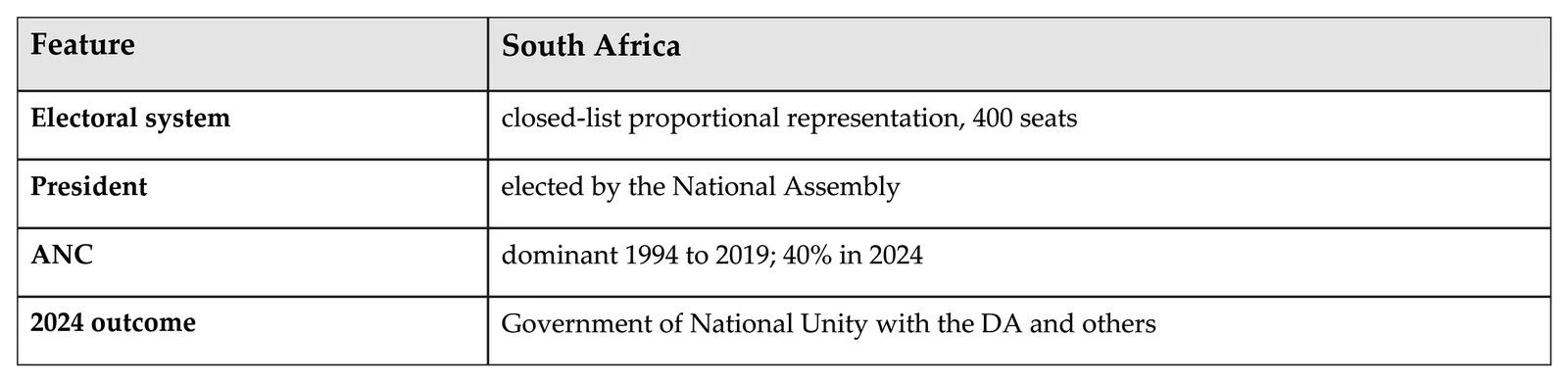
From 1994 to 2019, the ANC dominated, winning between 57 and 70 per cent of the vote, making South Africa a dominant-party democracy. Its main rivals were the Democratic Alliance (DA), the Economic Freedom Fighters (EFF, 2013) and the Inkatha Freedom Party. In 2024 the ANC fell to about 40 per cent, while Jacob Zuma’s new MK party won about 15 per cent. The ANC formed a Government of National Unity with the DA and other parties, and Cyril Ramaphosa was re-elected President.
6.4 Unitary and Federal Features: Cooperative Government
During negotiations, the ANC favoured a strong unitary state, while the National Party and Inkatha wanted federalism. The compromise is a quasi-federal system. The Constitution describes national, provincial and local spheres of government that are distinctive, interdependent and interrelated, bound by principles of cooperative government. There are nine provinces, each with an elected legislature and a Premier, and powers over concurrent subjects such as health, education and housing.

The National Council of Provinces (NCOP), the upper house, represents the provinces, with ten delegates each. But provinces depend on national transfers for most of their revenue, national law can override provincial law in many areas, and the national government can intervene in failing provinces. The DA’s control of the Western Cape since 2009 shows how provinces can provide space for opposition parties.
6.5 Important Questions
- Question 1 Discuss South Africa’s transition from apartheid to democracy and the main features of its Constitution.
- Question 2 Examine the relationship between society, economy and the state in post-apartheid South Africa.
- Question 3 Discuss the party and electoral system of South Africa.
- Question 4 Is South Africa a federal or a unitary state? Discuss the system of cooperative government.
DU asks the same idea in different words. So learn one broad answer for each question below; the same answer works for every question joined by OR.
Important Question 1
Discuss South Africa’s transition from apartheid to democracy and the main features of its Constitution.
OR
Examine the political traditions and constitutional development of South Africa.
OR
Discuss the role of the Constitutional Court and the Bill of Rights in South Africa.
Model Answer
“We, the people of South Africa, Recognise the injustices of our past … Believe that South Africa belongs to all who live in it, united in our diversity.”
— Constitution of the Republic of South Africa (1996), Preamble
Introduction. South Africa moved from one of the most systematic regimes of racial domination in modern history to a constitutional democracy through negotiation rather than civil war. Its 1996 Constitution is widely regarded as one of the most progressive in the world. Tom Lodge and Anthony Butler trace this development and its achievements and limits.
1. Colonial Foundations
The Dutch East India Company founded a settlement at the Cape in 1652. The British took over in the early nineteenth century, and Afrikaner settlers moved inland in the Great Trek, founding republics. Mineral discoveries drew British power inland, leading to the Anglo-Boer War.
2. The Union of 1910
The Union of South Africa united the British colonies and Boer republics under white minority rule. The Natives Land Act of 1913 restricted African land ownership to a small fraction of the country, laying the basis of territorial segregation.
3. Apartheid
After the National Party won the 1948 election, it built apartheid: the Population Registration Act (1950) classified everyone by race, the Group Areas Act (1950) segregated residential areas, Bantu Education gave Africans inferior schooling, and homelands were created to deny Africans South African citizenship.
4. Resistance
The ANC, founded in 1912, led resistance. The Freedom Charter (1955) declared that South Africa belongs to all who live in it. After the Sharpeville massacre of 1960, the ANC was banned and turned to armed struggle. Mandela was sentenced to life imprisonment in 1964. The Soweto uprising of 1976 and mass protests in the 1980s made the country ungovernable.
5. Negotiated Transition
International sanctions, economic decline and resistance led President F.W. de Klerk to unban the ANC and release Mandela in February 1990. Negotiations at CODESA and later talks, despite violence, produced an interim Constitution in 1993.
6. The 1994 Election
On 27 April 1994, South Africans of all races voted for the first time. The ANC won about 63 per cent, and Mandela became President of a Government of National Unity including the National Party and Inkatha.
7. The Final Constitution
An elected Constitutional Assembly drafted the final Constitution in line with principles agreed in the negotiations. The Constitutional Court certified it, after requiring changes, and it was signed in December 1996, coming into force in February 1997.
8. Constitutional Supremacy
The Constitution is the supreme law: any law or conduct inconsistent with it is invalid. Amending core values requires a 75 per cent majority, and the Bill of Rights requires a two-thirds majority and the support of six provinces.
9. Bill of Rights
The Bill of Rights protects equality, dignity, freedom and political rights, and also socio-economic rights to housing, health care, food, water, social security and education, which the state must progressively realise within available resources.
10. The Constitutional Court
The Constitutional Court enforces the Constitution. In Grootboom (2000) it required the state to provide for people in desperate need of housing, in the Treatment Action Campaign case (2002) it ordered a programme to prevent mother-to-child transmission of HIV, and in 2016 it found that President Zuma had violated the Constitution over the Nkandla affair.
11. Chapter 9 Institutions
Independent institutions supporting democracy include the Public Protector, the Human Rights Commission, the Commission for Gender Equality, the Auditor-General and the Electoral Commission. The Public Protector’s report on state capture (2016) was important in exposing corruption.
12. Truth and Reconciliation
The Truth and Reconciliation Commission, chaired by Archbishop Desmond Tutu, heard testimony about apartheid-era abuses and offered amnesty in exchange for full disclosure. It aimed at reconciliation rather than punishment, though many felt justice was incomplete.
13. Parliamentary-presidential System
The President is elected by the National Assembly and can be removed by a vote of no confidence. The ANC has removed sitting Presidents from office, recalling Thabo Mbeki in 2008 and forcing Jacob Zuma to resign in 2018.
14. Evaluation
South Africa’s transition and Constitution are major achievements of negotiation and constitutionalism. But the persistence of inequality shows that political liberation has not yet produced the social transformation the Constitution promises.
Conclusion. Thus, South Africa moved from colonial conquest and apartheid to a negotiated democracy in 1994. Its 1996 Constitution is supreme, protects civil and socio-economic rights, and is enforced by a strong Constitutional Court and independent institutions, though deep inequality remains.
Important Question 2
Examine the relationship between society, economy and the state in post-apartheid South Africa.
OR
Discuss the challenges of inequality and unemployment in South Africa.
OR
Is South Africa a developmental state? Discuss.
Model Answer
“South Africa is a country of two nations. One of these nations is white, relatively prosperous … The second and larger nation of South Africa is black and poor.”
— Thabo Mbeki, speech in the National Assembly (1998)
Introduction. Apartheid left South Africa with a society and economy deeply divided by race. Since 1994, the democratic state has tried to redistribute opportunities while maintaining economic growth in a globalised economy. Anthony Butler and Tom Lodge examine the successes and failures of these efforts and the nature of the post-apartheid state.
1. The Apartheid Economy
Apartheid’s economy was built on mining and cheap black labour, controlled through migrant labour, pass laws and job reservation for whites. Land, capital and skills were concentrated in white hands.
2. A Diverse Society
South Africa has about 62 million people, most of them black African, along with coloured, white and Indian South Africans. It recognises twelve official languages, reflecting its diversity, which the Constitution celebrates as unity in diversity.
3. Reconstruction and Development
The ANC’s Reconstruction and Development Programme (1994) promised houses, electricity, water and services for the poor. Millions of houses were built and services extended, though backlogs remained.
4. GEAR and Market Policies
In 1996, the government adopted the Growth, Employment and Redistribution strategy (GEAR), emphasising fiscal discipline, trade liberalisation and investment. Critics on the left argued that it abandoned redistribution for neoliberal policies.
5. Black Economic Empowerment
Black Economic Empowerment, given legal form in 2003, aimed to increase black ownership, management and skills in business. It created a black middle class and business elite, but critics argued it benefited a politically connected few.
6. Social Grants
South Africa built one of the largest social grant systems in the developing world, including old-age pensions and child support grants, which reduce poverty for millions of households.
7. Inequality
Despite these efforts, South Africa remains among the most unequal countries in the world. Inequality is now driven not only by race but also by class, as a black middle class has grown while many remain poor.
8. Unemployment
Unemployment is very high, around a third of the labour force, and higher among young people. Poor education, the decline of mining and manufacturing and spatial legacies of apartheid make it hard for the poor to find work.
9. Land
Land reform has been slow. Restitution and redistribution programmes have transferred only a small share of land, and debates continue over expropriation without compensation.
10. HIV/AIDS
South Africa suffered one of the world’s worst HIV epidemics. President Mbeki’s questioning of the science delayed treatment, but after court action and policy change, it built the world’s largest antiretroviral programme.
11. State Capture
Under President Zuma, private interests, notably the Gupta family, influenced appointments and contracts in state institutions. The Zondo Commission (2018–22) documented this state capture, which weakened state enterprises and institutions.
12. Energy Crisis
Mismanagement and corruption at Eskom, the state power company, led to frequent load shedding, scheduled power cuts, that harmed the economy, particularly in 2022 and 2023.
13. Nature of the State
The ANC aspired to build a developmental state that would drive growth and transformation. In practice, the state combines strong constitutional institutions and social welfare with weak capacity in many areas, corruption and dependence on party patronage.
14. Crime and Social Cohesion
South Africa has very high rates of violent crime, which reflect poverty, inequality and the legacy of apartheid-era violence. Outbreaks of xenophobic violence against migrants from other African countries, notably in 2008 and 2015, revealed tensions over jobs and services. Such problems test the ideal of a rainbow nation and the state’s capacity to protect all who live in the country.
15. Evaluation
Post-apartheid South Africa has extended rights and services to millions, but it has not overcome the structural inequality inherited from apartheid. The gap between constitutional promise and social reality is its central challenge.
Conclusion. Thus, South Africa’s democratic state has pursued redistribution through the RDP, BEE and social grants within a market economy shaped by GEAR. Inequality and unemployment remain extreme, and state capture weakened institutions, leaving the aspiration of a developmental state unfulfilled.
Important Question 3
Discuss the party and electoral system of South Africa.
OR
Is South Africa a dominant-party democracy? Discuss with reference to the ANC.
OR
Examine the proportional representation system in South Africa and the significance of the 2024 election.
Model Answer
“An electoral system that … results, in general, in proportional representation.”
— Constitution of the Republic of South Africa (1996), Section 46(1)(d)
Introduction. South Africa uses one of the most proportional electoral systems in the world, designed to include all groups in a divided society. For thirty years, however, this system coexisted with the dominance of a single party, the African National Congress. The 2024 election, when the ANC lost its majority, marked a turning point.
1. Choice of Proportional Representation
Negotiators chose proportional representation because it gives every significant group seats, encourages inclusion and avoids the winner-take-all results of first past the post, which could have deepened racial divisions.
2. The Electoral System
The 400-member National Assembly is elected by closed-list PR: 200 seats from national party lists and 200 from provincial lists. There is no formal threshold, so even small parties win seats. Provincial legislatures are elected by the same method.
3. Independent Candidates
After the Constitutional Court ruled in 2020 that excluding independents was unconstitutional, the Electoral Amendment Act of 2023 allowed independent candidates to contest national and provincial elections from 2024.
4. Merits and Criticisms
The system is highly representative and fair, but closed lists make members accountable to party leaders rather than voters, as there are no constituencies. Reformers have proposed a mixed system linking MPs to constituencies.
5. The ANC
The ANC, founded in 1912, led the liberation struggle and enjoys legitimacy as the party of Mandela. It governs in an alliance with the South African Communist Party and the trade union federation COSATU.
6. ANC Dominance
From 1994 to 2019, the ANC won between about 57 and 70 per cent of the vote in national elections, controlling the national government and most provinces. Scholars described South Africa as a dominant-party democracy.
7. Causes of Dominance
ANC dominance rested on its liberation credentials, racial and identity loyalties, the weakness and racial image of the opposition, patronage and the delivery of grants and services.
8. The Democratic Alliance
The Democratic Alliance, formed in 2000, is the main opposition, with strong support among white, coloured and Indian voters and a growing black membership. It has governed the Western Cape since 2009.
9. The EFF and Other Parties
The Economic Freedom Fighters, founded by Julius Malema in 2013 after his expulsion from the ANC, advocate land expropriation and nationalisation. The Inkatha Freedom Party is strong in KwaZulu-Natal.
10. Decline of the ANC
Corruption scandals, state capture, unemployment and power cuts eroded ANC support. Its vote fell to 57.5 per cent in 2019 and sharply to about 40 per cent in 2024.
11. The 2024 Election
In 2024, the DA won about 22 per cent and the new uMkhonto weSizwe (MK) party led by Jacob Zuma about 15 per cent, while the EFF won about 9.5 per cent. The ANC formed a Government of National Unity with the DA, IFP and others, and Cyril Ramaphosa was re-elected President.
12. Coalition Politics
The end of single-party dominance has brought coalition politics, already common in municipalities such as Johannesburg, where unstable coalitions have weakened governance.
13. Comparison
Like India’s Congress system and Mexico’s PRI, the ANC’s dominance arose from leading a national struggle. Like them, it has faced decline as voters judged its performance rather than its history.
14. Floor-crossing and Party Discipline
Between 2003 and 2009, laws allowed legislators to cross the floor to other parties during set windows without losing their seats. The ANC gained most from these defections, and the practice was abolished in 2009 amid criticism that it undermined voters’ choices under a list system. Party discipline is strong, because members owe their seats to their place on party lists.
15. Evaluation
South Africa’s PR system has ensured inclusive representation, while ANC dominance provided stability but weakened accountability. The 2024 election opened a more competitive, coalition-based era.
Conclusion. Thus, South Africa elects its National Assembly by closed-list proportional representation, producing a highly inclusive parliament. The ANC dominated from 1994 to 2019, but lost its majority in 2024, leading to a Government of National Unity and a more competitive party system.
Important Question 4
Is South Africa a federal or a unitary state? Discuss the system of cooperative government.
OR
Examine the role of provinces and the National Council of Provinces in South Africa.
OR
‘South Africa is a quasi-federal state.’ Discuss.
Model Answer
“In the Republic, government is constituted as national, provincial and local spheres of government which are distinctive, interdependent and interrelated.”
— Constitution of the Republic of South Africa (1996), Section 40(1)
Introduction. South Africa’s Constitution does not call the country a federation, but it divides power among national, provincial and local spheres of government. The result is often described as quasi-federal, combining features of unitary and federal systems under the principle of cooperative government.
1. The Negotiated Compromise
During the transition, the ANC wanted a strong central government to redress apartheid’s inequalities, while the National Party and the Inkatha Freedom Party sought strong regions to protect minorities. The Constitution was a compromise between these positions.
2. Spheres, Not Levels
The Constitution speaks of spheres of government rather than levels, suggesting partnership rather than hierarchy. Each sphere is distinctive, but they are interdependent and interrelated.
3. Cooperative Government
Chapter 3 sets out principles of cooperative government: all spheres must respect each other’s powers, cooperate in mutual trust and good faith, coordinate actions and avoid legal proceedings against one another where possible.
4. Nine Provinces
The interim Constitution replaced the four old provinces and the homelands with nine provinces, such as Gauteng, KwaZulu-Natal and the Western Cape. Each has an elected legislature, a Premier and an executive council.
5. Provincial Powers
Provinces share concurrent powers with the national government over areas such as education, health, housing, agriculture and welfare, and have exclusive powers over a few matters such as provincial roads and liquor licences.
6. National Override
National legislation prevails over provincial legislation on concurrent matters when uniform national standards are needed, for economic unity or national security. This gives the centre considerable power.
7. The National Council of Provinces
The NCOP, the upper house of Parliament, represents provinces. Each province sends a delegation of ten, and organised local government is also represented. It votes on bills affecting provinces.
8. Fiscal Dependence
Provinces raise little revenue of their own and depend on an equitable share of nationally raised revenue, divided by formula on the advice of the Financial and Fiscal Commission. This limits their autonomy.
9. National Intervention
Under Section 100, the national government can intervene when a province fails to fulfil its obligations, as it did in Limpopo and the Eastern Cape. Provinces can similarly intervene in failing municipalities.
10. Local Government
Local government is a constitutionally recognised sphere, with metropolitan, district and local municipalities responsible for water, electricity and basic services. Many municipalities struggle with poor finances and governance.
11. Provinces and Opposition
Provinces provide space for opposition parties. The Democratic Alliance has governed the Western Cape since 2009, using it to demonstrate its governing record.
12. Quasi-federalism
Because provinces have constitutionally protected powers and representation in the NCOP, South Africa has federal features. But national dominance, fiscal dependence and override powers make it closer to a unitary state with strong decentralisation.
13. Comparison
South Africa’s system resembles India’s quasi-federalism, with a strong centre, and Germany’s cooperative federalism, with a council representing state governments, more than the dual federalism of the United States.
14. Traditional Leaders
The Constitution also recognises the institution of traditional leadership according to customary law. Houses of traditional leaders exist nationally and in several provinces, and chiefs remain influential in rural areas, especially over land. Their role adds another layer to governance and raises debates about democracy, accountability and the rights of rural residents.
15. Evaluation
Cooperative government has helped manage diversity and include opposition parties, but weak provincial and municipal capacity has limited its effectiveness.
Conclusion. Thus, South Africa is a quasi-federal state with national, provincial and local spheres bound by cooperative government. Its nine provinces and the NCOP give it federal features, but national override powers, fiscal dependence and intervention powers keep it closer to a decentralised unitary state.
Short Notes
(a) Apartheid
The system of institutionalised racial segregation and white minority rule imposed by the National Party government from 1948. It classified people by race, segregated where they could live, work and study, created ethnic homelands and denied the black majority political rights. It ended through negotiations between 1990 and 1994.
(b) Truth and Reconciliation Commission
A body established in 1995 and chaired by Desmond Tutu to investigate human rights violations under apartheid. It heard testimony from victims and perpetrators and offered amnesty for politically motivated crimes in exchange for full disclosure, aiming at reconciliation rather than retribution.
(c) Government of National Unity
A coalition government of major parties. The first, under Mandela (1994–96), included the ANC, National Party and Inkatha. After the ANC lost its majority in 2024, it formed a new GNU with the DA, IFP and other parties under President Ramaphosa.
(d) State capture
The systematic influence of private interests over state decisions for their own benefit. In South Africa it refers mainly to the influence of the Gupta family over appointments and contracts during Jacob Zuma’s presidency, documented by the Public Protector and the Zondo Commission.
More notes: DSC-17 Comparative Political Systems
These notes are prepared by PADHO TO AISE for study help. They are not an official University of Delhi publication.