
Semester VI DSC-17 Comparative Political Systems
Unit III · 21 min read · Updated 24 Nov 2026
As per the University of Delhi (DU) BA (Hons) Political Science syllabus
Contents
- 3.1 Political Traditions and Constitutional Development
- 3.2 Society and Economy: Nature of the State
- 3.3 Party and Electoral System
- 3.4 The Federal System
- 3.5 Important Questions
- Trace the political traditions and constitutional development of Brazil.
- Examine the relationship between society, economy and the state in Brazil.
- Discuss the party and electoral system of Brazil.
- Examine the nature of federalism in Brazil.
- Short Notes
हमें तानाशाही से घृणा है। घृणा और वितृष्णा।
We hate the dictatorship. Hatred and disgust.
— Ulysses Guimarães, speech promulgating the Constitution (5 October 1988)
BRAZIL is the largest country in Latin America, with over 200 million people, the continent’s biggest economy and one of the world’s largest democracies. Its political history swung between empire and republic, democracy and dictatorship, until the Citizen Constitution of 1988 established a durable democracy. Brazil is a presidential federal republic with a highly fragmented multiparty system, and one of the most unequal societies in the world. This unit studies Brazil’s political traditions and constitutional development, its society and economy and the nature of the state, its party and electoral system, and its federal system, drawing on Alfred Montero and Frances Hagopian.

3.1 Political Traditions and Constitutional Development
Brazil was a Portuguese colony from 1500. When Napoleon invaded Portugal, the royal court moved to Rio de Janeiro in 1808, and in 1822 Brazil declared independence as an empire under Pedro I. The empire’s 1824 Constitution gave the emperor a moderating power over other branches. Slavery was abolished in 1888, and in 1889 a military coup proclaimed a republic. The Old Republic (1889–1930) was dominated by landowning oligarchies of São Paulo and Minas Gerais. Getúlio Vargas came to power in 1930 and ruled as dictator under the Estado Novo (1937–45), building a centralised, corporatist state.
After a democratic period (1946–64), the military seized power in 1964 and ruled for twenty-one years, repressing opponents while promoting rapid industrial growth. Gradual abertura (opening) and the Diretas Já movement led to civilian rule in 1985. A Constituent Assembly drafted the 1988 Constitution, called the Citizen Constitution for its extensive rights. Alfred Montero shows that since then Brazil has held regular free elections, though it has experienced two presidential impeachments (1992 and 2016), the Lava Jato corruption investigations and an attack on government buildings on 8 January 2023.
3.2 Society and Economy: Nature of the State
Brazilian society bears the legacy of slavery and large landed estates. It is racially diverse: in the 2022 census, people of mixed race formed the largest group, followed by white and Black Brazilians. Frances Hagopian, in ‘The Political Economy of Inequality’ (2019), shows that Brazil has long been among the most unequal countries in the world. Inequality fell in the 2000s through real increases in the minimum wage, the Bolsa Família cash transfer programme (2003) and expanded education, but it persists because of regressive taxation, privileged pensions, informality and regional gaps.

From Vargas onwards, Brazil pursued developmentalism: state-led industrialisation behind tariffs, with state enterprises such as Petrobras (1953) and the development bank BNDES (1952). The debt crisis and hyperinflation of the 1980s were ended by the Plano Real (1994). The 1990s brought privatisation, and the 2000s a commodity boom and social programmes under Lula. The Brazilian state is a democratic state with strong developmental and welfare functions, but also shaped by clientelism, corporatism and recurring corruption scandals.
3.3 Party and Electoral System
Brazil’s President is elected directly for four years by a two-round majority system, and since 1997 may be re-elected once. The Chamber of Deputies (513 seats) is elected by open-list proportional representation in each state, so voters choose individual candidates, encouraging personal campaigns. The Senate (81 seats) has three senators per state elected by plurality for eight years. Voting is compulsory for literate citizens aged 18 to 70, and Brazil has used electronic voting machines since 1996.
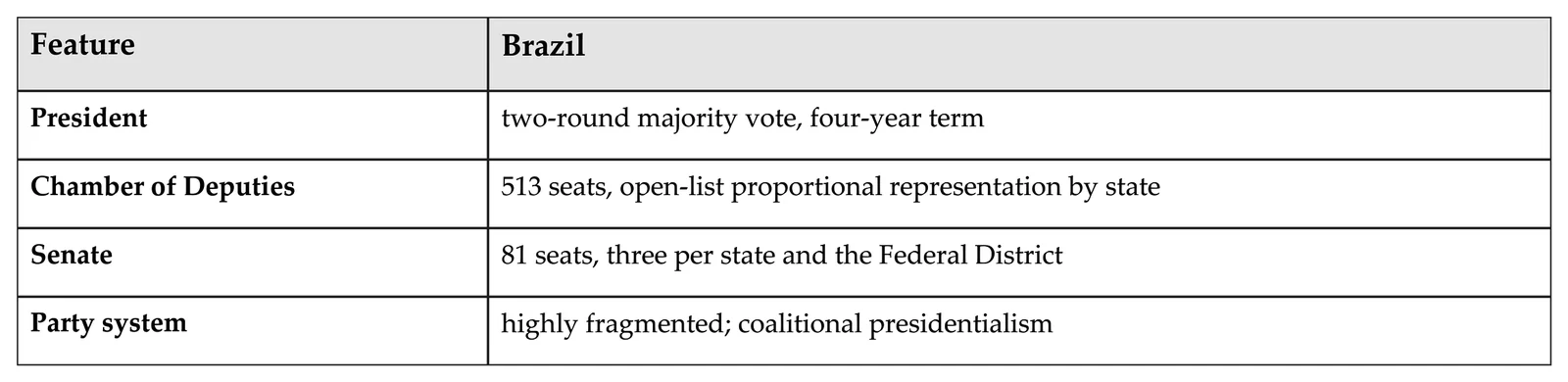
The result is one of the world’s most fragmented party systems, with more than twenty parties in Congress. Major parties include the Workers’ Party (PT, 1980), the PSDB (1988), the MDB and the Liberal Party (PL). Presidents must build broad coalitions, a pattern Sérgio Abranches called coalitional presidentialism, using cabinet posts and budget funds. Reforms since 2017 introduced a performance threshold and banned coalitions in proportional elections to reduce fragmentation.
3.4 The Federal System
Brazil is a federal republic. The 1988 Constitution recognises the Union, the 26 states, the Federal District and the municipalities as autonomous federal entities, making Brazil a three-level federation. States have their own constitutions, elected governors and legislatures, and powerful governors have long shaped national politics. The Constitution decentralised revenues and responsibilities, so states and municipalities deliver much of health care through the unified health system (SUS) and education.

Brazilian federalism faces challenges: deep regional inequality between the richer South and Southeast and the poorer North and Northeast, fiscal crises in states, and tensions between the Union and governors, as during the Covid-19 pandemic. The Fiscal Responsibility Law of 2000 imposed limits on state and municipal spending, an example of recentralisation.
3.5 Important Questions
- Question 1 Trace the political traditions and constitutional development of Brazil.
- Question 2 Examine the relationship between society, economy and the state in Brazil.
- Question 3 Discuss the party and electoral system of Brazil.
- Question 4 Examine the nature of federalism in Brazil.
DU asks the same idea in different words. So learn one broad answer for each question below; the same answer works for every question joined by OR.
Important Question 1
Trace the political traditions and constitutional development of Brazil.
OR
Discuss Brazil’s transition from military rule to democracy and the features of the 1988 Constitution.
OR
Examine the main features of Brazil’s presidential system.
Model Answer
“The sovereignty of the people shall be exercised by universal suffrage and by direct and secret vote, with equal value for all.”
— Constitution of Brazil (1988), Article 14
Introduction. Brazil’s political history has been marked by sharp swings between monarchy and republic, oligarchy and populism, democracy and military rule. Each period left its mark on Brazilian institutions. The Constitution of 1988, adopted after twenty-one years of military dictatorship, created the longest period of democracy in the country’s history. Alfred Montero traces this development.
1. Colonial Legacy
Portugal colonised Brazil from 1500, establishing sugar plantations worked by millions of enslaved Africans. Colonial society was dominated by large landowners, and the Catholic Church and the Crown were central institutions.
2. An Independent Empire
In 1808 the Portuguese royal family fled Napoleon to Rio de Janeiro. In 1822 Pedro I declared Brazil’s independence and became emperor. The 1824 Constitution created a constitutional monarchy with a moderating power that allowed the emperor to arbitrate among other powers. Brazil remained a monarchy until 1889, unlike its republican neighbours.
3. Abolition and the Republic
Brazil abolished slavery in 1888, the last country in the Americas to do so. In 1889 the army overthrew the monarchy and proclaimed a republic. The 1891 Constitution, inspired by the United States, created a federal presidential republic.
4. The Old Republic
From 1889 to 1930, politics was controlled by state oligarchies, especially the coffee planters of São Paulo and the cattle ranchers of Minas Gerais, who alternated the presidency. Local bosses called coronéis delivered votes in rural areas.
5. The Vargas Era
Getúlio Vargas took power in 1930 and established the authoritarian Estado Novo in 1937. He centralised power, promoted industry, created labour laws and organised workers and employers in state-controlled corporatist structures. He returned as an elected president in 1951 and died by suicide in 1954.
6. Democracy, 1946–64
Brazil was a democracy from 1946 to 1964, with elected presidents such as Juscelino Kubitschek, who built the new capital Brasília (1960). Political polarisation over land reform and economic policy rose under President João Goulart.
7. Military Rule, 1964–85
In 1964 the military overthrew Goulart. The regime kept a facade of elections with two permitted parties, but Institutional Act No. 5 (1968) closed Congress, suspended rights and enabled repression. The economy grew rapidly in the economic miracle of 1968–73.
8. Transition to Democracy
From 1974 the military began a slow political opening. Amnesty came in 1979, multiparty politics returned, and the Diretas Já campaign of 1984 demanded direct elections. In 1985 a civilian president took office, and the first direct presidential election was held in 1989.
9. The 1988 Constitution
The Constituent Assembly produced a long Constitution with extensive civil, political and social rights, including universal health care, education, indigenous rights and environmental protection. Its president, Ulysses Guimarães, called it the Citizen Constitution. It has been amended well over a hundred times.
10. Presidentialism
In a 1993 plebiscite, Brazilians chose a republic and presidentialism over monarchy and parliamentarism. The President is head of state and government, elected by two-round majority vote for four years, and may be re-elected once since 1997. The President has strong powers, including provisional measures with the force of law.
11. Congress and Courts
The bicameral National Congress, with the Chamber of Deputies and Senate, legislates and can impeach the President. The Supreme Federal Tribunal is a powerful constitutional court that has intervened in major political disputes.
12. Impeachments and Crises
Fernando Collor resigned during impeachment proceedings in 1992, and Dilma Rousseff was removed in 2016 for budgetary irregularities. The Lava Jato investigations exposed corruption across parties. Lula was jailed in 2018, but his convictions were annulled in 2021, and he won the presidency again in 2022.
13. Democratic Resilience
After the 2022 election, supporters of Jair Bolsonaro attacked Congress, the presidency and the Supreme Court on 8 January 2023. Institutions held, and in 2025 the Supreme Court convicted Bolsonaro of plotting to overturn the election, showing both the threats to and the resilience of Brazilian democracy.
14. Evaluation
Brazil’s constitutional development shows a long struggle to build democratic institutions in an unequal society. The 1988 Constitution has endured, but strong presidents, fragmented parties and corruption continue to test it.
Conclusion. Thus, Brazil moved from colony and empire through oligarchic republic, Vargas’s Estado Novo, democracy and military rule to the democratic Citizen Constitution of 1988, which created a presidential, federal and rights-based democracy that has survived serious crises.
Important Question 2
Examine the relationship between society, economy and the state in Brazil.
OR
Discuss the political economy of inequality in Brazil with reference to Frances Hagopian.
OR
Examine the role of the state in Brazil’s economic development.
Model Answer
“To eradicate poverty and substandard living conditions and to reduce social and regional inequalities.”
— Constitution of Brazil (1988), Article 3, one of the fundamental objectives of the Republic
Introduction. Brazil is a large, diverse and economically important country, but it is also one of the most unequal societies in the world. The Brazilian state has played a leading role in development, from Vargas’s industrialisation to the social programmes of the 2000s. Frances Hagopian examines why inequality has been so persistent and how democratic politics has affected it.
1. Legacy of Slavery
Brazil received more enslaved Africans than any other country in the Americas, and slavery lasted until 1888. Its legacy is visible in racial inequality in income, education, housing and violence.
2. Land and Oligarchy
Large landed estates dominated rural Brazil. Land remained highly concentrated, and the Landless Workers’ Movement (MST), founded in 1984, has campaigned for land reform.
3. Racial Diversity
Brazil long described itself as a racial democracy, but scholars showed persistent discrimination. In the 2022 census, people of mixed race formed the largest group. Affirmative action in universities, upheld by the Supreme Court in 2012, has expanded opportunities for Black and indigenous students.
4. Developmentalism
From the 1930s, Brazilian governments pursued state-led industrialisation through import substitution, tariffs, public enterprises and development banks. Petrobras (1953) and BNDES (1952) became central institutions. Industry grew rapidly, but inequality widened.
5. Military Growth Model
The military regime promoted rapid growth in the economic miracle of 1968–73, financed by foreign borrowing, but wages for the poor lagged. The debt crisis of the 1980s brought stagnation and hyperinflation.
6. Stabilisation and Reform
The Plano Real of 1994, designed under Fernando Henrique Cardoso, ended hyperinflation. Cardoso’s presidency (1995–2002) privatised state firms and opened the economy while beginning social programmes.
7. The PT Era
Under Lula (2003–10) and Dilma Rousseff, the Workers’ Party expanded social policies. Bolsa Família, launched in 2003, gave cash transfers to poor families on condition that children attend school and receive health checks. Real minimum wage increases raised incomes.
8. Falling Inequality
Hagopian shows that inequality fell significantly in the 2000s, thanks to minimum wage rises, cash transfers, expanded education and a commodity boom. Democratic competition gave politicians incentives to serve poor voters. Poverty fell sharply, and in 2014 the UN’s Food and Agriculture Organization removed Brazil from its Hunger Map.
9. Persistent Inequality
Yet inequality remains high. Hagopian points to a regressive tax system based on consumption taxes, generous pensions for public employees, a large informal labour market, unequal education and regional gaps between the Northeast and the South.
10. Recession and Reaction
A deep recession in 2015–16, corruption scandals and the impeachment of Rousseff ended the PT era. A constitutional amendment of 2016 capped public spending, and pension reform followed in 2019. Jair Bolsonaro’s presidency (2019–22) pursued market reforms and conservative social policies.
11. Clientelism and Corporatism
Brazilian politics has long relied on clientelism, the exchange of favours for votes, and on corporatist links between the state and organised groups established under Vargas. These patterns shape how the state distributes resources.
12. Violence and Insecurity
High rates of violent crime, especially in poor urban areas, and police violence reflect and reinforce inequality, and they have shaped political debates, contributing to support for tough-on-crime candidates.
13. Nature of the State
The Brazilian state is a democratic developmental state with extensive social rights, a large public sector and a strong role in the economy. But its capacity is uneven, and it is constrained by fiscal pressures, clientelism and powerful interests.
14. Pensions and the Fiscal State
Brazil has long spent an unusually large share of national income on pensions, with generous terms for public employees that benefit the better-off. The 2019 pension reform set minimum retirement ages of 65 for men and 62 for women and reduced some privileges. Hagopian’s analysis suggests that such reforms are central to the politics of inequality, because they decide who gains from public spending.
15. Evaluation
Brazil shows how democracy can reduce inequality through social policy, but also how deep historical inequalities, embedded in taxes, land and labour markets, are hard to change.
Conclusion. Thus, Brazil’s society bears the legacy of slavery and land concentration. Its state led development through industrialisation and later reduced inequality through social programmes such as Bolsa Família, but as Hagopian shows, inequality persists because of deep structural and political causes.
Important Question 3
Discuss the party and electoral system of Brazil.
OR
What is coalitional presidentialism? Examine its working in Brazil.
OR
Why is Brazil’s party system highly fragmented?
Model Answer
“The Federative Republic of Brazil … is founded on: sovereignty; citizenship; the dignity of the human person; the social values of labour and of the free enterprise; political pluralism.”
— Constitution of Brazil (1988), Article 1
Introduction. Brazil combines a directly elected President with a Congress elected by open-list proportional representation. This combination has produced one of the most fragmented party systems in the world and a distinctive style of governance known as coalitional presidentialism. Understanding this system is key to understanding Brazilian politics.
1. Presidential Elections
The President is elected by direct popular vote for four years. If no candidate wins an absolute majority, a run-off is held between the top two. Lula won the 2022 run-off with about 50.9 per cent against Jair Bolsonaro.
2. Chamber of Deputies
The 513 deputies are elected by open-list proportional representation in each state. Voters can vote for an individual candidate, and seats are allocated to parties by their total vote, then to their most-voted candidates. Each state has between 8 and 70 deputies, which over-represents small states.
3. The Senate
The Senate has 81 members, three for each state and the Federal District, elected by plurality for eight-year terms, with one-third and two-thirds renewed alternately every four years.
4. Compulsory and Electronic Voting
Voting is compulsory for literate citizens aged 18 to 70 and optional for those aged 16 and 17, the elderly and the illiterate. Brazil introduced electronic voting machines in 1996, allowing rapid counting.
5. Fragmentation
Open-list PR with large districts, few barriers to entry and the absence of a national threshold produced extreme fragmentation. After the 2018 election, thirty parties held seats in the Chamber of Deputies, one of the highest numbers in any democracy.
6. Weak Parties
Because voters choose individual candidates, deputies build personal reputations and rely on local networks, and many switch parties. Parties are often weak and centred on leaders, with the Workers’ Party a notable exception as a programmatic, organised party.
7. Main Parties
The Workers’ Party (PT), founded in 1980 from trade unions and social movements and led by Lula, is the main left party. The PSDB, founded in 1988, led governments under Cardoso. The MDB, heir to the official opposition under military rule, is a large centrist party, and the Liberal Party (PL) became the vehicle of Bolsonaro’s right.
8. Coalitional Presidentialism
Sérgio Abranches coined the term coalitional presidentialism (1988) to describe how Brazilian presidents, whose parties never hold a majority, build broad multiparty coalitions in Congress, distributing cabinet posts and budget amendments to allied parties.
9. Does It Work
Political scientists such as Argelina Figueiredo and Fernando Limongi showed that presidents often succeed in passing legislation, thanks to agenda powers and party leaders’ control. Yet the system encourages patronage and has been linked to corruption scandals such as the Mensalão (2005) and Lava Jato.
10. Impeachment and Coalitions
When coalitions collapse, presidents become vulnerable. Dilma Rousseff lost her coalition partners and was impeached in 2016, showing how coalitional presidentialism can produce instability.
11. Reforms
Constitutional changes in 2017 introduced a performance threshold for parties to receive public funds and broadcasting time, and banned electoral coalitions in proportional elections from 2020. Parties may form federations that must last for four years. The number of parties in Congress fell after 2022.
12. Polarisation
Recent elections have polarised voters between Lula’s PT and Bolsonaro’s right, organised around corruption, security, religion and economic policy. Evangelical Christians have become an important political force.
13. Comparison
Unlike the two-party systems of the UK and USA, Brazil’s system combines presidentialism with extreme multipartism, a combination that Juan Linz and Scott Mainwaring considered especially difficult for democracy.
14. Evaluation
Brazil’s electoral system ensures broad representation but produces fragmentation and weak parties. Coalitional presidentialism has allowed governance but at the cost of patronage and periodic crises.
Conclusion. Thus, Brazil elects its President by two-round majority and its Chamber by open-list PR, producing a highly fragmented, candidate-centred party system. Presidents govern through coalitional presidentialism, which has enabled governance but fostered patronage and instability, prompting recent reforms.
Important Question 4
Examine the nature of federalism in Brazil.
OR
Discuss the role of states and municipalities in Brazil’s federal system.
OR
‘Brazil is a three-level federation.’ Discuss.
Model Answer
“The political and administrative organization of the Federative Republic of Brazil comprises the Union, the states, the Federal District and the municipalities, all of them autonomous.”
— Constitution of Brazil (1988), Article 18
Introduction. Brazil is one of the world’s major federations, covering a vast territory with sharp regional differences. Its federalism has alternated between periods of decentralisation and centralisation. The 1988 Constitution created a distinctive three-level federation by recognising municipalities as federal entities alongside the Union and the states.
1. Origins of Federalism
The 1891 republican Constitution, modelled on the United States, transformed the provinces of the empire into states with considerable autonomy. During the Old Republic, powerful states such as São Paulo and Minas Gerais dominated national politics in what was called the politics of the governors.
2. Centralisation under Vargas and the Military
Vargas’s Estado Novo centralised power, appointing state governors. The military regime also centralised taxation and control, though it kept elections for some offices. Each authoritarian period reduced the autonomy of states.
3. Decentralisation in 1988
The 1988 Constitution reacted against centralisation by decentralising revenues and responsibilities to states and municipalities, which received larger shares of federal taxes through transfer funds.
4. The Union
The Union is responsible for defence, foreign affairs, currency, major taxes and national laws on many subjects. The President and Congress dominate national policy, and federal transfers give the Union leverage over other levels.
5. The States
Brazil has 26 states and the Federal District. Each state has its own constitution, an elected governor and a unicameral legislature. States are responsible for policing, secondary education, health services and some taxes, notably a state tax on goods and services.
6. Municipalities
Brazil has over 5,500 municipalities, each with an elected mayor and council. Their recognition as autonomous federal entities in 1988 is unusual among federations. They run primary education, basic health care and local services. Many small municipalities, however, depend almost entirely on transfers from the Union and the states.
7. Cooperative Policies
Many policies are shared among all three levels. The unified health system (SUS) provides universal health care through federal, state and municipal cooperation, and education funding is pooled through national funds for basic education.
8. Powerful Governors
Governors are important political actors who control state resources and influence their states’ deputies in Congress. Presidents must negotiate with them to pass legislation, a feature of Brazilian coalitional politics. Governors also command the state military police, giving them a central role in public security.
9. Fiscal Problems and Recentralisation
In the 1990s, many states fell into debt crises, and the Union renegotiated their debts in exchange for fiscal discipline. The Fiscal Responsibility Law of 2000 limited spending and borrowing by states and municipalities, strengthening central control.
10. Regional Inequality
Brazil has deep regional inequalities: the South and Southeast are richer and more industrial, the North and Northeast poorer. Federal transfers aim to reduce these gaps, but they persist.
11. Federalism and the Pandemic
During Covid-19, President Bolsonaro opposed lockdowns, while many governors imposed restrictions. The Supreme Court upheld the authority of states and municipalities to act, showing federalism as a check on central power.
12. Amazon and Indigenous Lands
Federal responsibility for indigenous lands and the Amazon environment creates tensions with states that favour agricultural expansion, making environmental governance a federal issue of global importance.
13. Comparison
Like the United States, Brazil has strong states with their own constitutions, but unlike it, municipalities are constitutional units and fiscal transfers play a much larger role. Like India, Brazil faces large regional disparities.
14. Evaluation
Brazilian federalism balances national unity with regional diversity through three levels of government. Decentralisation has empowered states and municipalities, but fiscal dependence and inequality limit their autonomy.
Conclusion. Thus, Brazil is a three-level federation of the Union, 26 states and the Federal District, and over 5,500 municipalities. The 1988 Constitution decentralised power after military rule, but fiscal crises, recentralisation and regional inequality continue to shape Brazilian federalism.
Short Notes
(a) Coalitional presidentialism
Sérgio Abranches’s term (1988) for Brazil’s system, in which a directly elected President, whose party lacks a majority in a fragmented Congress, governs by building broad multiparty coalitions through cabinet posts, budget resources and negotiation.
(b) Bolsa Família
A conditional cash transfer programme launched in 2003 under Lula. Poor families receive monthly payments if their children attend school and receive health check-ups. It reached about a quarter of Brazil’s population and helped reduce poverty and inequality, inspiring similar programmes elsewhere.
(c) Estado Novo
The ‘New State’, the authoritarian regime of Getúlio Vargas from 1937 to 1945. It centralised power, abolished parties and Congress, promoted industrialisation and created labour laws and corporatist structures linking workers and employers to the state.
(d) Citizen Constitution
The name given to Brazil’s Constitution of 1988, drafted after military rule with broad popular participation. It guarantees extensive civil, political and social rights, including universal health care, and established Brazil’s current democratic and federal system.
(e) Lava Jato
‘Operation Car Wash’, a corruption investigation begun in 2014 into kickbacks on contracts with the state oil company Petrobras. It led to the conviction of many politicians and business leaders, including Lula, whose convictions were later annulled. Praised for fighting impunity, it was criticised for political bias after leaked messages in 2019, and it was wound down in 2021.
More notes: DSC-17 Comparative Political Systems
These notes are prepared by PADHO TO AISE for study help. They are not an official University of Delhi publication.