
Semester VI DSC-17 Comparative Political Systems
Unit II · 21 min read · Updated 24 Nov 2026
As per the University of Delhi (DU) BA (Hons) Political Science syllabus
Contents
- 2.1 Political Traditions and Constitutional Development
- 2.2 Society and Economy: Nature of the State
- 2.3 Party and Electoral System
- 2.4 The Federal System
- 2.5 Important Questions
- Discuss the political traditions and salient features of the Constitution of the United States.
- Examine the relationship between society, economy and the nature of the American state.
- Discuss the party and electoral system of the United States.
- Discuss the nature and evolution of federalism in the United States.
- Short Notes
महत्वाकांक्षा का मुकाबला महत्वाकांक्षा से कराया जाना चाहिए।
Ambition must be made to counteract ambition.
— James Madison, The Federalist No. 51 (1788)
THE United States has the oldest written national constitution still in force, drafted in Philadelphia in 1787. Its founders, fearing tyranny, divided power between three branches of government and between the national government and the states. The result is a presidential system with separation of powers, checks and balances and federalism, quite different from the British parliamentary model. This unit studies American political traditions and constitutional development, its society and economy and the nature of the American state, its party and electoral system, and its federal system. The readings include Louis DeSipio, John Geer and colleagues, and Robert Singh, along with O’Neil, McCormick and Powell.

2.1 Political Traditions and Constitutional Development
The American colonies declared independence from Britain in 1776, proclaiming that all men are created equal and endowed with unalienable rights. The first national government under the Articles of Confederation (1781) was too weak, so delegates met at Philadelphia in 1787 and drafted a new Constitution. The Great Compromise gave states equal representation in the Senate and representation by population in the House. The Federalist Papers, written by Alexander Hamilton, James Madison and John Jay, defended it, and the Bill of Rights (1791) added the first ten amendments protecting liberties.

The Constitution rests on popular sovereignty, limited government, separation of powers among Congress, the President and the courts, checks and balances, federalism and judicial review, established in Marbury v. Madison (1803). The Civil War (1861–65) led to the 13th, 14th and 15th Amendments, abolishing slavery, guaranteeing equal protection and protecting the vote regardless of race. Later amendments gave women the vote (1920) and lowered the voting age to eighteen (1971). The Constitution is rigid: amendments need two-thirds of both houses and ratification by three-quarters of the states.
2.2 Society and Economy: Nature of the State
The United States is a nation of immigrants, with great religious, racial and ethnic diversity. Alexis de Tocqueville, in Democracy in America (1835–40), admired its equality of conditions and civic associations, while Louis Hartz argued that America had a single liberal tradition of individual rights and limited government. Yet American history was also shaped by slavery, segregation and the struggle for civil rights, from Brown v. Board of Education (1954) to the Civil Rights Act (1964) and Voting Rights Act (1965).
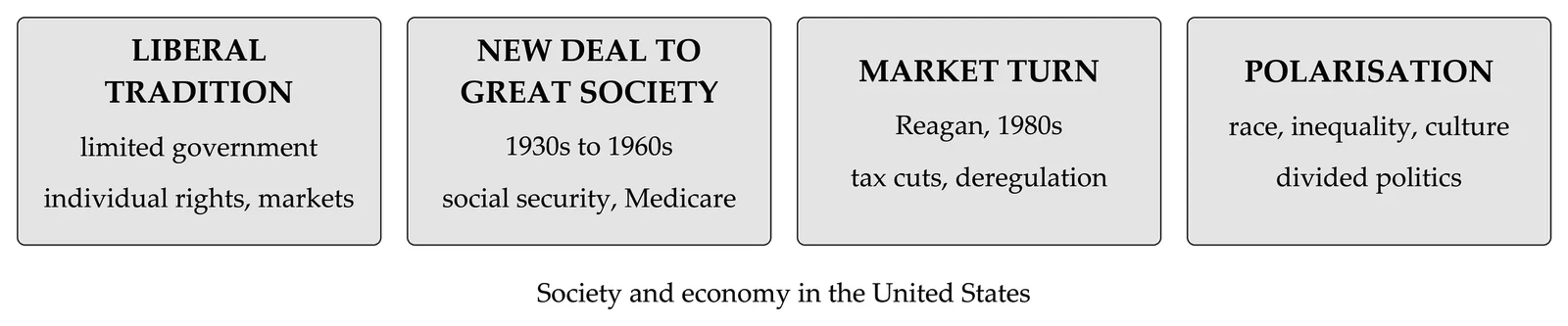
The United States has the world’s largest economy, a liberal market economy with a limited welfare state. Franklin Roosevelt’s New Deal in the 1930s created Social Security, and Lyndon Johnson’s Great Society added Medicare and Medicaid in 1965. From the 1980s, Ronald Reagan cut taxes and regulation. Louis DeSipio highlights rising inequality, immigration debates and deep polarisation between Democrats and Republicans, seen in conflicts over race, abortion, guns and the 2020 election, followed by the attack on the Capitol on 6 January 2021.
2.3 Party and Electoral System
American politics is dominated by two parties: the Democratic Party, whose roots go back to Jefferson and Andrew Jackson, and the Republican Party, founded in 1854 against the spread of slavery. Elections use single-member districts and plurality voting, which favour two parties. Candidates are chosen through primaries and caucuses, which became central after reforms in the 1970s, so parties are weaker and more decentralised than in Britain. Third parties, such as Ross Perot’s campaign in 1992, rarely win.
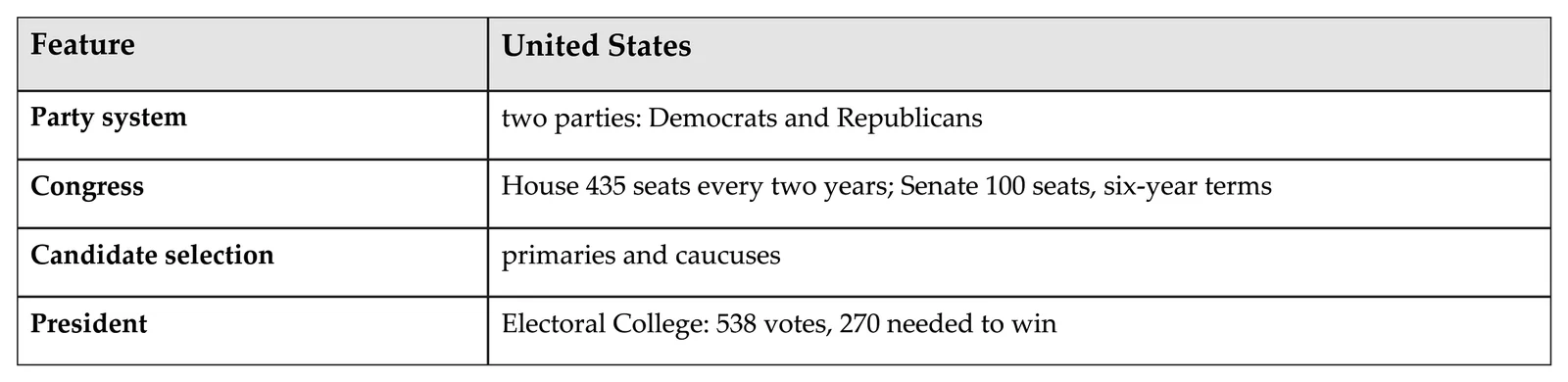
The President is chosen by the Electoral College: each state has electors equal to its members of Congress, and almost all states award all their electors to the candidate who wins the state. A candidate needs 270 of 538 votes. In 2000 and 2016, the winner lost the national popular vote. Campaign finance is largely unregulated in practice since Citizens United v. FEC (2010) allowed unlimited independent spending through super PACs. Gerrymandering of districts and the Senate filibuster also shape outcomes.
2.4 The Federal System
The United States is a federation of 50 states. The Constitution grants Congress enumerated powers, such as taxation, defence and regulating commerce among the states, and the Tenth Amendment reserves other powers to the states or the people. The supremacy clause makes federal law supreme. States control most criminal law, education, elections and local government. In McCulloch v. Maryland (1819), the Supreme Court gave Congress broad implied powers.

Federalism has evolved from dual federalism, with separate spheres, to cooperative federalism after the New Deal, when the national government expanded through grants and regulation, described by Morton Grodzins as a marble cake. Presidents Nixon and Reagan promoted a new federalism returning powers to states. The Supreme Court continues to shape the balance, as in Dobbs v. Jackson Women’s Health Organization (2022), which returned abortion law to the states.
2.5 Important Questions
- Question 1 Discuss the political traditions and salient features of the Constitution of the United States.
- Question 2 Examine the relationship between society, economy and the nature of the American state.
- Question 3 Discuss the party and electoral system of the United States.
- Question 4 Discuss the nature and evolution of federalism in the United States.
DU asks the same idea in different words. So learn one broad answer for each question below; the same answer works for every question joined by OR.
Important Question 1
Discuss the political traditions and salient features of the Constitution of the United States.
OR
Examine the principle of separation of powers and checks and balances in the US Constitution.
OR
Trace the constitutional development of the United States.
Model Answer
“We the People of the United States, in Order to form a more perfect Union … do ordain and establish this Constitution for the United States of America.”
— Constitution of the United States, Preamble (1787)
Introduction. The Constitution of the United States, drafted in 1787, is the oldest written national constitution in force. It created a republic based on popular sovereignty and limited government, and its system of separation of powers, checks and balances and federalism has influenced constitution-makers across the world. Its development since 1787 reflects struggles over slavery, rights and the role of government.
1. Revolutionary Origins
The American Revolution was a revolt against British rule in the name of rights and self-government. The Declaration of Independence (1776), drafted by Thomas Jefferson, proclaimed that all men are created equal and endowed with unalienable rights to life, liberty and the pursuit of happiness, and that governments derive their just powers from the consent of the governed.
2. The Articles of Confederation
The first national government under the Articles of Confederation (1781) was a loose league of sovereign states. Congress could not tax or regulate commerce, and the states quarrelled. Shays’ Rebellion (1786–87) convinced many leaders that a stronger national government was needed.
3. The Philadelphia Convention
Delegates met in Philadelphia in 1787. The Virginia Plan favoured representation by population, the New Jersey Plan equal representation of states. The Great Compromise created a House based on population and a Senate with two members per state. A notorious compromise counted three-fifths of enslaved people for representation.
4. Ratification and the Federalist
Hamilton, Madison and Jay wrote The Federalist Papers to persuade New York to ratify. Madison argued that a large republic with many factions and divided powers would protect liberty. Anti-Federalists feared a strong central government, and their pressure led to the Bill of Rights.
5. A Written and Rigid Constitution
The Constitution is a short written document of seven articles and 27 amendments. It is rigid: amendments require a two-thirds vote in both houses of Congress and ratification by three-quarters of the states, which is why it has been amended only 27 times.
6. Separation of Powers
Legislative power is vested in Congress, executive power in the President and judicial power in the Supreme Court and lower courts. Members of each branch are chosen separately and cannot serve in another, unlike the British fusion of powers.
7. Checks and Balances
Each branch checks the others: the President can veto bills, Congress can override with two-thirds majorities, the Senate confirms appointments and ratifies treaties, Congress can impeach and remove officials, and courts can review laws. Madison argued that ambition must be made to counteract ambition.
8. Federalism
Power is divided between the national government and the states. The Constitution lists the powers of Congress and reserves the rest to the states, creating two levels of government each with its own sphere.
9. Judicial Review
In Marbury v. Madison (1803), Chief Justice John Marshall established that courts can strike down laws that conflict with the Constitution. Judicial review made the Supreme Court a powerful guardian and interpreter of the Constitution.
10. Bill of Rights
The first ten amendments (1791) protect freedom of religion, speech, press and assembly, the right to bear arms, due process, fair trial and protection from cruel punishment. The Fourteenth Amendment (1868) later extended many of these protections against the states.
11. Civil War Amendments
After the Civil War, the Thirteenth Amendment (1865) abolished slavery, the Fourteenth (1868) guaranteed citizenship and equal protection, and the Fifteenth (1870) prohibited racial discrimination in voting, though Southern states evaded it until the Voting Rights Act of 1965.
12. Growth of Presidential Power
The presidency has grown far beyond the founders’ design, especially in foreign affairs and through executive orders. Arthur Schlesinger warned of an imperial presidency in 1973. Impeachment has been used against Andrew Johnson, Bill Clinton and Donald Trump, though none was removed.
13. Living Constitution
The Constitution has adapted through judicial interpretation as well as amendment. Debates between originalists, who seek the original meaning, and those who see a living constitution shape the Supreme Court’s decisions on rights and powers.
14. Evaluation
The US Constitution has provided stability and protected liberty for over two centuries. Its divided powers prevent tyranny but can also produce gridlock, and its compromises on slavery show that its democratic promise was realised only through long struggles.
Conclusion. Thus, the US Constitution emerged from the Revolution and the Philadelphia Convention as a written, rigid constitution based on popular sovereignty, separation of powers, checks and balances, federalism, judicial review and the Bill of Rights, and it has developed through amendment, interpretation and struggle.
Important Question 2
Examine the relationship between society, economy and the nature of the American state.
OR
‘America has a liberal tradition and a limited welfare state.’ Discuss.
OR
Discuss the role of race, inequality and polarisation in American politics.
Model Answer
“The great advantage of the Americans is that they have arrived at a state of democracy without having to endure a democratic revolution; and that they are born equal, instead of becoming so.”
— Alexis de Tocqueville, Democracy in America (1840)
Introduction. American society and economy have shaped a distinctive kind of state: a liberal democracy with a strong market economy, limited welfare provision and a powerful tradition of individual rights. At the same time, race, immigration and inequality have created deep divisions. Tocqueville, Hartz and DeSipio offer different perspectives on this relationship.
1. Tocqueville’s America
Alexis de Tocqueville visited the United States in 1831 and wrote Democracy in America. He admired the equality of conditions, local self-government and the habit of forming voluntary associations, but warned of the tyranny of the majority and the dangers of individualism.
2. The Liberal Tradition
Louis Hartz, in The Liberal Tradition in America (1955), argued that America, lacking a feudal past, developed a consensus around Lockean liberalism: individual rights, private property and limited government. This helps explain the weakness of socialism in America.
3. A Nation of Immigrants
Waves of immigration from Europe, Asia and Latin America made the United States highly diverse. Debates over immigration, from the restrictions of the 1920s to current controversies over undocumented migrants, remain central, as DeSipio notes.
4. Race and Slavery
Slavery and racial segregation contradicted America’s liberal creed. After emancipation, Jim Crow laws in the South denied African Americans equal rights. The civil rights movement led by Martin Luther King Jr. won the Civil Rights Act (1964) and Voting Rights Act (1965), but racial inequality persists.
5. A Market Economy
The United States has the world’s largest economy, based on private enterprise, innovation and finance. Peter Hall and David Soskice classify it as a liberal market economy, in which firms coordinate mainly through markets rather than through organised labour and state bargaining.
6. The New Deal
The Great Depression led Franklin Roosevelt’s New Deal of the 1930s to create Social Security, regulate banks, protect trade unions and build public works. The federal government became responsible for economic stability and basic welfare.
7. The Great Society
Lyndon Johnson’s Great Society in the 1960s declared a war on poverty and created Medicare for the elderly and Medicaid for the poor in 1965, along with civil rights laws and aid to education.
8. The Market Turn
From the 1980s, Ronald Reagan argued that government was the problem, cutting taxes, reducing regulation and challenging unions. Later administrations debated the size of government, with Barack Obama’s Affordable Care Act (2010) expanding health coverage.
9. A Limited Welfare State
Gøsta Esping-Andersen described the United States as a liberal welfare regime, with modest, means-tested benefits and reliance on private insurance and employers. Unlike most rich democracies, it lacks universal public health care.
10. Inequality
Income and wealth inequality have risen sharply since the 1970s. Stagnant wages for many workers, the decline of manufacturing and the concentration of wealth at the top have fuelled political discontent on both left and right.
11. Polarisation
Democrats and Republicans have become deeply polarised over race, immigration, abortion, guns, climate and the role of government. Polarisation has led to gridlock in Congress, contested elections and the attack on the Capitol on 6 January 2021.
12. Religion and Culture
The United States is more religious than most rich democracies, and evangelical Christians form an important part of the Republican coalition. Culture wars over abortion, sexuality and education have become central to politics, especially after the Dobbs decision (2022).
13. Nature of the American State
The American state is a liberal democratic, capitalist state with fragmented institutions and limited welfare. It is powerful abroad and in regulating the economy, but its domestic social role is smaller than in Europe.
14. Evaluation
American society’s liberal tradition, diversity and market economy have produced a dynamic but unequal democracy. Persistent racial divisions and polarisation challenge the ideals of equality and consensus that Tocqueville and Hartz described.
Conclusion. Thus, the American state reflects a liberal tradition of individual rights and limited government, a powerful market economy and a limited welfare state built by the New Deal and Great Society. Race, inequality and polarisation remain central challenges to American democracy.
Important Question 3
Discuss the party and electoral system of the United States.
OR
Why does the United States have a two-party system?
OR
Examine the method of electing the President of the United States.
Model Answer
“Let me … warn you in the most solemn manner against the baneful effects of the spirit of party generally.”
— George Washington, Farewell Address (1796)
Introduction. Although George Washington warned against parties, American politics soon organised around them. Today two parties, the Democrats and the Republicans, dominate elections at every level. The American electoral system, with its single-member districts, primaries and Electoral College, shapes this two-party system and gives American elections a distinctive character.
1. Origins of Parties
The first parties formed in the 1790s: Hamilton’s Federalists, who favoured a strong national government, and Jefferson’s Democratic-Republicans. Andrew Jackson’s Democratic Party emerged in the 1820s, and the Republican Party was founded in 1854 to oppose the spread of slavery, winning the presidency with Abraham Lincoln in 1860.
2. The Democratic Party
The Democrats became the party of the New Deal coalition from 1932, uniting workers, immigrants, Southern whites and later African Americans. Today they support a larger role for government in welfare, regulation, civil rights and climate policy.
3. The Republican Party
The Republicans became the party of business, lower taxes and smaller government. After the civil rights laws of the 1960s, the South shifted towards them. Today they emphasise tax cuts, conservative social values, gun rights and, under Donald Trump, restrictions on immigration and trade protection.
4. Why Two Parties
Plurality elections in single-member districts, as Duverger’s law predicts, discourage third parties. The Electoral College’s winner-take-all rules, ballot access laws and the absence of public funding for small parties reinforce two-party dominance.
5. Third Parties
Third parties occasionally influence outcomes: Ross Perot won 19 per cent of the popular vote in 1992 but no electoral votes, and Ralph Nader’s votes in 2000 may have affected the result in Florida. They rarely win offices.
6. Weak and Decentralised Parties
American parties are less disciplined than British ones. Members of Congress often vote independently, candidates raise their own money and party organisations are decentralised among states and localities.
7. Primaries and Caucuses
Since reforms in the early 1970s, presidential candidates are chosen mainly through state primaries and caucuses, in which voters select delegates to national conventions. Primaries give voters power but can favour candidates with strong appeal to activists.
8. Congressional Elections
All 435 members of the House are elected every two years from single-member districts. One-third of the 100 senators are elected every two years for six-year terms, two from each state. Midterm elections often go against the President’s party.
9. The Electoral College
The President is elected indirectly. Each state has electors equal to its total members of Congress, and the District of Columbia has three, making 538. In almost every state, the winner of the popular vote takes all electors. A candidate needs 270 to win.
10. Criticisms of the Electoral College
In 2000 and 2016, the candidate with fewer popular votes won the presidency. Critics argue that the system focuses campaigns on a few swing states and over-represents small states; defenders say it protects federalism.
11. Money in Elections
American elections are extremely expensive. In Citizens United v. FEC (2010), the Supreme Court held that independent political spending by corporations and unions is protected speech, leading to super PACs that raise unlimited sums.
12. Districts and Voting Rules
State legislatures draw House districts, often engaging in gerrymandering to favour their party. Voting rules, such as identification requirements and registration, vary by state and are fiercely contested.
13. Polarisation of Parties
Since the 1990s, the two parties have become ideologically distinct and polarised, with fewer moderates. This has increased party unity in Congress but also gridlock, especially under divided government.
14. Evaluation
The American party and electoral system produces stable two-party competition and gives voters a direct role in choosing candidates. But the Electoral College, money and gerrymandering raise questions about representation and equality.
Conclusion. Thus, the US has a two-party system of Democrats and Republicans, sustained by plurality elections and the Electoral College. Parties are decentralised, candidates are chosen through primaries, and debates continue over the Electoral College, campaign finance and gerrymandering.
Important Question 4
Discuss the nature and evolution of federalism in the United States.
OR
Distinguish between dual federalism and cooperative federalism in the USA.
OR
Examine the role of the Supreme Court in shaping American federalism.
Model Answer
“The powers not delegated to the United States by the Constitution, nor prohibited by it to the States, are reserved to the States respectively, or to the people.”
— Constitution of the United States, Tenth Amendment (1791)
Introduction. The United States was the first modern federation. Its founders combined a stronger national government with the continued existence of the states, dividing sovereignty between them. American federalism has evolved significantly, through constitutional interpretation, civil war, economic crises and political change.
1. Meaning of Federalism
Federalism divides power between a national government and regional governments, each with its own sphere of authority guaranteed by a constitution. In the United States, both levels act directly on citizens.
2. Constitutional Basis
Article I, Section 8 lists the enumerated powers of Congress, including taxation, defence, currency and regulating interstate commerce, and adds a necessary and proper clause. The Tenth Amendment reserves other powers to the states, and Article VI makes federal law supreme.
3. Powers of the States
States control most criminal and civil law, education, policing, elections, marriage, local government and many public services. Each state has its own constitution, governor, legislature and courts.
4. McCulloch v. Maryland
In McCulloch v. Maryland (1819), Chief Justice Marshall held that Congress had implied powers to create a national bank under the necessary and proper clause, and that states could not tax it. This strengthened the national government.
5. States’ Rights and the Civil War
Southern states invoked states’ rights to defend slavery and claimed the right to secede. The Civil War (1861–65) settled that the Union is permanent, and the Fourteenth Amendment allowed federal protection of rights against the states.
6. Dual Federalism
Until the 1930s, American federalism was largely dual, with separate spheres for national and state governments, often described as a layer cake. Courts limited federal regulation of the economy.
7. Cooperative Federalism
The New Deal expanded federal power through grants, regulation and programmes run jointly with states. Morton Grodzins described this cooperative federalism as a marble cake, with mixed responsibilities. The Supreme Court accepted broad federal power under the commerce clause.
8. Grants-in-aid
Federal grants to states for highways, education, health and welfare became a major tool. Conditions attached to grants allowed Washington to influence state policy, a pattern called fiscal federalism. Unfunded mandates, requirements imposed on states without money to pay for them, became a major grievance, leading Congress to pass the Unfunded Mandates Reform Act of 1995.
9. Civil Rights and Federal Power
In the 1950s and 1960s, federal courts and laws overrode state segregation laws, as in Brown v. Board of Education (1954) and the Civil Rights Act (1964). Federal power was used to protect the rights of citizens against discriminatory states.
10. New Federalism
Presidents Nixon and Reagan promoted a new federalism, returning responsibilities and block grants to the states. The Supreme Court in United States v. Lopez (1995) limited the commerce power for the first time in decades.
11. Recent Developments
In NFIB v. Sebelius (2012), the Court limited federal power to force states to expand Medicaid. In Dobbs (2022), it returned the regulation of abortion to the states, producing very different laws across the country.
12. Laboratories of Democracy
Justice Louis Brandeis described states as laboratories of democracy that can experiment with new policies. States have pioneered policies on welfare, marriage, environment and drugs before national adoption.
13. Comparison with India
Unlike India’s federation with a strong centre, emergency powers and an integrated judiciary, American federalism gives states greater autonomy, separate constitutions and courts, and equal representation in the Senate.
14. Local Government
Below the states lie counties, cities, towns, school districts and special districts, about ninety thousand local governments in all. They are created by the states and have no independent constitutional status, but they run schools, police, water and land use. Their number and variety make American government highly fragmented, giving citizens many points of access but also creating inequalities between rich and poor areas.
15. Evaluation
American federalism has balanced unity and diversity, though the balance has shifted towards the national government. Its flexibility has allowed adaptation, but disputes between Washington and the states remain central to American politics.
Conclusion. Thus, American federalism divides power between the national government and fifty states. It evolved from dual federalism to cooperative federalism and new federalism, shaped by the Supreme Court, the Civil War, the New Deal and civil rights, and continues to be contested.
Short Notes
(a) Checks and balances
The system by which each branch of the American government can limit the others: the presidential veto, congressional override, Senate confirmation of appointments and treaties, impeachment, and judicial review. It was designed by the framers, especially Madison, to prevent any branch from becoming tyrannical.
(b) Electoral College
The body that formally elects the US President. Each state has electors equal to its representatives plus senators, and DC has three, totalling 538. Most states award all electors to the statewide winner, so a candidate can win the presidency without winning the national popular vote, as in 2000 and 2016.
(c) Judicial review
The power of courts to declare laws and executive actions unconstitutional. Not mentioned explicitly in the Constitution, it was established by Chief Justice John Marshall in Marbury v. Madison (1803) and made the Supreme Court a central political institution.
(d) Cooperative federalism
The model of federalism, dominant since the New Deal, in which national and state governments share responsibilities and work together through grants-in-aid and joint programmes. Morton Grodzins compared it to a marble cake, in contrast to the layer cake of dual federalism.
More notes: DSC-17 Comparative Political Systems
These notes are prepared by PADHO TO AISE for study help. They are not an official University of Delhi publication.