
Semester VI DSC-17 Comparative Political Systems
Unit I · 22 min read · Updated 24 Nov 2026
As per the University of Delhi (DU) BA (Hons) Political Science syllabus
Contents
- 1.1 Political Traditions and Constitutional Development
- 1.2 Society and Economy: Nature of the State
- 1.3 Party and Electoral System
- 1.4 A Unitary State with Devolution
- 1.5 Important Questions
- Discuss the political traditions and main features of the British constitution.
- Examine the relationship between society, economy and the nature of the British state.
- Discuss the party and electoral system of the United Kingdom.
- Is the United Kingdom a unitary state? Discuss the nature and impact of devolution.
- Short Notes
अंग्रेज़ी संविधान का कुशल रहस्य कार्यपालिका और विधायी शक्तियों के घनिष्ठ मेल, लगभग पूर्ण संलयन, में है।
The efficient secret of the English Constitution may be described as the close union, the nearly complete fusion, of the executive and legislative powers.
— Walter Bagehot, The English Constitution (1867)
THE United Kingdom of Great Britain and Northern Ireland is the classic model of parliamentary democracy, often called the Westminster model, which India and many other Commonwealth countries adapted. Its constitution is uncodified, developed over eight centuries through statutes, judicial decisions and conventions rather than written in a single document. Its central principle is parliamentary sovereignty. This unit studies Britain’s political traditions and constitutional development, its society and economy and the changing nature of the British state, its party and electoral system, and its character as a unitary state with devolution. The readings include Peter Rutland, Joel Krieger and Duncan Watts, along with Patrick O’Neil, John McCormick and G. Bingham Powell.

1.1 Political Traditions and Constitutional Development
Britain’s constitution evolved gradually. Magna Carta (1215) limited royal power; the Glorious Revolution of 1688 and the Bill of Rights (1689) established the supremacy of Parliament over the Crown; the Reform Acts of 1832, 1867 and 1884 widened the franchise, and women gained the vote in 1918 and on equal terms in 1928; the Parliament Acts of 1911 and 1949 limited the House of Lords. The constitution is uncodified: its sources are statutes, common law, conventions and authoritative works such as A.V. Dicey’s Introduction to the Study of the Law of the Constitution (1885) and Walter Bagehot’s The English Constitution (1867).
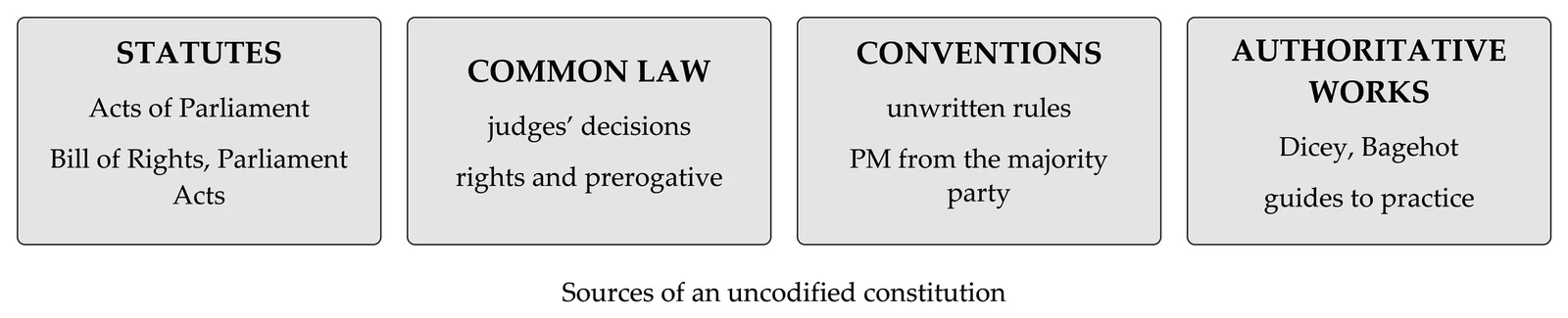
Its key principles are parliamentary sovereignty, which Dicey described as Parliament’s right to make or unmake any law; the rule of law; a constitutional monarchy, in which the monarch reigns but does not rule; and the fusion of powers, since ministers sit in Parliament and are responsible to it. Bagehot distinguished the dignified parts of the constitution, such as the monarchy, from the efficient parts, the Cabinet and Commons. Recent reforms, the Human Rights Act (1998), devolution, the Supreme Court and membership of and exit from the EU, have changed the constitution substantially.
1.2 Society and Economy: Nature of the State
Britain was the first industrial nation and a global empire, and its society was long structured by class, which shaped party loyalties. After 1945, the Labour government of Clement Attlee built a welfare state based on the Beveridge Report (1942), creating the National Health Service (1948) and nationalising key industries, within a post-war consensus. From 1979, Margaret Thatcher broke with this consensus, privatising industries, weakening trade unions and promoting markets. New Labour under Tony Blair (1997–2010) pursued a Third Way between markets and welfare.
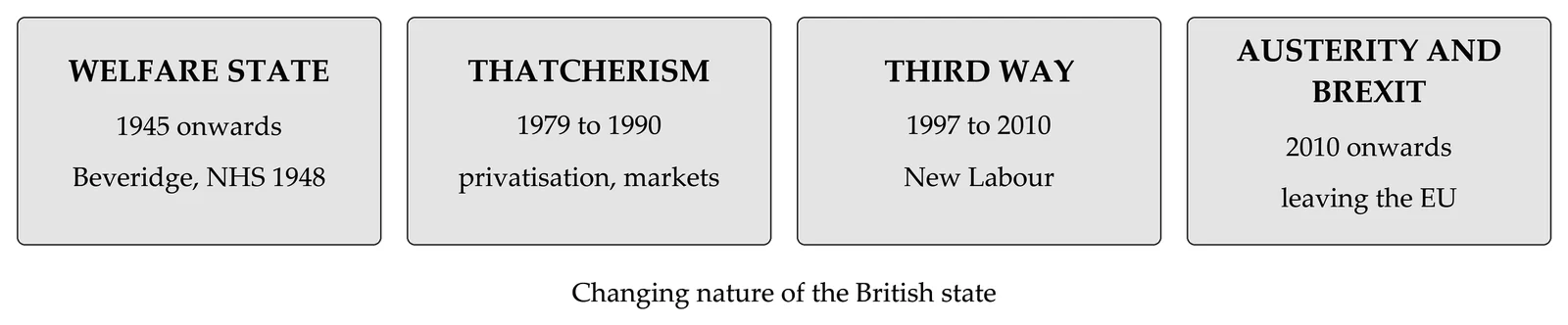
Joel Krieger emphasises how globalisation, deindustrialisation and the decline of empire shaped Britain’s political economy, and how immigration made it a multicultural society. After the financial crisis of 2008, governments pursued austerity, and in 2016 voters chose Brexit, reflecting divisions of region, age, education and identity. The British state is a liberal democratic, capitalist welfare state, though its scope has shifted repeatedly with changing governments.
1.3 Party and Electoral System
The House of Commons is elected by first past the post in 650 single-member constituencies. This system tends to produce a two-party system, dominated by the Conservatives and Labour, and single-party majority governments, though third parties such as the Liberal Democrats, the Scottish National Party and Reform UK win many votes. Results can be highly disproportionate: in 2024 Labour won 411 seats with about a third of the vote, while Reform UK won about 14 per cent of the vote but only 5 seats. A 2011 referendum rejected a change to the alternative vote.
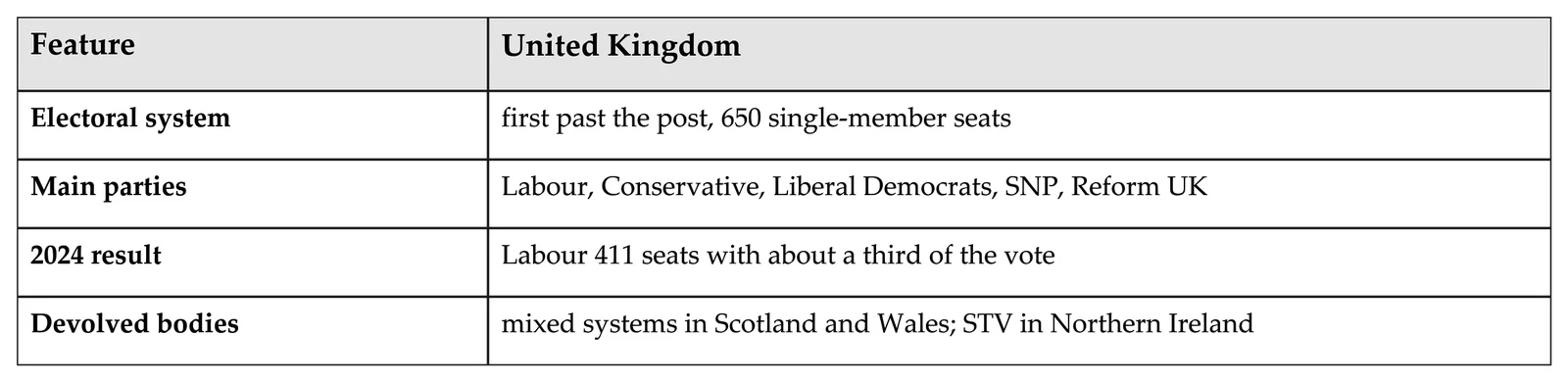
The devolved bodies use more proportional systems: the additional member system in Scotland and Wales and the single transferable vote in Northern Ireland. The House of Lords is unelected: most members are appointed life peers, 92 hereditary peers remain after the House of Lords Act 1999, and 26 bishops sit by right. Parties are disciplined and choose leaders through internal elections, and the leader of the majority party becomes Prime Minister by convention.
1.4 A Unitary State with Devolution
The UK is a unitary state: Parliament at Westminster is sovereign and can, in law, change or abolish any other body. But since 1998 it has developed extensive devolution. The Scotland Act 1998 created the Scottish Parliament, the Government of Wales Act 1998 created the Welsh Assembly, now the Senedd, and the Good Friday Agreement of 1998 led to the Northern Ireland Assembly with power-sharing between unionists and nationalists. England has no parliament of its own but has elected mayors and combined authorities.
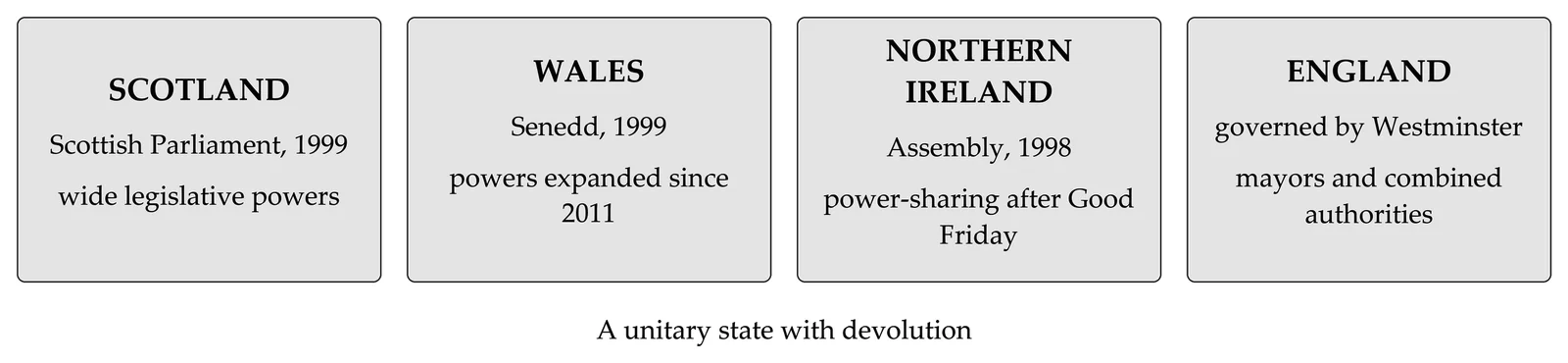
Devolution is asymmetric, since each nation has different powers, and it is protected by convention: the Sewel convention says Westminster will not normally legislate on devolved matters without consent. Scotland voted 55 per cent against independence in 2014, but the SNP continued to seek a second referendum, which the Supreme Court ruled in 2022 could not be held without Westminster’s consent. Scholars describe the UK as a union state or quasi-federal system.
1.5 Important Questions
- Question 1 Discuss the political traditions and main features of the British constitution.
- Question 2 Examine the relationship between society, economy and the nature of the British state.
- Question 3 Discuss the party and electoral system of the United Kingdom.
- Question 4 Is the United Kingdom a unitary state? Discuss the nature and impact of devolution.
DU asks the same idea in different words. So learn one broad answer for each question below; the same answer works for every question joined by OR.
Important Question 1
Discuss the political traditions and main features of the British constitution.
OR
‘The British constitution is unwritten and flexible.’ Discuss.
OR
Examine the principle of parliamentary sovereignty and its changing nature in the United Kingdom.
Model Answer
“The principle of Parliamentary sovereignty means neither more nor less than this, namely, that Parliament … has, under the English constitution, the right to make or unmake any law whatever.”
— A.V. Dicey, Introduction to the Study of the Law of the Constitution (1885)
Introduction. The British constitution is one of the oldest in the world and the model for parliamentary government in many countries, including India. Unlike most constitutions, it is not contained in a single document but has evolved over centuries. Its features, parliamentary sovereignty, the rule of law, constitutional monarchy and the fusion of powers, reflect a tradition of gradual change rather than revolutionary breaks.
1. Evolutionary Development
The constitution developed through landmarks such as Magna Carta (1215), which subjected the king to law; the Petition of Right (1628); the Glorious Revolution of 1688 and the Bill of Rights (1689), which established parliamentary supremacy; and the Act of Settlement (1701), which secured judicial independence. Britain avoided the revolutionary ruptures of France, so institutions adapted gradually.
2. Widening Democracy
The Reform Acts of 1832, 1867 and 1884 extended the vote to the middle and working classes. Women over thirty gained the vote in 1918 and equal suffrage came in 1928; the voting age was lowered to eighteen in 1969. The Parliament Acts of 1911 and 1949 limited the power of the unelected House of Lords to delay legislation.
3. Uncodified Constitution
The British constitution is uncodified rather than wholly unwritten. Much of it is written in statutes and judicial decisions, but there is no single constitutional document with special status. Its sources are statutes, common law, conventions, the law and custom of Parliament, and authoritative works.
4. Conventions
Conventions are unwritten rules observed as binding in practice, though not enforced by courts: the monarch gives assent to bills passed by Parliament, appoints as Prime Minister the leader who commands the Commons, and acts on ministers’ advice; ministers are collectively and individually responsible to Parliament.
5. Flexibility
The constitution is flexible: it can be changed by an ordinary Act of Parliament, without special procedures. This allowed major reforms such as devolution and the creation of a Supreme Court, but critics argue it gives a majority government too much power.
6. Parliamentary Sovereignty
Dicey described parliamentary sovereignty as Parliament’s right to make or unmake any law, with no person or body able to override its legislation. Courts cannot strike down Acts of Parliament, and no Parliament can bind its successors.
7. Rule of Law
Dicey’s second principle, the rule of law, means that no one is punished except for a breach of law established in ordinary courts, that everyone is equal before the law, and that rights are secured by judicial decisions in particular cases.
8. Constitutional Monarchy
The monarch is head of state, but the powers of the Crown, the royal prerogative, are exercised by ministers. Bagehot described the monarch’s rights as the right to be consulted, to encourage and to warn. The monarchy provides continuity and a symbol of unity.
9. Fusion of Powers and Cabinet Government
Unlike the American separation of powers, the British system fuses the executive and legislature: ministers are members of Parliament and remain in office while they command a majority. Bagehot called this fusion the efficient secret. Over time, observers such as Richard Crossman argued that cabinet government had become prime ministerial government.
10. Bicameral Parliament
Parliament consists of the elected House of Commons, which is supreme, and the House of Lords, mostly appointed life peers, which revises legislation. The Commons controls finance and can override the Lords after a year’s delay.
11. Changes to Sovereignty
Membership of the European Communities from 1973 gave EU law priority over Acts of Parliament, as the Factortame case (1990) showed. The Human Rights Act 1998 allows courts to declare laws incompatible with rights, and devolution created other legislatures. Brexit in 2020 restored formal sovereignty, but its practical limits remain debated.
12. Supreme Court and Judicial Role
The Constitutional Reform Act 2005 created a Supreme Court, which began work in 2009, separating the highest court from the House of Lords. In the Miller cases (2017 and 2019) the Court held that Parliament’s role could not be bypassed by the government, strengthening the courts’ constitutional role.
13. Evaluation
The British constitution combines continuity and adaptability. Its flexibility and conventions have allowed peaceful change, but its reliance on the self-restraint of governments has been questioned in recent years, leading to calls for a codified constitution.
Conclusion. Thus, the British constitution is an evolved, uncodified and flexible constitution based on parliamentary sovereignty, the rule of law, constitutional monarchy and the fusion of powers. Recent reforms, devolution, the Human Rights Act, the Supreme Court and Brexit, have changed it significantly while preserving its core.
Important Question 2
Examine the relationship between society, economy and the nature of the British state.
OR
Trace the evolution of the British welfare state from the post-war consensus to Thatcherism and after.
OR
Discuss the impact of class, globalisation and Brexit on British politics.
Model Answer
“Want is one only of five giants on the road of reconstruction … The others are Disease, Ignorance, Squalor and Idleness.”
— William Beveridge, Social Insurance and Allied Services (1942)
Introduction. The nature of the British state has changed with its society and economy. From the first industrial nation and imperial power, Britain became a welfare state after 1945, a market-oriented state after 1979, and a society divided over Europe and identity in the twenty-first century. Joel Krieger and Peter Rutland trace these changes.
1. Industrialisation and Class
Britain was the first industrial nation. Industrialisation created a large working class and a powerful middle class. Class became the main basis of party politics, with the Labour Party, founded in 1900, representing workers and the Conservatives representing property and the middle classes.
2. Empire and Its Decline
Britain ruled the largest empire in history. Decolonisation after 1947, beginning with India, reduced its global role, and immigration from the Commonwealth made Britain a multiracial and multicultural society.
3. The Post-war Welfare State
The Beveridge Report (1942) identified five giants, want, disease, ignorance, squalor and idleness. Clement Attlee’s Labour government (1945–51) created the National Health Service in 1948, expanded social insurance and nationalised coal, railways and steel.
4. Post-war Consensus
From 1945 to the 1970s, both major parties broadly accepted a mixed economy, Keynesian demand management, full employment and the welfare state, a consensus sometimes called Butskellism after the Conservative R.A. Butler and Labour’s Hugh Gaitskell.
5. The Crisis of the 1970s
In the 1970s Britain faced inflation, industrial decline and strikes, culminating in the Winter of Discontent of 1978–79. Critics argued that the state had become overloaded and that trade unions were too powerful.
6. Thatcherism
Margaret Thatcher, Prime Minister from 1979 to 1990, privatised state industries such as telecommunications and gas, curbed trade union power, sold council houses, deregulated finance and promoted free markets. The state’s economic role shrank, though it became more centralised and assertive in some areas.
7. New Labour and the Third Way
Tony Blair’s New Labour (1997–2010) accepted much of the market economy while investing in health and education, introducing a minimum wage and pursuing constitutional reforms. Anthony Giddens described this approach as the Third Way.
8. Austerity
After the financial crisis of 2008, the Conservative-led governments from 2010 reduced public spending to cut the deficit. Critics linked austerity to rising inequality and regional discontent.
9. Brexit
In the referendum of June 2016, 51.9 per cent voted to leave the European Union. The vote reflected divisions between old and young, graduates and non-graduates, cities and declining industrial towns, and debates on immigration and sovereignty. Britain left on 31 January 2020. Leaving the EU also returned powers over trade, agriculture, fisheries and immigration to the British state.
10. Changing Social Cleavages
Class voting has declined. Education, age and attitudes to identity and immigration now divide voters, as shown in the 2019 and 2024 elections, and national identities in Scotland and Wales shape politics.
11. Globalisation
Krieger stresses that globalisation, the City of London’s role as a financial centre and deindustrialisation of the north reshaped Britain’s economy, creating prosperous and left-behind regions.
12. Nature of the State
The British state is a liberal democratic, capitalist welfare state. Its scope has expanded and contracted with governments, but it retains universal healthcare and social security alongside a market economy.
13. The Free Economy and the Strong State
Andrew Gamble described Thatcherism as combining a free economy with a strong state. The government withdrew from owning industry and managing demand, but it strengthened central authority over local councils, trade unions and public services, expanded policing and defended national sovereignty. This shows that a smaller state in the economy can be a more assertive state in politics and society.
14. Evaluation
British history shows how changes in society and economy reshape the state. The swing from welfare consensus to markets and the divisions over Europe reveal a state continually renegotiating its role.
Conclusion. Thus, Britain moved from an industrial, imperial and class-based society to a welfare state after 1945, a market-oriented state under Thatcher, the Third Way of New Labour, and an era of austerity and Brexit. The British state remains a liberal democratic welfare state whose scope continues to be contested.
Important Question 3
Discuss the party and electoral system of the United Kingdom.
OR
Why does the United Kingdom have a two-party system? Examine recent changes.
OR
Examine the merits and demerits of the first-past-the-post system in Britain.
Model Answer
“The simple-majority single-ballot system favours the two-party system.”
— Maurice Duverger, Political Parties (1951)
Introduction. The United Kingdom is the classic example of a two-party system produced by a plurality electoral system. For most of the twentieth century, the Conservative and Labour parties alternated in power. Yet in recent decades smaller parties have gained ground, and the disproportionality of first past the post has provoked debate on electoral reform.
1. First Past the Post
The House of Commons is elected from 650 single-member constituencies. In each, the candidate with the most votes wins, even without a majority. The party that wins a majority of seats forms the government.
2. Duverger’s Law
Maurice Duverger argued that the simple-majority single-ballot system favours a two-party system, because small parties are under-represented and voters avoid wasting votes on them. Britain largely confirms this law, though regional parties survive where their votes are concentrated.
3. The Conservative Party
The Conservative Party, with roots in the Tories of the seventeenth century, stands for tradition, the market economy, national sovereignty and the union. It has been the most successful party of the last two centuries, governing from 2010 to 2024.
4. The Labour Party
The Labour Party was founded in 1900 as the Labour Representation Committee by trade unions and socialist societies. It built the post-war welfare state and, under Blair, moved to the centre. It returned to power in 2024 under Keir Starmer.
5. Third and Regional Parties
The Liberal Democrats, formed in 1988, are the main third party and joined a coalition with the Conservatives from 2010 to 2015. The Scottish National Party dominated Scotland after 2015, while Plaid Cymru operates in Wales and separate parties compete in Northern Ireland. Reform UK and the Greens have grown recently.
6. Advantages of FPTP
Supporters argue that first past the post is simple, gives voters a clear link with their constituency MP, usually produces stable single-party governments and allows voters to remove a government decisively.
7. Disproportionality
Critics point to the gap between votes and seats. In 2024 Labour won 411 of 650 seats with about a third of the vote, while Reform UK won around 14 per cent of the vote but only five seats. Many votes are wasted, and governments can win large majorities with minority support. In 1983 the Liberal–SDP Alliance won about a quarter of the vote but only 23 seats.
8. Electoral Reform Debate
A 2011 referendum on replacing first past the post with the alternative vote was rejected by about two-thirds of voters. Proposals for proportional representation continue, supported by the Liberal Democrats and others.
9. Devolved Electoral Systems
The Scottish Parliament and the Senedd originally used the additional member system, combining constituency seats with regional list seats, and the Northern Ireland Assembly uses the single transferable vote. These produce more proportional results and coalition or minority governments.
10. Party Organisation
British parties are disciplined: MPs usually vote as their party whips direct. Leaders are chosen by MPs and members, and parties are funded by members, trade unions and donors, with spending limits on campaigns.
11. Changing Party System
Since the 1970s, the combined vote share of the two main parties has fallen. Hung parliaments occurred in 2010 and 2017, and the rise of the SNP, UKIP and Reform UK has fragmented voting. Scholars describe a two-party system in seats but a multi-party system in votes.
12. House of Lords
The House of Lords is not elected. Most members are life peers appointed on the Prime Minister’s advice, with 92 hereditary peers and 26 bishops. Reform of the Lords remains an unfinished part of the constitutional agenda.
13. Historical Changes in the Two-party System
The two main parties have not always been the same. In the nineteenth century the Conservatives competed with the Liberals. After the First World War, Labour replaced the Liberals as the second party, forming its first minority government under Ramsay MacDonald in 1924. Since then, Conservatives and Labour have dominated, though their combined share of the vote has steadily declined.
14. Evaluation
Britain’s party and electoral system has provided stable, accountable government, but at the cost of proportionality. Growing fragmentation in voting puts pressure on the two-party model and keeps electoral reform on the agenda.
Conclusion. Thus, the UK’s first-past-the-post system has produced a two-party system dominated by Conservatives and Labour, as Duverger predicted. But third and regional parties have grown, results are often disproportionate, and devolved bodies use more proportional systems.
Important Question 4
Is the United Kingdom a unitary state? Discuss the nature and impact of devolution.
OR
Examine devolution in Scotland, Wales and Northern Ireland.
OR
‘The UK has become a quasi-federal union state.’ Discuss.
Model Answer
“There shall be a Scottish Parliament.”
— Scotland Act 1998, Section 1(1)
Introduction. The United Kingdom has traditionally been described as a unitary state, in which sovereignty rests with Parliament at Westminster. Since 1998, however, devolution has transferred substantial powers to elected bodies in Scotland, Wales and Northern Ireland. This has led scholars to describe the UK as a union state or quasi-federal system.
1. A Union of Nations
The UK was formed by the union of England and Wales with Scotland in 1707 and with Ireland in 1801. Most of Ireland became independent in 1922, leaving Northern Ireland in the UK. The union retained distinct institutions, such as Scottish law, churches and education.
2. Unitary Principle
Constitutionally, Westminster is sovereign. Devolved bodies are created by Acts of Parliament and could in law be altered or abolished by Parliament. This distinguishes devolution from federalism, in which sub-national units have constitutionally guaranteed powers.
3. Background to Devolution
Nationalist movements in Scotland and Wales grew from the 1960s. Referendums in 1979 failed, but under the Conservative governments of the 1980s and 1990s, which had little support in Scotland, demand for home rule grew. New Labour held referendums in 1997, and both Scotland and Wales voted for devolution.
4. Scotland
The Scotland Act 1998 created the Scottish Parliament, which first met in 1999. It can legislate on all matters not reserved to Westminster, such as health, education, justice and local government. Later acts in 2012 and 2016 transferred tax and welfare powers.
5. Wales
The Government of Wales Act 1998 created the National Assembly for Wales with secondary powers. Its powers grew through later acts, and after a referendum in 2011 it gained primary law-making powers. It was renamed the Senedd in 2020.
6. Northern Ireland
The Good Friday Agreement of 10 April 1998 ended decades of conflict known as the Troubles. It created a Northern Ireland Assembly and a power-sharing executive in which unionists and nationalists must govern together. The executive has been suspended several times when parties failed to agree.
7. England
England, with over four-fifths of the UK population, has no parliament of its own. Elected mayors and combined authorities, such as in Greater Manchester, have been created. The West Lothian question asks why Scottish MPs can vote on English matters while English MPs cannot vote on devolved Scottish matters.
8. Asymmetry
Devolution is asymmetric: Scotland has the most powers, Wales somewhat fewer, Northern Ireland a distinctive power-sharing system, and England none. This asymmetry reflects different national identities and histories.
9. The Sewel Convention
Under the Sewel convention, Westminster does not normally legislate on devolved matters without the consent of the devolved legislature. It was recognised in statute in 2016, but the Supreme Court held in Miller (2017) that it is not legally enforceable.
10. Scottish Independence
In the independence referendum of 18 September 2014, Scotland voted 55 per cent to stay in the UK. After Brexit, which Scotland opposed, the SNP sought a second referendum, but the Supreme Court ruled in 2022 that the Scottish Parliament could not hold one without Westminster’s consent.
11. Brexit and the Union
Brexit strained the union: Scotland and Northern Ireland voted to remain, and the Northern Ireland Protocol created special trade arrangements, creating tensions with unionists and debates over powers returned from the EU.
12. Union State or Quasi-federation
Scholars describe the UK as a union state, in which different nations joined on different terms, or as quasi-federal, since devolved powers are politically entrenched by referendums and convention even if legally revocable.
13. Local Government
Below the national level, England is governed by a mix of county, district and unitary councils, and London has an elected Mayor and Greater London Authority since 2000. Local government in Britain has limited constitutional protection and depends heavily on central grants, so successive governments have been able to reorganise or cap it, another sign of the unitary character of the state.
14. Evaluation
The UK remains unitary in law but increasingly federal in practice. Devolution has accommodated national identities but has also raised questions about the future of the union.
Conclusion. Thus, the UK is legally a unitary state based on parliamentary sovereignty, but devolution to Scotland, Wales and Northern Ireland since 1998 has made it an asymmetric, quasi-federal union state, with continuing debates over Scottish independence and English governance.
Short Notes
(a) Conventions of the constitution
Unwritten rules of political behaviour that are regarded as binding, though not enforced by courts. Examples include the monarch giving royal assent to bills, the Prime Minister being the leader of the majority party in the Commons, and ministers resigning if they lose a vote of confidence. They give the British constitution flexibility.
(b) Parliamentary sovereignty
Dicey’s principle that Parliament can make or unmake any law and that no body can override its legislation. It has been qualified in practice by EU membership (until 2020), the Human Rights Act and devolution, but remains the formal foundation of the British constitution.
(c) Westminster model
The British pattern of parliamentary government, featuring a fusion of executive and legislature, cabinet government, a strong Prime Minister, a disciplined two-party system, first-past-the-post elections and an official opposition. It was adopted, with changes, by India and many Commonwealth countries.
(d) Good Friday Agreement
The 1998 agreement that ended the conflict in Northern Ireland. It created a power-sharing executive and Assembly, cross-border bodies with the Republic of Ireland, and recognised the principle that Northern Ireland’s status can change only with the consent of a majority of its people.
More notes: DSC-17 Comparative Political Systems
These notes are prepared by PADHO TO AISE for study help. They are not an official University of Delhi publication.