
Semester IV DSC-10 Public Administration in India
Unit VI · 27 min read · Updated 24 Nov 2026
As per the University of Delhi (DU) BA (Hons) Political Science syllabus
Contents
- 6.1 Ethics in Administration: Integrity vs Corruption
- Principles of Ethical Conduct
- Causes of Corruption
- Measures against Corruption
- 6.2 Accountability: RTI, Lokpal and Citizens’ Charter
- 6.3 The Political Executive and the Permanent Executive
- Principles of the Relationship
- Problems in Practice
- 6.4 Generalists and Specialists
- The Case for Generalists
- The Case for Specialists
- Balance
- 6.5 Gender Sensitivity and Gender Participation
- 6.6 Important Questions
- Discuss the mechanisms for ensuring accountability in Indian administration with reference to RTI, Lokpal and Citizens’ Charter.
- Examine the relationship between the political executive and the permanent executive in India.
- Discuss ethics in administration with reference to integrity and corruption in India.
- Examine the generalist–specialist debate in Indian administration and discuss the need for gender sensitivity.
- Short Notes
धूप को सबसे अच्छा कीटाणुनाशक कहा जाता है।
Sunlight is said to be the best of disinfectants.
— Louis Brandeis, Other People’s Money (1914)
ADMINISTRATION is not only a matter of structures and procedures; it also raises difficult questions of values and relationships. How can officials be made honest and accountable? Who should take decisions, the elected minister or the expert civil servant? Should top administrators be generalists or specialists? And how can administration become sensitive to gender? This final chapter studies five such issues and debates listed in the syllabus: ethics (integrity versus corruption), accountability (RTI, Lokpal and Citizens’ Charter), the relationship between the political and the permanent executive, generalists versus specialists, and gender sensitivity and participation. They bring together everything studied in earlier chapters.
6.1 Ethics in Administration: Integrity vs Corruption
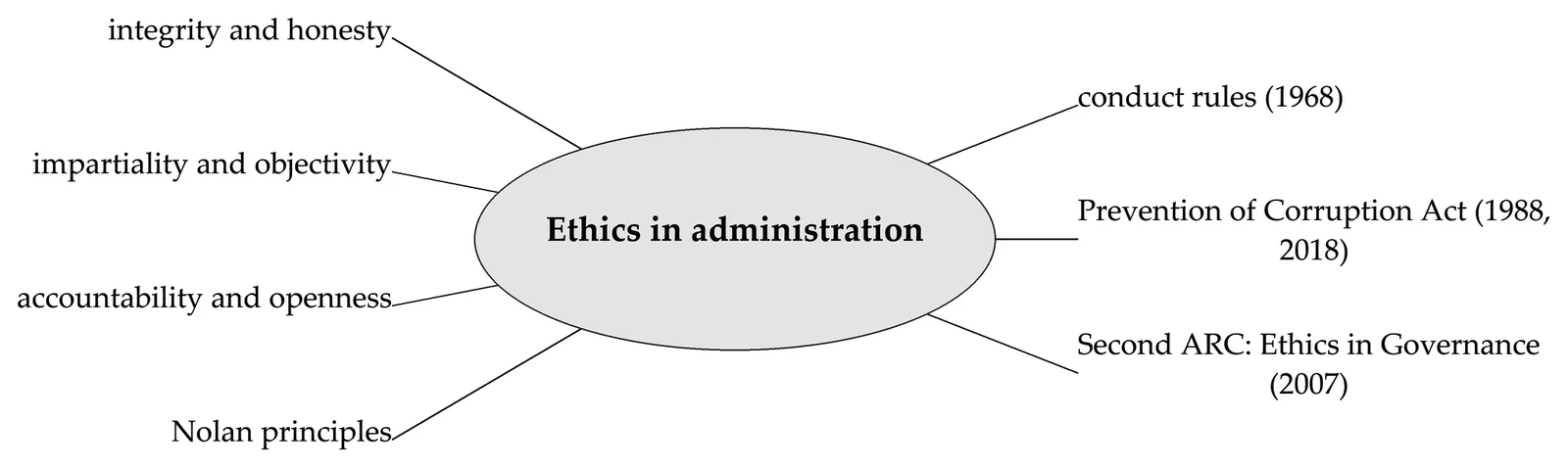
Ethics in administration means the moral principles that guide the conduct of public servants: honesty, impartiality, fairness, accountability and dedication to the public interest. Integrity means consistently acting according to these principles even when no one is watching. Corruption is the misuse of public office for private gain, through bribery, nepotism, embezzlement or favouritism.
Principles of Ethical Conduct
The Nolan Committee in Britain (1995) laid down seven principles of public life: selflessness, integrity, objectivity, accountability, openness, honesty and leadership. In India, the Central Civil Services (Conduct) Rules, 1964 and the All India Services (Conduct) Rules, 1968 require civil servants to maintain absolute integrity, political neutrality and devotion to duty. The Second ARC’s report ‘Ethics in Governance’ (2007) recommended a code of ethics, a stronger Lokpal, and protection for whistle-blowers.
Causes of Corruption
- Excessive discretion and complex procedures, which create opportunities for bribes.
- Lack of transparency and accountability.
- Low salaries in some posts and weak enforcement of rules.
- Political interference and the high cost of elections.
- Social acceptance of ‘speed money’ and gifts.
Measures against Corruption
Institutional measures include the Prevention of Corruption Act, 1988 (amended in 2018 to make bribe-giving an offence), the Central Vigilance Commission (set up in 1964 on the Santhanam Committee’s recommendation), the CBI, the Lokpal, the Whistle Blowers Protection Act, 2014, and technological measures such as e-procurement and Direct Benefit Transfer, which reduce human discretion.
Codes of conduct
Ethics in Indian administration rests partly on rules: the All India Services (Conduct) Rules, 1968 and the Central Civil Services (Conduct) Rules forbid officials from taking part in politics, accepting gifts or using office for private gain. The Second ARC’s report on Ethics in Governance (2007) recommended a code of ethics stating values such as integrity, impartiality, commitment to public service and accountability, beyond mere rules of conduct.
6.2 Accountability: RTI, Lokpal and Citizens’ Charter
Accountability means that public officials must answer for their actions to those affected by them and to higher authorities. It has several forms: legislative (questions, debates and committees in Parliament), executive (hierarchy and supervision), judicial (courts and judicial review), financial (audit by the CAG) and citizen-based (RTI, social audit, grievance redressal) (Figure 6.2).

A. The Right to Information Act, 2005
The RTI Act grew out of the struggle of the Mazdoor Kisan Shakti Sangathan (MKSS) in Rajasthan, whose public hearings (jan sunwais) in the 1990s exposed corruption in local works. Its main provisions are: every citizen can seek information from public authorities on payment of a small fee; information must be given within 30 days (48 hours where life or liberty is involved); every authority must have Public Information Officers and publish information proactively (Section 4); certain information, such as that affecting national security, is exempt (Section 8); and the Central and State Information Commissions hear appeals and can penalise officers. RTI has been called a powerful tool against corruption, but it faces problems such as delays, backlogs in Information Commissions, attacks on RTI activists, and the 2019 amendment that allowed the central government to fix the tenure and salary of Information Commissioners, which critics say weakens their independence.
B. The Lokpal and Lokayuktas Act, 2013
The idea of an ombudsman, an independent officer who investigates complaints against officials, came from Sweden (1809). The First ARC recommended a Lokpal and Lokayuktas in 1966; after many failed bills and the India Against Corruption movement led by Anna Hazare (2011), Parliament passed the Lokpal and Lokayuktas Act, 2013. The Lokpal has a chairperson and up to eight members, half of them judicial members; it can inquire into allegations of corruption against public servants, including the Prime Minister with certain safeguards, ministers, MPs and officials. The first Lokpal, Justice Pinaki Chandra Ghose, was appointed in 2019. States are required to set up Lokayuktas. Critics point to delays in appointment, the dependence on government agencies for investigation, and the small number of cases decided.
C. Citizens’ Charter
A Citizens’ Charter is a public document in which an organisation states the services it provides, the standards of service, the time limits, and the means of grievance redressal. The idea began in Britain under John Major (1991). In India, a conference of Chief Ministers in 1997 adopted an action plan for effective and responsive administration, and ministries began issuing charters; the Sevottam model (2006) linked charters with grievance redressal and service quality. Some states have passed Right to Services Acts, starting with Madhya Pradesh (2010), which make time-bound delivery a legal right with penalties for delay. Charters often remain on paper, because they lack legal force, are not prepared in consultation with citizens and are poorly publicised.
6.3 The Political Executive and the Permanent Executive
The political executive consists of ministers, who are elected representatives responsible to the legislature and change with elections. The permanent executive consists of civil servants, who are recruited on merit, hold office until retirement and serve whichever government is in power. The relationship between them is central to democratic administration.
Principles of the Relationship
- Ministerial responsibility: ministers are responsible to Parliament for their departments (Article 75(3)), so civil servants work under their direction.
- Neutrality and anonymity: civil servants are politically neutral and remain anonymous, while ministers take public responsibility.
- Advice and implementation: civil servants give frank advice based on facts and law; ministers decide policy; civil servants implement it faithfully.
- Politics–administration dichotomy: Woodrow Wilson (1887) argued that politics and administration should be separated, though later scholars showed that the two always overlap.
Problems in Practice
In India the relationship has often been strained. During the late 1960s and the Emergency (1975–77), the idea of a ‘committed bureaucracy’, committed to the ruling party’s programmes, threatened neutrality. Today problems include frequent transfers used as punishment, political pressure on officers, the politicisation of the bureaucracy, and sometimes the collusion of politicians and officials in corruption. In T.S.R. Subramanian v. Union of India (2013), the Supreme Court recommended a fixed minimum tenure for civil servants, Civil Services Boards to manage transfers, and the recording of oral instructions in writing. The ideal relationship is one of partnership: ministers provide democratic direction, and civil servants provide expertise, continuity and impartial implementation (Table 6.1).
| Basis | Political executive | Permanent executive |
|---|---|---|
| Members | Ministers | Civil servants |
| Selection | Elected; chosen by the Prime Minister or Chief Minister | Recruited on merit through UPSC or state commissions |
| Tenure | Temporary; changes with elections | Permanent until retirement |
| Role | Policy-making, political direction | Advice, implementation, continuity |
| Responsibility | To the legislature and the people | To the minister; neutral and anonymous |
The ‘committed bureaucracy’ debate
In the late 1960s and early 1970s, some leaders argued that civil servants should be committed to the government’s socialist programme. Critics feared that this would turn ‘commitment to policy’ into commitment to a party or leader, as seemed to happen during the Emergency. Most scholars now argue that civil servants should be committed to the Constitution and the public interest while remaining politically neutral.
6.4 Generalists and Specialists
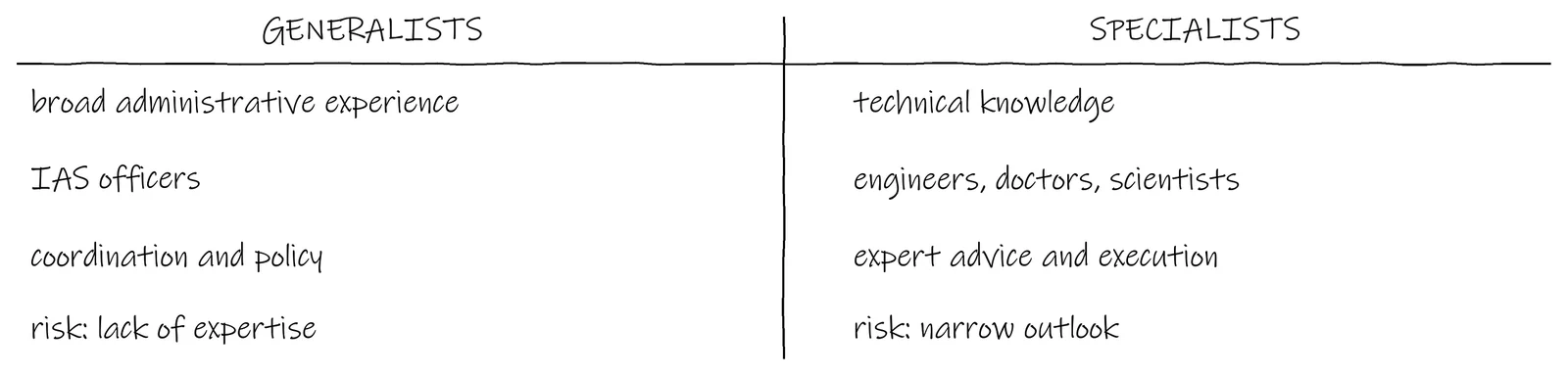
Generalists are administrators with broad experience across many fields rather than deep technical knowledge, such as IAS officers who move from district administration to finance, health or industry. Specialists are experts with professional or technical qualifications, such as engineers, doctors, scientists and economists. The debate is about who should hold the top policy-making and management posts (Figure 6.3).
The Case for Generalists
Generalists provide a broad perspective, coordinate many specialisms, understand the political and administrative context, are accountable to ministers, and ensure that policies serve the public interest rather than narrow professional interests. The British tradition, inherited by India, held that ‘the expert should be on tap, not on top’.
The Case for Specialists
Modern government deals with complex technical issues such as health, technology, climate and finance, which need expert knowledge. The Fulton Committee in Britain (1968) criticised the ‘cult of the amateur’ and recommended more professionalism. In India the First ARC recommended functional specialisation, and lateral entry (from 2018) brought specialists into senior posts. Specialists complain that generalists dominate the top posts and that they are denied equal status and pay.
Balance
Most experts now favour a balance: generalists with domain specialisation after some years of service, and specialists with opportunities to rise to management posts, working in teams. Mission Karmayogi’s competency-based approach reflects this idea.
6.5 Gender Sensitivity and Gender Participation
Gender sensitivity in administration means awareness of the different needs, roles and problems of women and men, and the design of policies and services that do not disadvantage women. Gender participation means the representation of women in administrative and decision-making positions.
- Representation: Anna Rajam Malhotra became the first woman IAS officer in 1951, but women still hold a small share of senior posts in the civil services and the police.
- Local government: the 73rd and 74th Amendments reserved one-third of seats for women (raised to 50% in many states), bringing over a million women into local governance.
- Gender budgeting: introduced in 2005–06 to assess the impact of spending on women.
- Workplace safety: the Vishaka guidelines (1997) and the Sexual Harassment of Women at Workplace (POSH) Act, 2013 require internal complaints committees.
- Policy design: schemes such as the Janani Suraksha Yojana, Beti Bachao Beti Padhao (2015) and the NFSA’s recognition of women as heads of households show gender-sensitive design.
- Representation in legislatures: the 106th Amendment (2023, Nari Shakti Vandan Adhiniyam) provides for one-third reservation for women in the Lok Sabha and state assemblies, to take effect after delimitation.
Challenges remain: patriarchal attitudes within the bureaucracy, the ‘glass ceiling’ in promotions, lack of facilities such as crèches, and proxy representation by husbands of elected women. A gender-sensitive administration needs both more women in decision-making and gender awareness among all officials.
Women in the civil services
Anna Rajam Malhotra became the first woman IAS officer in 1951, at a time when women officers could be required to resign on marriage, a rule later removed. Women’s share in the civil services has grown, and many have led districts and ministries, but they remain under-represented in the most senior posts. Gender-sensitive administration also requires women in the police and frontline services, safe workplaces and gender budgeting.
6.6 Important Questions
- Question 1 Discuss the mechanisms for ensuring accountability in Indian administration with reference to RTI, Lokpal and Citizens’ Charter.
- Question 2 Examine the relationship between the political executive and the permanent executive in India.
- Question 3 Discuss ethics in administration with reference to integrity and corruption in India.
- Question 4 Examine the generalist–specialist debate in Indian administration and discuss the need for gender sensitivity.
DU asks the same idea in different words. So learn one broad answer for each question below; the same answer works for every question joined by OR.
Important Question 1
Discuss the mechanisms for ensuring accountability in Indian administration with reference to RTI, Lokpal and Citizens’ Charter.
OR
Evaluate the role of the Right to Information Act in ensuring transparency.
OR
Write a note on the Lokpal.
Model Answer
“Sunlight is said to be the best of disinfectants.”
— Louis Brandeis (1914)
Introduction. Accountability means that public officials must answer for their actions. In a democracy, administration must be accountable not only to ministers and Parliament but also directly to citizens. RTI, Lokpal and Citizens’ Charters are major instruments of such accountability.
1. Forms of Accountability
Legislative (Parliament and its committees), executive (hierarchy), judicial (courts), financial (CAG audit) and citizen-based (RTI, social audit, grievance redressal). Accountability can be vertical (to citizens through elections), horizontal (between institutions) and social (through civil society and the media).
2. The RTI Act, 2005
Born from the MKSS struggle in Rajasthan, it allows every citizen to obtain information within 30 days, requires proactive disclosure, exempts sensitive information (Section 8), and creates Information Commissions. It has exposed corruption and empowered citizens, but faces delays, backlogs, threats to activists and concerns about the 2019 amendment. Information must be supplied within thirty days, or within forty-eight hours where life or liberty is involved. Lakhs of applications are filed every year, making it one of the most used transparency laws in the world.
3. Amendments to the RTI Act
The RTI (Amendment) Act, 2019 allowed the Union to fix the tenure and salaries of Information Commissioners, which critics said weakened their independence, and the Digital Personal Data Protection Act (2023) widened the exemption for personal information.
4. The Lokpal
Recommended by the First ARC (1966) and demanded by the India Against Corruption movement (2011), the Lokpal and Lokayuktas Act (2013) created an anti-corruption ombudsman covering ministers, MPs and officials; the first Lokpal was appointed in 2019. Delays and dependence on other agencies have limited its impact. The first Lokpal, Justice Pinaki Chandra Ghose, was appointed in 2019.
5. Lokayuktas
States had Lokayuktas earlier, Maharashtra’s from 1971, and Karnataka’s Lokayukta became known for investigating mining scams; the Lokpal Act required every state to set one up.
6. Citizens’ Charter
Adopted from 1997, charters state service standards and time limits; Sevottam (2006) and state Right to Services Acts (from 2010) strengthened them. Many remain ineffective because they lack legal force and citizen involvement. Charters often lacked remedies when standards were not met.
7. Right to Services Acts
Many states have enacted laws that guarantee the delivery of services within fixed times, with penalties on officials for delay, turning charters into enforceable rights.
8. Protection of Whistleblowers
The Whistle Blowers Protection Act (2014) seeks to protect those who expose corruption, though it has not been fully operationalised; attacks on RTI activists show the risks they face.
9. The Central Vigilance Commission
The CVC, set up in 1964 on the Santhanam Committee’s recommendation and made statutory in 2003, supervises vigilance in central government departments.
10. Other Mechanisms
Social audits under MGNREGA, the CVC, e-governance, grievance portals such as CPGRAMS, and judicial review complement these instruments.
11. Media and Civil Society
Investigative journalism, civil society campaigns such as the MKSS and the anti-corruption movement of 2011, and social media have become powerful informal mechanisms of accountability.
12. Evaluation
These mechanisms have increased transparency, but their effectiveness depends on independent institutions, timely action and active citizens. Accountability works best when formal institutions and active citizens reinforce each other.
13. Ethics and Accountability
Accountability is linked to ethics: rules and institutions work only if officials have integrity. The Nolan principles, conduct rules, the Prevention of Corruption Act (amended 2018), the CVC and the Whistle Blowers Protection Act, 2014 support ethical conduct. The Nolan principles of public life, selflessness, integrity, objectivity, accountability, openness, honesty and leadership, offer a model code.
14. Suggestions
Stronger and independent Information Commissions and Lokpal, statutory Right to Services Acts in all states, regular social audits, protection for RTI activists and whistle-blowers, and e-governance with process re-engineering can make accountability more effective. Vacancies in Information Commissions should be filled promptly.
15. Social Audit and Citizen Participation
Beyond formal institutions, citizens themselves enforce accountability through social audits, public hearings (jan sunwais) pioneered by the MKSS, citizen report cards (first used by the Public Affairs Centre in Bengaluru in 1994) and grievance portals.
Conclusion. Thus, RTI, Lokpal and Citizens’ Charters have shifted Indian administration from secrecy towards openness and answerability, though they need stronger implementation.
Important Question 2
Examine the relationship between the political executive and the permanent executive in India.
OR
Discuss the generalist–specialist debate in Indian administration.
OR
Write a note on the neutrality of the civil service.
Model Answer
“Bureaucratic administration means fundamentally domination through knowledge.”
— Max Weber, Economy and Society (1922)
Introduction. The political executive (ministers) and the permanent executive (civil servants) together run the government. Ministers provide democratic direction; civil servants provide expertise, continuity and implementation. Their relationship is central to good governance.
1. Principles
Ministerial responsibility to Parliament (Article 75(3)), civil service neutrality and anonymity, frank advice and faithful implementation, and Woodrow Wilson’s idea (1887) of separating politics from administration. Ministers decide policy and answer to Parliament, while civil servants advise frankly and implement decisions faithfully. Article 311 protects civil servants from arbitrary dismissal, supporting their neutrality.
2. Wilson and Weber
Woodrow Wilson’s politics–administration dichotomy (1887) and Max Weber’s ideal of a neutral, expert bureaucracy both separate political and administrative roles, though in practice the two overlap.
3. Problems in India
The ‘committed bureaucracy’ debate of the late 1960s and the Emergency, frequent punitive transfers, political pressure, politicisation of officers and collusion in corruption have strained the relationship. Officials who resist political pressure may face punishment postings.
4. Judicial and Reform Responses
In T.S.R. Subramanian (2013) the Supreme Court recommended fixed tenure, Civil Services Boards and written instructions; the Second ARC recommended a code of ethics and protection of neutrality. In Prakash Singh (2006) the Court ordered police reforms to insulate the police from political interference.
5. Civil Services Boards
Following the T.S.R. Subramanian judgment, the Union and many states created Civil Services Boards to recommend transfers and postings, but they are often bypassed.
6. Generalists and Specialists
Generalists (such as IAS officers) offer broad perspective and coordination; specialists offer technical expertise. The Fulton Committee (1968) criticised the ‘cult of the amateur’, and lateral entry (2018) brought specialists into senior posts. Britain’s Fulton Committee (1968) criticised the ‘cult of the generalist’. The Second ARC recommended domain specialisation for senior officers.
7. Lateral Entry
Lateral entry of specialists into senior posts since 2018 aims to bring expertise into government, though critics worry about politicisation and the absence of reservation.
8. The Civil Servant in a Democracy
Patel saw the civil service as a neutral instrument of the Constitution; the ideal civil servant gives fearless advice but loyally implements lawful decisions, as the Second ARC also recommended.
9. Comparative Models
In Britain senior civil servants give confidential advice and remain neutral, while in the United States many senior posts change with each new president; India follows the British model, with considerable political control over postings.
10. Towards Partnership
The ideal relationship is a partnership based on mutual respect: ministers decide policy and take responsibility, while civil servants give honest advice and implement policy impartially.
11. Neutrality versus Commitment
A neutral civil service serves any government impartially; a committed civil service shares the goals of the ruling party. In the late 1960s some leaders argued for a committed bureaucracy to implement socialist programmes, but critics warned that it would destroy impartiality, as the experience of the Emergency showed. The accepted view is that civil servants should be committed to the Constitution and the public interest, not to a party. Commitment to the Constitution, not to a party, is the right form of commitment.
12. Transfers and Tenure
Frequent transfers are the most common instrument of political pressure on civil servants: honest officers are often moved for resisting improper demands. Fixed minimum tenure, Civil Services Boards for postings, and written orders, as recommended in T.S.R. Subramanian (2013) and by the Second ARC, aim to protect officers while keeping them accountable to elected governments. The case of Ashok Khemka, transferred dozens of times in his career, became a symbol of this problem.
13. Ethical Dilemmas
Civil servants sometimes receive orders that are legal but unwise or unfair; the ethic of service requires them to record their objections in writing and, if orders are illegal, to refuse them.
14. Evaluation
The relationship works best when politicians respect the professional independence of civil servants and civil servants respect the democratic authority of ministers. Fixed tenure, transparent postings and a code of ethics can help achieve this balance.
Conclusion. Thus, a healthy relationship between the political and permanent executives, combining democratic control with professional independence, is essential for effective and accountable administration.
Important Question 3
Discuss ethics in administration with reference to integrity and corruption in India.
OR
What is integrity in public administration? How can corruption be controlled?
OR
Examine the recommendations of the Second ARC on ethics in governance.
Model Answer
“Recall the face of the poorest and the weakest man whom you may have seen, and ask yourself if the step you contemplate is going to be of any use to him.”
— M.K. Gandhi, ‘Gandhi’s Talisman’
Introduction. Ethics in administration concerns the values that guide public officials in exercising power entrusted to them. Integrity is its core, and corruption, the abuse of public office for private gain, is its greatest enemy. India has built many laws and institutions against corruption, but ethical governance depends on values as well as rules.
1. Meaning of Administrative Ethics
Administrative ethics refers to standards of right conduct for public officials: honesty, impartiality, accountability, respect for law and concern for the public interest. Officials exercise discretion, so their values shape how laws affect citizens.
2. Integrity
Integrity means consistency between values and actions, refusing to misuse office even when no one is watching. It includes financial honesty, intellectual honesty in advice and moral courage to resist improper orders. The Second ARC described integrity as the first among civil service values, and noted that an honest officer also needs the professional competence to act effectively.
3. Forms and Causes of Corruption
Corruption ranges from petty bribery for routine services to grand corruption in contracts and licences. Its causes include wide discretion, complex procedures, low accountability, political funding needs and social tolerance of corruption. The Santhanam Committee (1964), whose report led to the creation of the Central Vigilance Commission, noted that delays and wide discretionary powers create opportunities for ‘speed money’, a problem that still persists.
4. Effects of Corruption
Corruption raises costs, diverts welfare from the poor, weakens trust in government and undermines the rule of law and economic growth. Major scams in areas such as telecom licences and coal block allocation have shown how grand corruption damages both public finances and public confidence in government.
5. Legal and Institutional Framework
The Prevention of Corruption Act (1988), amended in 2018 to punish bribe-givers and require sanction for investigating officials, the Central Vigilance Commission, the CBI, the Lokpal and Lokayuktas Act (2013), the Benami Transactions Act and the RTI Act form the framework. The Whistle Blowers Protection Act (2014) aims to protect those who expose wrongdoing, though it has not been fully operationalised, and the first Lokpal was appointed only in 2019, more than five years after the Act was passed.
6. The Second ARC on Ethics
The Second ARC’s report Ethics in Governance (2007) recommended a code of ethics for ministers, legislators and civil servants, stronger anti-corruption laws, confiscation of illegally acquired property, protection for whistleblowers and reform of political funding.
7. Codes and Values
The All India Services (Conduct) Rules, 1968 regulate conduct, and the Nolan principles of public life, selflessness, integrity, objectivity, accountability, openness, honesty and leadership, offer a model of values. A code of ethics, unlike a code of conduct, states positive values to inspire officials rather than only listing prohibited acts.
8. Ethical Dilemmas
Anil Swarup, in Ethical Dilemmas of a Civil Servant (2021), shows that officials often face conflicts between loyalty to superiors, legal rules, political pressure and conscience, and that courage and clarity of values are needed to resolve them. Officials must also balance efficiency with fairness and confidentiality with transparency; ethical reasoning, not mere rule-following, helps them choose the course that best serves the public interest.
9. Technology and Citizens
E-governance, direct benefit transfers, e-procurement, social audits and the RTI Act reduce discretion and increase transparency, while citizens and the media act as watchdogs.
10. Political Corruption
Corruption in administration is closely connected with the cost of elections and opaque political funding. The Supreme Court struck down the electoral bond scheme in 2024 because it hid the identity of donors from voters. Reform of party finance is therefore part of any strategy against administrative corruption.
11. Citizens’ Charters and Social Audit
Citizens’ charters set time limits for services, and several states have passed right to services laws that penalise officials for delay. Social audits of MGNREGA, pioneered by the Mazdoor Kisan Shakti Sangathan in Rajasthan, allow villagers to check records in public meetings and expose fraud.
12. Leadership and Organisational Culture
Ethics in an organisation depends heavily on the example set by its leaders. When senior officers and ministers act with integrity, protect honest juniors and refuse to tolerate wrongdoing, a culture of honesty spreads; when they reward loyalty over merit, even good rules fail. Training in academies such as the LBSNAA therefore includes ethics, case studies of dilemmas and the values of the Constitution.
13. Evaluation
Laws and institutions are necessary but not sufficient; ethical administration requires leadership by example, protection for honest officials and a culture of integrity. Simplifying procedures, reducing discretion, rewarding honesty and punishing corruption quickly would build the culture of integrity described by the Nolan principles and the Second ARC.
Conclusion. Thus, integrity is the foundation of good administration, and controlling corruption in India needs strong institutions, transparent processes and, above all, officials guided by public service values.
Important Question 4
Examine the generalist–specialist debate in Indian administration and discuss the need for gender sensitivity.
OR
Should India rely on generalists or specialists in its higher civil service?
OR
Discuss gender sensitivity and women’s participation in Indian administration.
Model Answer
“The Service is still essentially based on the philosophy of the amateur (or ‘generalist’ or ‘all-rounder’).”
— Fulton Committee on the Civil Service (UK), 1968
Introduction. Two important debates in Indian administration concern who should lead it and how inclusive it is. The generalist–specialist debate asks whether officers with broad administrative experience or experts in particular fields should occupy top positions. The debate on gender sensitivity asks whether administration recognises the different needs of women and includes women in its own ranks.
1. Meaning
Generalists, such as IAS officers, are recruited for general ability and move across departments; specialists, such as engineers, doctors and economists, are recruited for expertise in a particular field.
2. The Case for Generalists
Generalists offer a broad perspective, coordination across departments, field experience in districts and the ability to balance technical advice with political and social realities. Supporters argue that specialists may take a narrow view of problems, while generalists who have served in districts and ministries understand how policies affect people on the ground and how departments interact.
3. The Case for Specialists
Modern government deals with complex technical issues such as health, climate, finance and technology, which require expertise; specialists often resent generalist control of senior posts. Specialist services often complain of a glass ceiling, because most senior posts in ministries go to generalist officers and their own pay and promotion lag behind; this disparity has produced resentment and demands for parity.
4. The Fulton Report
Britain’s Fulton Committee (1968) criticised the dominance of the generalist ‘amateur’ and recommended more specialists and professional training, which influenced Indian debates.
5. The Indian Debate
The First ARC (1966–70) recommended opening senior posts to specialists, and the Second ARC recommended domain assignment so that senior officers specialise in particular sectors. The Second ARC suggested that officers be assigned to domains such as social, economic or security administration after about thirteen years of service, and that senior positions be opened to competition among officers of all services.
6. Lateral Entry
Since 2018 the Union has recruited specialists from outside the services as joint secretaries and directors. Supporters see this as bringing expertise; critics worry about politicisation and the absence of reservation. In 2024 an advertisement for lateral entry posts was withdrawn after objections that it made no provision for reservation, showing the political sensitivity of the issue.
7. Meaning of Gender Sensitivity
Gender sensitivity means awareness of how policies and administrative practices affect women and men differently, and designing them to promote equality.
8. Women in the Civil Services
Anna Rajam Malhotra became the first woman IAS officer in 1951, and discriminatory rules on married women officers were challenged by C.B. Muthamma in 1979. Women’s share has grown, but they remain under-represented in the most senior posts. Women now form a significant share of new IAS recruits, but few hold posts such as Chief Secretary or Secretary to the Government of India, and women officers often face stereotyping and family pressures.
9. Gender-Sensitive Measures
Gender budgeting, the POSH Act (2013), child care leave for women employees, women’s help desks in police stations and gender training in academies aim to make administration more gender-sensitive. The Vishaka guidelines (1997), laid down by the Supreme Court, were the basis of the POSH Act, and gender sensitisation in the police and judiciary aims to change attitudes that discourage women from approaching public offices.
10. Specialists in India Today
Specialists already lead many technical bodies, such as ISRO, the Atomic Energy Commission and the Indian Council of Medical Research, and economists head key positions in the Finance Ministry and RBI. The debate is therefore less about excluding either group than about how to combine field experience with technical knowledge at the top of ministries.
11. Gender and Policy Outcomes
Research on local governments in India, such as studies of women-led panchayats, has found that women leaders tend to invest more in drinking water and other services that women prioritise. Greater representation of women in administration can similarly make policies more responsive to the needs of half the population.
12. Evaluation
Indian administration needs both generalists and specialists in a balanced team, and it needs more women in leadership and gender awareness among all officials to serve all citizens fairly. Domain expertise within the generalist services, specialist leadership in technical departments and mentoring for women officers could together create an administration that is both competent and representative.
Conclusion. Thus, the generalist–specialist debate calls for combining breadth with expertise, while gender sensitivity requires both more women in administration and gender-aware policies, so that administration serves society as a whole.
Short Notes
(a) Ethics in Administration
Ethics in administration refers to the values that guide public servants, such as integrity, impartiality, accountability and service. The Nolan Committee (1995) listed seven principles of public life, and India’s conduct rules require integrity and neutrality. Corruption arises from discretion, opacity and weak enforcement; remedies include the Prevention of Corruption Act, the CVC, the Lokpal, RTI, whistle-blower protection and e-governance.
(b) Gender Sensitivity in Administration
Gender sensitivity means designing administration and policy with awareness of women’s needs and ensuring their participation in decision-making. Measures include reservation for women in local bodies, gender budgeting (2005–06), the POSH Act (2013) and the 106th Amendment (2023). Challenges include low representation of women in senior posts and patriarchal attitudes.
More notes: DSC-10 Public Administration in India
These notes are prepared by PADHO TO AISE for study help. They are not an official University of Delhi publication.