
Semester IV DSC-10 Public Administration in India
Unit V · 27 min read · Updated 24 Nov 2026
As per the University of Delhi (DU) BA (Hons) Political Science syllabus
Contents
- 5.1 Welfare Policy and the Rights-Based Approach
- 5.2 Education: The Right to Education
- 5.3 Health: The National Health Mission
- 5.4 Food: The Right to Food Security
- 5.5 Employment: MGNREGA
- 5.6 Important Questions
- Discuss the major social welfare policies in India with reference to education, health, food and employment.
- Critically evaluate MGNREGA as a social welfare policy.
- Critically examine the Right to Education and the National Health Mission as social welfare policies in India.
- Discuss the right to food security in India with reference to the National Food Security Act, 2013.
- Short Notes
जो सबसे गरीब और कमज़ोर आदमी तुमने देखा हो, उसकी शक्ल याद करो और अपने दिल से पूछो कि जो कदम उठाने का तुम विचार कर रहे हो, वह उस आदमी के लिए कितना उपयोगी होगा।
Recall the face of the poorest and the weakest man whom you may have seen, and ask yourself if the step you contemplate is going to be of any use to him.
— Mahatma Gandhi, Gandhi’s talisman (1948)
THE CONSTITUTION describes India as a socialist welfare state. The Directive Principles ask the state to secure a social order based on justice (Article 38), adequate means of livelihood (Article 39), the right to work, education and public assistance (Article 41), and the raising of nutrition and public health (Article 47). In the twenty-first century many of these directions became legal rights through landmark laws and missions. This chapter studies four of them: the Right to Education, the National Health Mission, the Right to Food Security and MGNREGA. For each we ask what it provides, how it is administered, and what its achievements and problems are.
5.1 Welfare Policy and the Rights-Based Approach
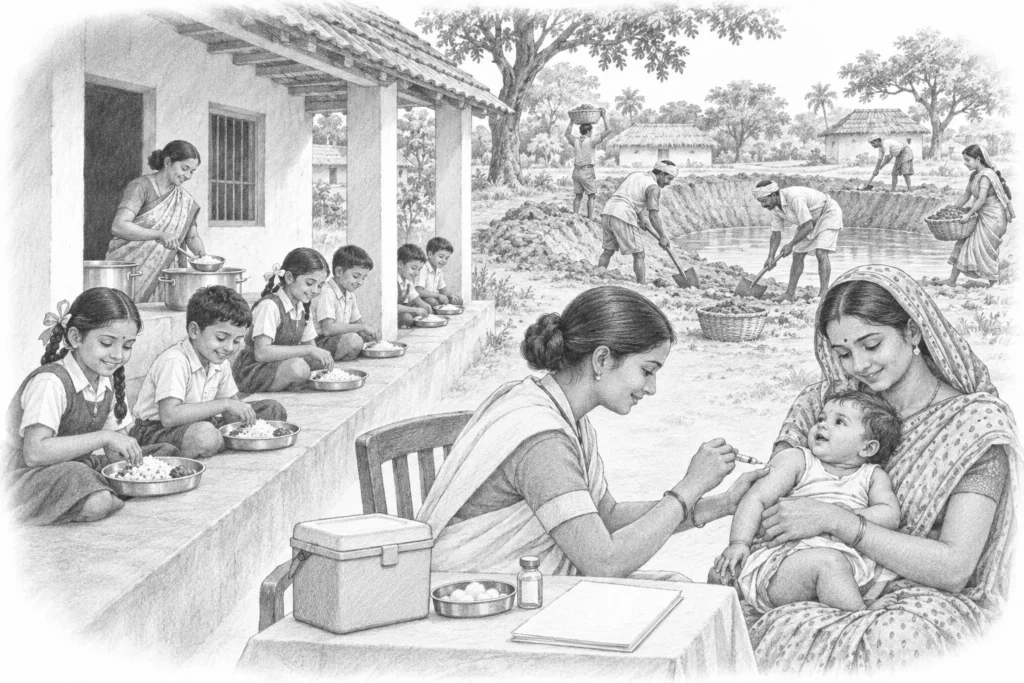
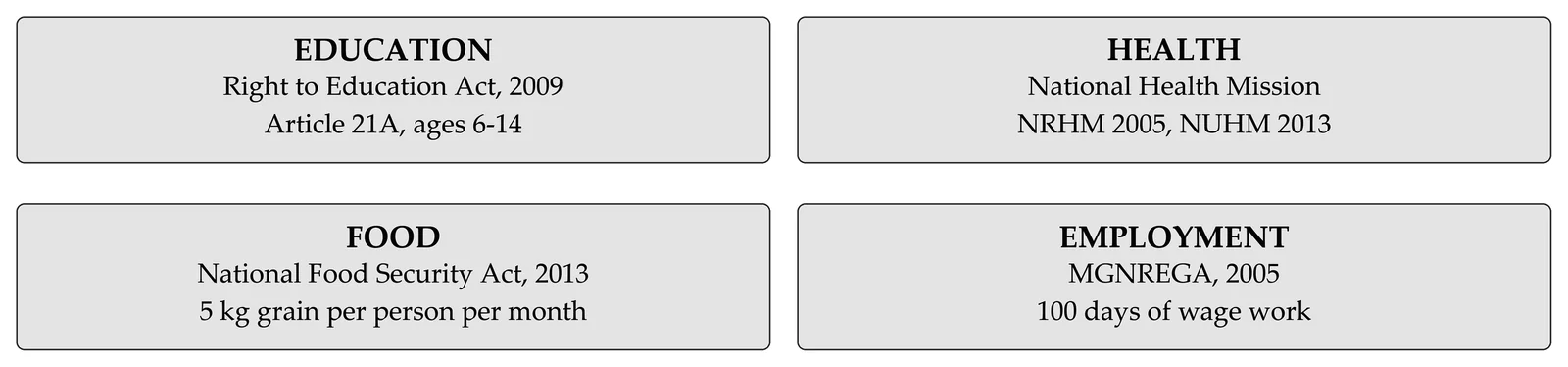
A public policy is a course of action adopted by the government to deal with a public problem. Social welfare policies aim to protect and promote the well-being of citizens, especially the poor and vulnerable, through education, health, food, employment and social security. In India, early welfare was delivered through schemes that depended on the discretion of the government. From the 2000s, under pressure from social movements, courts and the National Advisory Council, India shifted to a rights-based approach, in which welfare became a legal entitlement that citizens can claim (Figure 5.2). The Supreme Court’s ‘right to food’ case, PUCL v. Union of India (from 2001), in which it converted schemes such as midday meals into entitlements, played a key role.
Measuring welfare
Welfare policies are judged by their outcomes. NITI Aayog’s Multidimensional Poverty Index, based on the National Family Health Surveys, measures deprivation in health, education and living standards rather than income alone, and reports a large fall in multidimensional poverty in recent years. Such measures show progress but also persistent gaps, especially in nutrition, among Scheduled Tribes and in poorer states.
5.2 Education: The Right to Education
The Right of Children to Free and Compulsory Education Act, 2009 gives effect to Article 21A. Its main provisions are these:
- Free and compulsory education for every child aged 6 to 14 in a neighbourhood school until the completion of elementary education (classes 1 to 8).
- 25% reservation in entry-level classes of private unaided schools for children from disadvantaged groups and weaker sections, with fees reimbursed by the government.
- Norms and standards for schools: pupil–teacher ratios (30:1 in primary classes), buildings, toilets, drinking water, libraries and working days.
- Qualified teachers and a ban on private tuition by teachers.
- Prohibition of capitation fees, screening tests for admission, physical punishment and mental harassment.
- School Management Committees, with three-fourths of members from parents, to monitor schools.
- Age-appropriate admission for out-of-school children with special training.
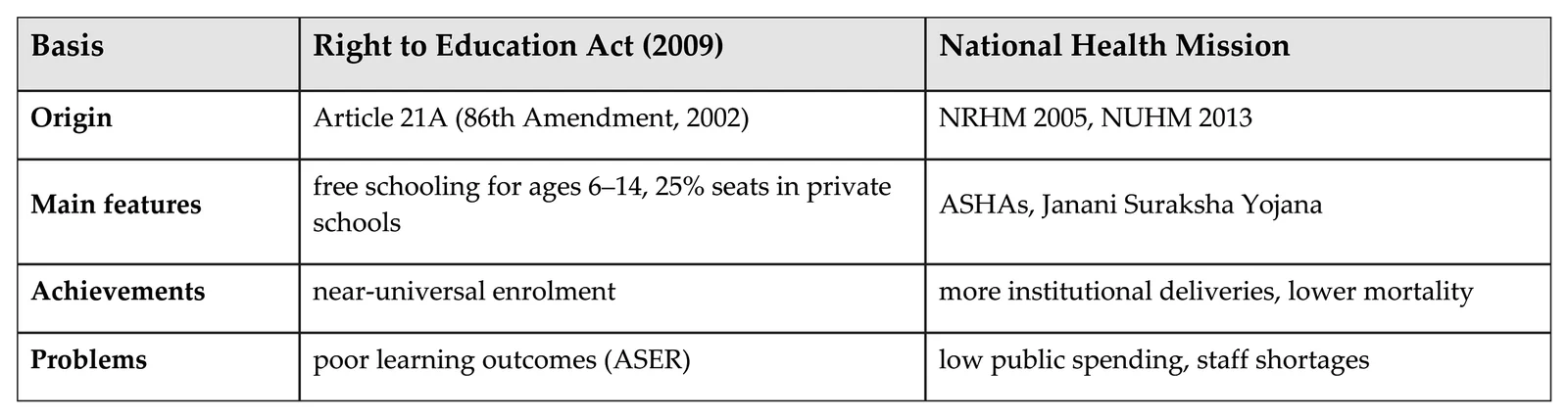
Administration and implementation. Education is in the Concurrent List; the Act is implemented by state governments and local authorities, with funds from the Samagra Shiksha scheme (2018, which merged Sarva Shiksha Abhiyan and other schemes). The National Commission for Protection of Child Rights monitors it. Achievements: near-universal enrolment, better infrastructure and the admission of lakhs of poor children to private schools. Problems: poor learning outcomes, as shown by the ASER surveys of Pratham; teacher shortages and absenteeism; weak implementation of the 25% quota; and the no-detention policy, which was amended in 2019 to allow states to hold back students who fail. The Act also does not cover children below six or above fourteen.
Learning outcomes
Access to school has improved greatly, but learning has not kept pace. Surveys such as the Annual Status of Education Report (ASER) and the National Achievement Survey have repeatedly found that a large share of children in upper primary classes cannot read simple texts or do basic arithmetic. The National Education Policy, 2020 therefore stresses foundational literacy and numeracy, and the NIPUN Bharat mission (2021) aims to ensure that every child can read and do basic maths by the end of class three.
5.3 Health: The National Health Mission
The National Rural Health Mission (NRHM) was launched on 12 April 2005 to provide accessible, affordable and quality health care to the rural population, especially the vulnerable. In 2013 it was combined with the new National Urban Health Mission (NUHM) under the umbrella of the National Health Mission (NHM). Its main features are these:
- ASHA workers: an Accredited Social Health Activist in every village, a local woman trained to link the community with the health system.
- Janani Suraksha Yojana: cash incentives to promote institutional deliveries and reduce maternal and infant deaths.
- Strengthening health infrastructure: sub-centres, primary health centres and community health centres, with Indian Public Health Standards.
- Decentralised planning: Village Health, Sanitation and Nutrition Committees and Rogi Kalyan Samitis (patient welfare committees) with untied funds.
- Disease control programmes: for tuberculosis, malaria, leprosy and others, and immunisation.
- Communitisation and convergence: with water, sanitation, nutrition and women’s welfare.
Achievements: NHM contributed to a sharp increase in institutional deliveries and a decline in maternal and infant mortality, and ASHAs became the backbone of community health, as seen during COVID-19. Problems: low public spending on health (around 1–1.5% of GDP), shortages of doctors and specialists in rural areas, high out-of-pocket expenditure, and overburdened, poorly paid ASHAs. The National Health Policy 2017 aims to raise public health spending to 2.5% of GDP, and Ayushman Bharat (2018) added health and wellness centres and the PM-JAY health insurance scheme.
Ayushman Bharat
Launched in 2018, Ayushman Bharat has two parts: Pradhan Mantri Jan Arogya Yojana, which provides health insurance of up to five lakh rupees per family per year for hospital care, and a network of Ayushman Arogya Mandirs (health and wellness centres) offering primary care. Supporters see it as a step towards universal health coverage; critics argue that public spending on health remains low and that insurance cannot replace a strong public health system.
5.4 Food: The Right to Food Security
The National Food Security Act, 2013 (NFSA) gave legal entitlement to subsidised food grains for about two-thirds of India’s population. It grew out of the Supreme Court’s right-to-food case and the campaign of civil society groups. Its main provisions are these:
- Coverage: up to 75% of the rural and 50% of the urban population.
- Entitlement: 5 kg of food grain per person per month for priority households; 35 kg per household per month for the poorest under the Antyodaya Anna Yojana (AAY). Grain was sold at ₹3, ₹2 and ₹1 per kg for rice, wheat and coarse grains, and has been free since January 2023.
- Nutrition support: free meals for children through anganwadis (6 months to 6 years) and midday meals in schools (6 to 14 years), and for pregnant women and lactating mothers.
- Maternity benefit: at least ₹6,000 for pregnant women.
- Women’s empowerment: the eldest woman of the household is treated as its head for issuing ration cards.
- Grievance redressal: district grievance redressal officers, state food commissions, and social audits.
Administration: food grains are procured by the Food Corporation of India and distributed by states through the Targeted Public Distribution System and fair price shops. Reforms include computerisation, Aadhaar-based authentication, One Nation One Ration Card (portability across states) and direct cash transfer in some union territories. Achievements: reduced hunger and leakages in many states, and a crucial safety net during the COVID-19 lockdowns. Problems: exclusion of eligible households because coverage is based on old population data, leakages and corruption in some states, authentication failures, a focus on cereals rather than nutrition, and high storage costs.
The Public Distribution System
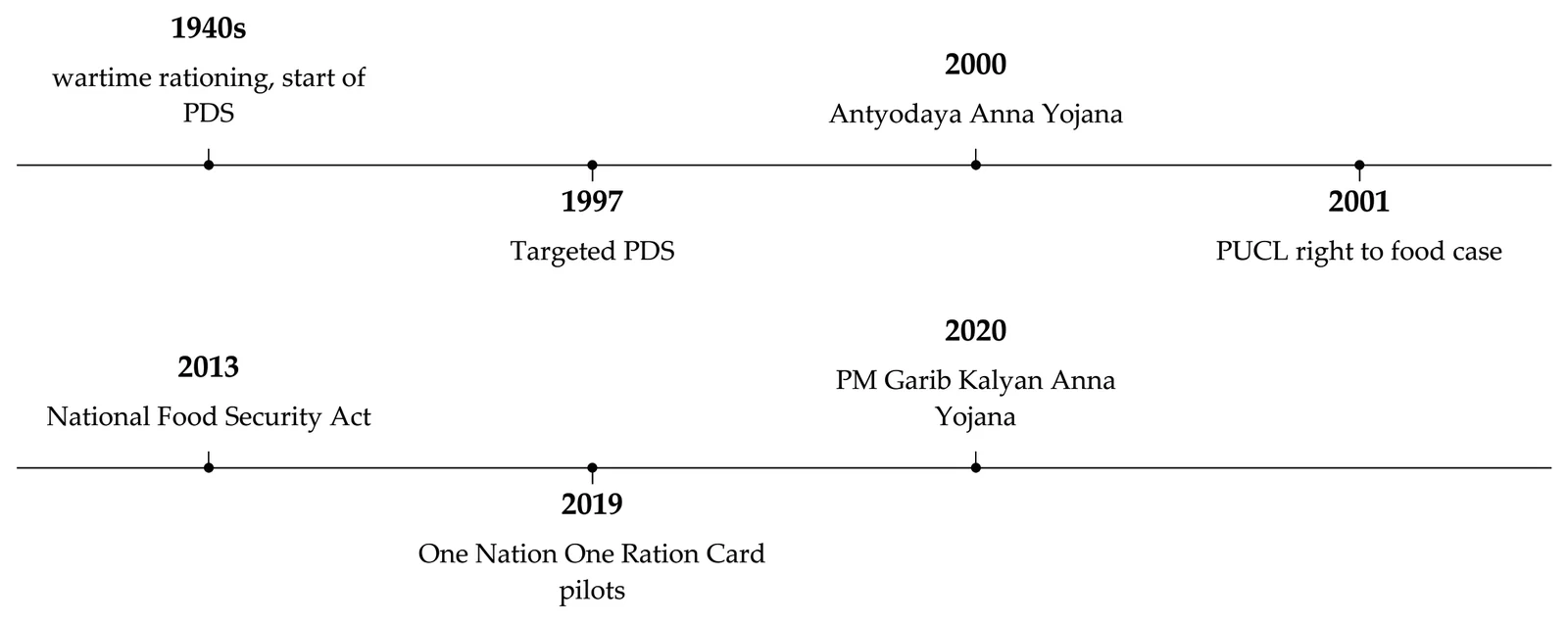
The Public Distribution System grew out of wartime rationing in the 1940s. It became targeted in 1997, legally guaranteed by the NFSA in 2013, and portable through One Nation One Ration Card, which lets migrant workers draw rations anywhere. During the COVID-19 pandemic, the PM Garib Kalyan Anna Yojana provided free foodgrains, later merged with the NFSA entitlement. States such as Tamil Nadu and Chhattisgarh have run near-universal PDS systems with low leakage.
5.5 Employment: MGNREGA
The National Rural Employment Guarantee Act was passed in 2005 and implemented from 2 February 2006 in 200 districts, extended to all rural districts by 2008; it was renamed the Mahatma Gandhi NREGA in 2009. It is the world’s largest public works programme and the first to make work a legal right. Its main provisions are these:
- Guarantee: at least 100 days of wage employment in a financial year to every rural household whose adult members volunteer to do unskilled manual work.
- Demand-driven: work must be provided within 15 days of application, otherwise an unemployment allowance is payable.
- Wages: statutory minimum wages, paid within 15 days, directly into bank or post office accounts.
- Works: labour-intensive works such as water conservation, ponds, rural roads, land development and afforestation, creating durable assets; no contractors or labour-displacing machines.
- Women: at least one-third of beneficiaries should be women; worksite facilities such as crèches and drinking water.
- Role of PRIs: gram sabhas select works, and gram panchayats execute at least 50% of works by cost.
- Transparency: social audits by gram sabhas (Section 17), job cards, public display of records and the MIS.
Achievements: MGNREGA increased rural wages and incomes, reduced distress migration, empowered women, who form more than half of its workers in recent years, and created water and land assets; it acted as a safety net during droughts and COVID-19. Problems: delays in wage payments, insufficient budgets that suppress demand, corruption and fake job cards in some states, poor quality of some assets, and low wage rates in some states compared with minimum wages. Its strengths and weaknesses show that rights-based laws depend on administrative capacity and political commitment.
Welfare and federalism
Most welfare schemes are centrally sponsored: the Union designs and partly funds them, while states implement them and add their own schemes. States have often led innovation: Tamil Nadu’s mid-day meal, Kerala’s public health system and Maharashtra’s Employment Guarantee Scheme inspired national programmes. Critics argue that rigid central schemes leave states too little freedom, while supporters say they ensure minimum standards across the country.
5.6 Important Questions
- Question 1 Discuss the major social welfare policies in India with reference to education, health, food and employment.
- Question 2 Critically evaluate MGNREGA as a social welfare policy.
- Question 3 Critically examine the Right to Education and the National Health Mission as social welfare policies in India.
- Question 4 Discuss the right to food security in India with reference to the National Food Security Act, 2013.
DU asks the same idea in different words. So learn one broad answer for each question below; the same answer works for every question joined by OR.
Important Question 1
Discuss the major social welfare policies in India with reference to education, health, food and employment.
OR
Examine the shift towards a rights-based approach to welfare in India.
OR
Evaluate the role of the state in social welfare.
Model Answer
“Recall the face of the poorest and the weakest man whom you may have seen.”
— Gandhi’s talisman (1948)
Introduction. India is a welfare state committed by the Directive Principles (Articles 38, 39, 41 and 47) to securing social and economic justice. In the 2000s it shifted from discretionary schemes to legal entitlements in education, health, food and employment.
1. The Rights-Based Approach
Social movements, the Supreme Court’s right-to-food case (PUCL, from 2001) and the National Advisory Council pushed welfare towards legal rights that citizens can claim, with grievance redressal and social audits. Jean Drèze and Amartya Sen argued that public action is essential for development, not merely economic growth.
2. Education: RTE
Article 21A (2002) and the RTE Act (2009) guarantee free and compulsory education to children aged 6–14, with 25% seats in private schools for weaker sections, school standards and School Management Committees. Enrolment is near-universal, but learning outcomes remain poor. It reserves 25 per cent of seats in private unaided schools for children from weaker sections. School management committees involve parents in running schools.
3. Health: NHM
The NRHM (2005) and NUHM (2013) formed the National Health Mission, with ASHA workers, Janani Suraksha Yojana and community committees; institutional deliveries rose and maternal and infant mortality fell, but public health spending and staff remain inadequate. Ayushman Bharat (2018) added health insurance and health and wellness centres. ASHA workers link communities with the health system.
4. Food: NFSA
The NFSA (2013) entitles up to 75% of the rural and 50% of the urban population to 5 kg of grain per person per month (35 kg for AAY households), supports anganwadi and midday meals, and gives maternity benefit; One Nation One Ration Card added portability. The mid-day meal scheme (now PM POSHAN) and the ICDS also address child nutrition.
5. Employment: MGNREGA
MGNREGA (2005) guarantees 100 days of wage work to rural households, with unemployment allowance, social audits and a central role for gram panchayats; it raised rural incomes and empowered women. It is often described as the largest public works programme in the world. It also provides a safety net in droughts and economic shocks.
6. Direct Benefit Transfer
Since 2013 many benefits have been paid directly into beneficiaries’ bank accounts, reducing leakages but excluding those without accounts or with authentication problems.
7. Social Security for Informal Workers
Over ninety per cent of Indian workers are informal; pensions, insurance and the e-Shram portal (2021) try to extend social security to them.
8. Debates on Welfare
Supporters see welfare as a right and an investment in human capability; critics call some benefits ‘freebies’ and argue for growth-led poverty reduction, and the debate continues in Indian politics.
9. Welfare and Women
Many schemes target women, such as maternity benefits, the Ujjwala cooking gas scheme and self-help groups under the National Rural Livelihoods Mission, recognising women’s role in household welfare.
10. Common Problems
Weak implementation capacity, inadequate funds, corruption and leakages, exclusion errors linked to technology, and poor quality of services limit these policies. The quality of services, such as learning in schools, often lags behind access.
11. Constitutional Basis
The Directive Principles direct the state to secure social, economic and political justice (Article 38), adequate livelihood and fair distribution of resources (Article 39), the right to work, education and public assistance (Article 41), maternity relief (Article 42) and improved nutrition and public health (Article 47). The courts have also read the right to food, health and education into the right to life under Article 21. Articles 41, 45 and 47 refer to work, early childhood care and nutrition.
12. Delivery Mechanisms
These policies are delivered through ministries, state departments, PRIs and frontline workers such as teachers, ASHAs, anganwadi workers and ration dealers. Technology (DBT, Aadhaar, MIS), social audits and grievance systems are used to reduce leakages and increase accountability. Frontline workers such as ASHAs, anganwadi workers and teachers are the backbone of delivery.
13. Implementation Matters
Reforms of the PDS in states such as Chhattisgarh and Tamil Nadu sharply reduced leakages, which shows that implementation, not only policy design, decides outcomes.
14. Evaluation
India’s welfare policies have moved from charity to rights, improving access to education, health, food and work. Their success now depends on quality, adequate funding, accountability and the inclusion of the most vulnerable.
Conclusion. Thus, India’s welfare policies have turned constitutional directives into legal rights. Their success depends on adequate funding, efficient administration and active participation by citizens and local bodies.
Important Question 2
Critically evaluate MGNREGA as a social welfare policy.
OR
Discuss the role of Panchayati Raj Institutions in MGNREGA.
OR
Examine the significance of the right to work in India.
Model Answer
“… providing at least one hundred days of guaranteed wage employment in every financial year to every household whose adult members volunteer to do unskilled manual work.”
— Preamble, Mahatma Gandhi National Rural Employment Guarantee Act, 2005
Introduction. The Mahatma Gandhi National Rural Employment Guarantee Act (2005) is the world’s largest public works programme and India’s first law to make work a legal right, giving effect to Article 41 of the Directive Principles.
1. Background
Earlier employment schemes, such as Maharashtra’s Employment Guarantee Scheme (1972) and the Food for Work programme, inspired it; it was passed in 2005 and launched on 2 February 2006 in 200 districts. The Right to Work campaign and the National Advisory Council pressed for a law, which was passed in 2005 and began in 200 districts in 2006. It drew on Maharashtra’s Employment Guarantee Scheme, introduced after the drought of the early 1970s.
2. Main Provisions
100 days of work per rural household per year; work within 15 days or unemployment allowance; minimum wages paid within 15 days into accounts; labour-intensive works without contractors; one-third women; and social audits. At least one-third of beneficiaries must be women, and wages must be paid within fifteen days. Worksites must provide drinking water, shade and childcare, and work should be given within five kilometres of the worker’s home.
3. A Rights-Based Design
Unlike earlier schemes, MGNREGA is demand-driven and legally enforceable: work must be provided when demanded, and failure entitles the worker to an unemployment allowance.
4. Comparison with Earlier Schemes
Unlike earlier schemes such as the Sampoorna Grameen Rozgar Yojana (2001) and the Food for Work Programme (2004), which were limited and discretionary, MGNREGA created a legal right to work for every rural household.
5. Role of PRIs
Gram sabhas select works and conduct social audits, and gram panchayats execute at least half the works by cost, making MGNREGA a major channel of decentralised implementation. At least half the works by cost must be executed by gram panchayats. This makes the gram panchayat the main implementing agency of the scheme.
6. Transparency Provisions
Muster rolls are public, payments go into bank or post office accounts, and social audits, pioneered in Andhra Pradesh, let villagers check works and payments.
7. Achievements
It raised rural wages and incomes, reduced distress migration, created water and land assets, provided a safety net during droughts and COVID-19, and empowered women, who form more than half of its workers. Women’s share of person-days has been over half in recent years. It also helped reduce rural poverty and distress borrowing.
8. Impact on Women
MGNREGA gave many rural women their first cash wages, equal pay with men and greater bargaining power at home, though childcare and worksite facilities remain weak.

9. Problems
Delayed wage payments, insufficient budgets that ration work, corruption and fake job cards, poor-quality assets, and low wages in some states weaken it. In some states its wage rates fall below the state minimum wage. Delays by the Union government in releasing funds have often caused wage arrears.
10. Debates on the Assets
Critics say that many assets are of poor quality, while studies show that water conservation and land development works raised farm productivity in many areas.
11. Economic Debates
Some economists argue that MGNREGA raises rural wages and labour costs for farmers, while others reply that higher wages are a benefit, not a cost, for the rural poor.
12. Evaluation
Studies by economists such as Jean Drèze and Reetika Khera show that MGNREGA worked best where social audits and active gram sabhas existed, as in Rajasthan and Andhra Pradesh, which shows the importance of accountability. It also acts as an automatic stabiliser, expanding in bad years.
13. Recent Administrative Changes
Recent changes include geo-tagging of assets, the mandatory National Mobile Monitoring System app for attendance, and the Aadhaar-based payment system, made mandatory from January 2024. Supporters say they reduce fraud; critics argue that technical problems have excluded genuine workers and delayed wages. Critics argue that app-based attendance excludes workers in areas with poor connectivity.
14. MGNREGA during COVID-19
During the COVID-19 pandemic (2020–21), when migrant workers returned to villages, demand for MGNREGA work reached record levels and the budget was raised sharply. The programme acted as a crucial safety net, which showed the value of a demand-driven legal guarantee. Its budget was raised to over one lakh crore rupees in 2020–21.
15. The Future of MGNREGA
Proposals include wages linked to inflation, timely payments, an urban employment guarantee and convergence with agriculture and skill programmes.
Conclusion. Thus, MGNREGA is a landmark in India’s welfare policy. Its promise of work as a right can be fully realised only with adequate funds, timely payments and strong local institutions.
Important Question 3
Critically examine the Right to Education and the National Health Mission as social welfare policies in India.
OR
Discuss the achievements and limitations of the Right to Education Act, 2009.
OR
Examine the role of the National Health Mission in improving public health in India.
Model Answer
“The State shall provide free and compulsory education to all children of the age of six to fourteen years in such manner as the State may, by law, determine.”
— Article 21A, Constitution of India
Introduction. Education and health are the foundations of human development. India has turned education into a fundamental right and has built a large mission for public health. Both have widened access, but quality, funding and implementation remain serious challenges.
1. Education as a Right
In Unni Krishnan (1993) the Supreme Court read the right to education into Article 21. The 86th Amendment (2002) inserted Article 21A, and the Right of Children to Free and Compulsory Education Act (2009) came into force on 1 April 2010.
2. Main Provisions of RTE
The Act guarantees free education in a neighbourhood school for children aged six to fourteen, reserves twenty-five per cent of seats in private unaided schools for disadvantaged children, bans capitation fees and screening, sets pupil–teacher ratios and infrastructure norms, and creates School Management Committees with parents. It also bans corporal punishment and mental harassment, prohibits private tuition by teachers and their deployment for non-educational work other than the census, elections and disaster relief, and makes the state responsible for ensuring that every child completes eight years of schooling.
3. Achievements in Education
Enrolment in elementary education has become nearly universal, more girls attend school, and schools have better infrastructure such as toilets and drinking water.
4. Problems in Education
Learning outcomes remain poor: surveys such as Pratham’s ASER, discussed by Rukmini Banerji, show that many children in upper primary classes cannot read simple texts. Teacher vacancies, weak training and uneven implementation of the twenty-five per cent quota persist, and the no-detention policy was diluted in 2019. Many children attend irregularly or drop out after the elementary stage, and school closures during COVID-19 caused learning losses, especially among poor children without devices. The National Education Policy (2020) stresses foundational literacy and numeracy to close these gaps.
5. Health and the State
Health is not an explicit fundamental right, but courts have read it into Article 21, and Article 47 directs the state to improve public health. The National Rural Health Mission (2005) and the National Urban Health Mission (2013) were merged into the National Health Mission.
6. Main Features of NHM
The mission strengthened primary health care through ASHA workers, Rogi Kalyan Samitis, the Janani Suraksha Yojana for institutional deliveries and decentralised planning with states and districts. ASHAs are local women chosen from the village who link households with the health system, encourage immunisation and institutional deliveries and receive incentives for specific tasks; their work became vital during the COVID-19 pandemic.
7. Achievements in Health
Institutional deliveries rose sharply, and maternal and infant mortality declined significantly; immunisation coverage also improved.
8. Problems in Health
Public spending on health remains low, well below the target of 2.5 per cent of GDP set by the National Health Policy (2017); there are shortages of doctors and specialists in rural areas, and families still pay a large share of health costs out of their own pockets. Ayushman Bharat–PMJAY (2018), which insures poor families for hospital care, has been welcomed, but critics argue that spending on insurance may divert attention from strengthening public primary health care, which matters most for preventing disease.
9. Variation across States
Louise Tillin and her co-authors show in Politics of Welfare (2015) that outcomes vary widely across states, depending on state capacity and political commitment, with Kerala and Tamil Nadu performing far better than others.
10. Centre–State Dimension
Education is on the Concurrent List and health is a state subject, so the success of both policies depends on states. Centrally sponsored schemes such as Samagra Shiksha and the NHM provide funds with conditions, which ensures national priorities but can limit states’ flexibility to design programmes for local needs.
11. Privatisation and Equity
The growth of private schools and hospitals has widened choice for those who can pay, but has also created a two-tier system in which the poor depend on under-resourced public institutions. Critics argue that welfare rights cannot be realised without strong public provision, while others see regulated private participation as a way to expand capacity quickly.
12. Evaluation
RTE and NHM represent a shift towards a rights-based welfare state, but they need more funding, accountability and attention to quality. Both policies show that rights must be backed by budgets, trained staff and monitoring; courts, civil society and social audits have played an important role in holding governments to their commitments.
Conclusion. Thus, the Right to Education and the National Health Mission have greatly expanded access to schooling and health care, but India must now move from access to quality to fulfil the promise of these rights.
Important Question 4
Discuss the right to food security in India with reference to the National Food Security Act, 2013.
OR
Examine the evolution of the Public Distribution System in India.
OR
How far has the National Food Security Act ensured food security in India?
Model Answer
“The State shall regard the raising of the level of nutrition and the standard of living of its people and the improvement of public health as among its primary duties.”
— Article 47, Constitution of India
Introduction. Food security means that all people at all times have access to sufficient, safe and nutritious food. India, once dependent on food imports, now produces surplus grain, yet malnutrition remains widespread. The National Food Security Act, 2013 made food a legal entitlement for most of the population.
1. Meaning of Food Security
The FAO (1996) defines food security through availability, access, utilisation and stability. Amartya Sen showed that famines result from a failure of people’s entitlements to food, not only from shortages, which makes access the key issue. Food security is therefore closely linked to income, employment and social protection, while nutrition security adds the need for a balanced diet, clean water and health care.
2. The Public Distribution System
The PDS began with wartime rationing in the 1940s and expanded after the Green Revolution. It became the Targeted PDS in 1997, focusing on poor households, and the Antyodaya Anna Yojana (2000) targeted the poorest. Targeting produced large exclusion errors, as many poor families were left out of below-poverty-line lists, while leakage of grain to the open market was high in several states. These problems strengthened demands for a universal and legally enforceable right to food.
3. The Right to Food Case
In PUCL v. Union of India (from 2001), the Supreme Court treated the right to food as part of Article 21 and turned schemes such as midday meals into legal entitlements, appointing commissioners to monitor them.
4. Main Provisions of NFSA
The Act covers up to seventy-five per cent of the rural and fifty per cent of the urban population, giving five kilograms of grain per person per month at very low prices, with thirty-five kilograms per month for Antyodaya households. It also provides maternity benefits of at least ₹6,000, meals for children through anganwadis and schools, ration cards in the name of the eldest woman, and grievance redress. The Act obliges the Union to supply grain and the states to identify beneficiaries and distribute it, provides a food security allowance if grain is not supplied, and creates State Food Commissions to monitor implementation.
5. Reforms in Delivery
Digitised ration cards, automation of fair price shops and One Nation One Ration Card, which lets migrants draw rations anywhere, have reduced leakages.
6. Free Grains
During the COVID-19 pandemic the PM Garib Kalyan Anna Yojana gave additional free grain, and from 2023 the government made NFSA grain free for its beneficiaries.
7. Achievements
The PDS has become a major safety net, reducing hunger in crises, and states such as Chhattisgarh and Tamil Nadu have run near-universal systems with low leakage.
8. Problems
Exclusion errors, outdated population data, authentication failures and a focus on cereals rather than balanced nutrition remain problems; NFHS-5 (2019–21) found that about a third of children under five were stunted. Procurement concentrates on rice and wheat, encouraging water-intensive cultivation in states such as Punjab, while coarse grains and pulses that improve nutrition receive less support; the promotion of millets since 2023 seeks to diversify diets.
9. Global Dimensions
Anjoo Sharan Upadhyaya and her co-authors show that India’s food governance is linked to global trade rules: India defends its public stockholding for food security at the WTO.
10. Nutrition Schemes beyond the PDS
The Integrated Child Development Services (1975) provides supplementary nutrition, health check-ups and pre-school education through anganwadis, and the midday meal scheme, now PM POSHAN, feeds children in government schools. Studies show that midday meals have improved school attendance, especially among girls and children from poor families, while also reducing classroom hunger.
11. Technology and Delivery
Electronic point-of-sale machines, online allocation of grain and doorstep delivery have improved transparency, but connectivity failures and fingerprint mismatches can still deny rations. Several states therefore allow alternative identification and nominee arrangements for the elderly and disabled.
12. Women and Food Security
Making the eldest woman the head of the household for ration cards recognises women’s central role in feeding families. Maternity benefits under the PM Matru Vandana Yojana support nutrition during pregnancy, though critics note that the scheme covers only the first child in most cases and pays less than the Act promises.
13. Evaluation
The NFSA has strengthened the right to food, but true food and nutrition security requires diverse diets, better health and sanitation and accountable delivery. Jean Drèze and Reetika Khera have shown that the PDS improved significantly in many states after reforms and made a real contribution to reducing poverty, and states such as Tamil Nadu show that political commitment can make universal entitlements work.
Conclusion. Thus, the National Food Security Act made food a legal right for most Indians and the PDS a vital safety net, though the challenge has shifted from hunger to nutrition.
Short Notes
(a) Right to Education Act, 2009
It provides free and compulsory education to all children aged 6 to 14 under Article 21A, reserves 25% of seats in private unaided schools for disadvantaged children, sets norms for schools and teachers, bans capitation fees, screening and corporal punishment, and creates School Management Committees. Its main challenge is improving the quality of learning.
(b) ASHA Workers
Accredited Social Health Activists are local women selected in every village under the National Health Mission (2005). They promote institutional deliveries and immunisation, provide basic care, and link the community with the health system. They have been central to India’s improvements in maternal and child health and to COVID-19 response, though they are paid through incentives rather than regular salaries.
More notes: DSC-10 Public Administration in India
These notes are prepared by PADHO TO AISE for study help. They are not an official University of Delhi publication.